Establishing effective AI governance across an enterprise is hampered by platforms that force you into cloud-only deployment, complex onboarding, or usage-based pricing that balloons with scale. Many solutions only cover a narrow range of models, demand deep engineering effort for integration, or lack clear compliance mapping to regulations like GDPR and the EU AI Act. This comparison covers deployment models, enforcement depth, pricing, and real audit features so you can pick an AI governance platform that matches your regulatory obligations and technical requirements.
Table of Contents
- Configurato
- Trussed AI
- Difinity.ai
- Optro
- SmartFlow
- PolicyGuard AI
- Selections for Enterprise AI Governance
Configurato
At a Glance
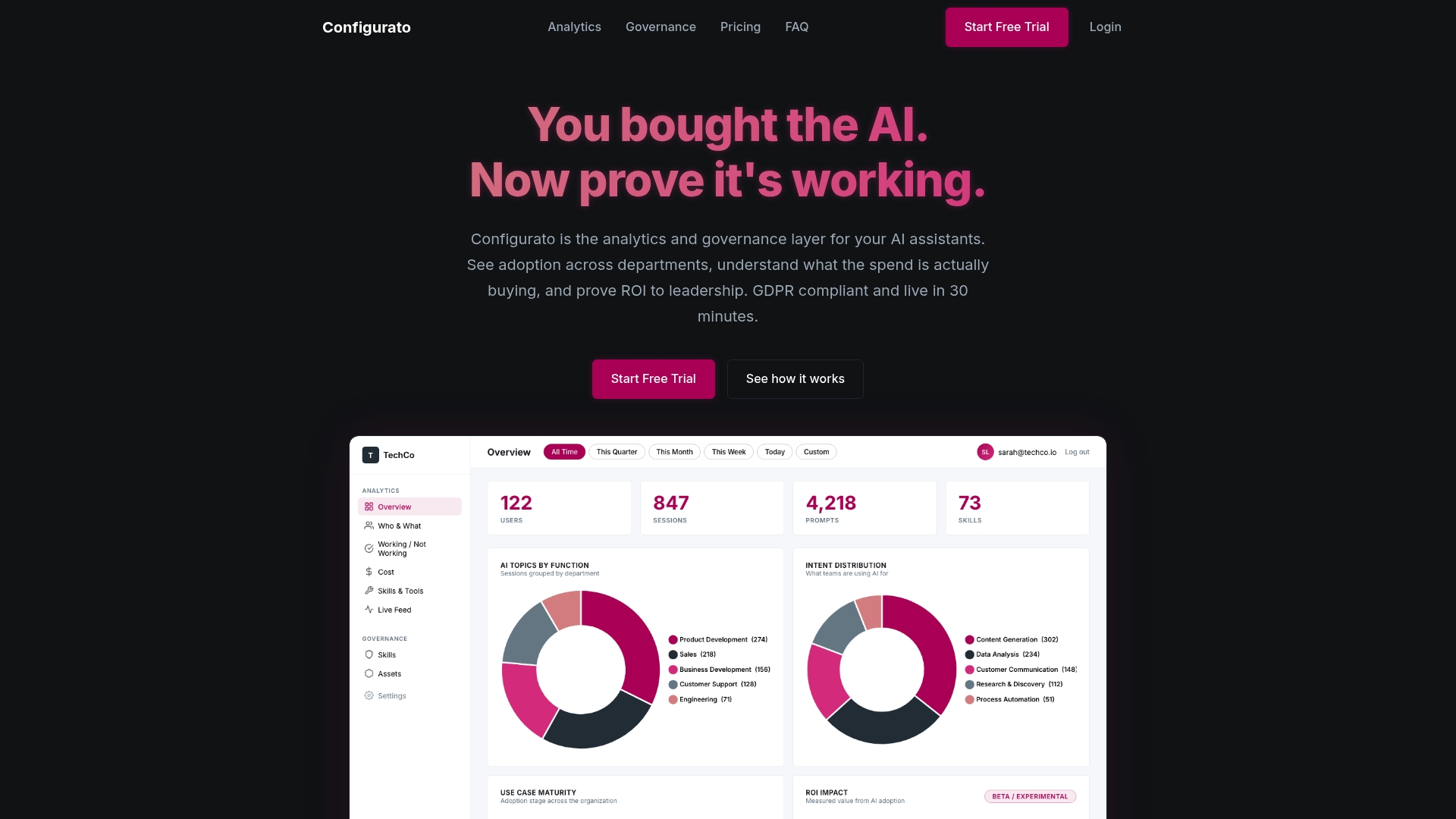
The vendor advertises quick deployment within 30 minutes and states Configurato is GDPR compliant with full data anonymization. The platform reports vendor-independent support across assistants such as Claude, Gemini, GitHub Copilot, and Microsoft Copilot.
Configurato focuses on tracing adoption, use case distribution, and cost allocation at team and department level so leaders can compare spend and ROI across the organization.
Core Features
- Org-wide adoption analytics by department for rollup and drill-down views of where assistants are actually used.
- Use case distribution analysis that surfaces which tasks drive the most volume and cost per team.
- Cost allocation and spending trends to map consumption back to budgets and departments.
- Operational optimization recommendations that point to configuration or policy changes to reduce wasted spend.
- Department and company-wide configuration management with MCP and OpenTelemetry support for connectivity.
Key Differentiator
Configurato is built around vendor independence and open standards. That design avoids locking telemetry or governance into a single assistant vendor and lets you compare usage across multiple assistant products without invasive per-user monitoring.
That focus on open standards and anonymized, organization-level reporting is the feature that separates Configurato from assistant-specific dashboards.
Pros
- Real-time visibility into adoption and ROI gives you a single source of truth for executive reporting rather than stitching together vendor dashboards.
- Full data anonymization and the vendor’s GDPR claim reduce risk of employee-level surveillance while still measuring program performance.
- Vendor-independent support removes the auditing burden when your teams use a mix of Claude, Gemini, and Copilot variants.
- Fast deployment lets a proof of value run quickly; the vendor advertises getting basic telemetry live in about 30 minutes.
- Customizable reporting and governance let security and procurement teams map policies to departmental spend and use cases.
Cons
- Requires adoption of MCP and OpenTelemetry standards for connectivity, which may demand engineering effort or an intermediary pipeline for legacy systems.
Who It’s For
Large organizations deploying multiple AI assistants that need governance, cost transparency, and standardized configurations. Best for teams that want centralized reporting and policy control without capturing identifiable employee activity.
Unique Value Proposition
Configurato ties anonymized department-level usage directly to cost allocation and configuration management. That linkage turns adoption signals into budget actions so finance and engineering can reassign license spend or alter configurations based on measurable ROI.
When paired with Tekkr Configurations, the product fits into an agent-to-agent governance flow Tekkr describes, where a governance layer talks to an employee’s AI assistant in the background so outputs already reflect company processes and quality standards.
Real World Use Case
A large enterprise used Configurato to map three assistants across product, support, and engineering teams. Leadership identified two high-cost, low-value use cases, remapped spend to a shared pool, and enforced a single department configuration to cut duplicate consumption.
That analysis produced executive-ready reports that justified a reallocation of annual AI budget.
Pricing
Configurato offers a free tier and a Pro tier by quote. The vendor states Pro pricing is available on request, so getting precise cost requires contacting sales.
Website: https://configurato.tekkr.io
Trussed AI
At a Glance
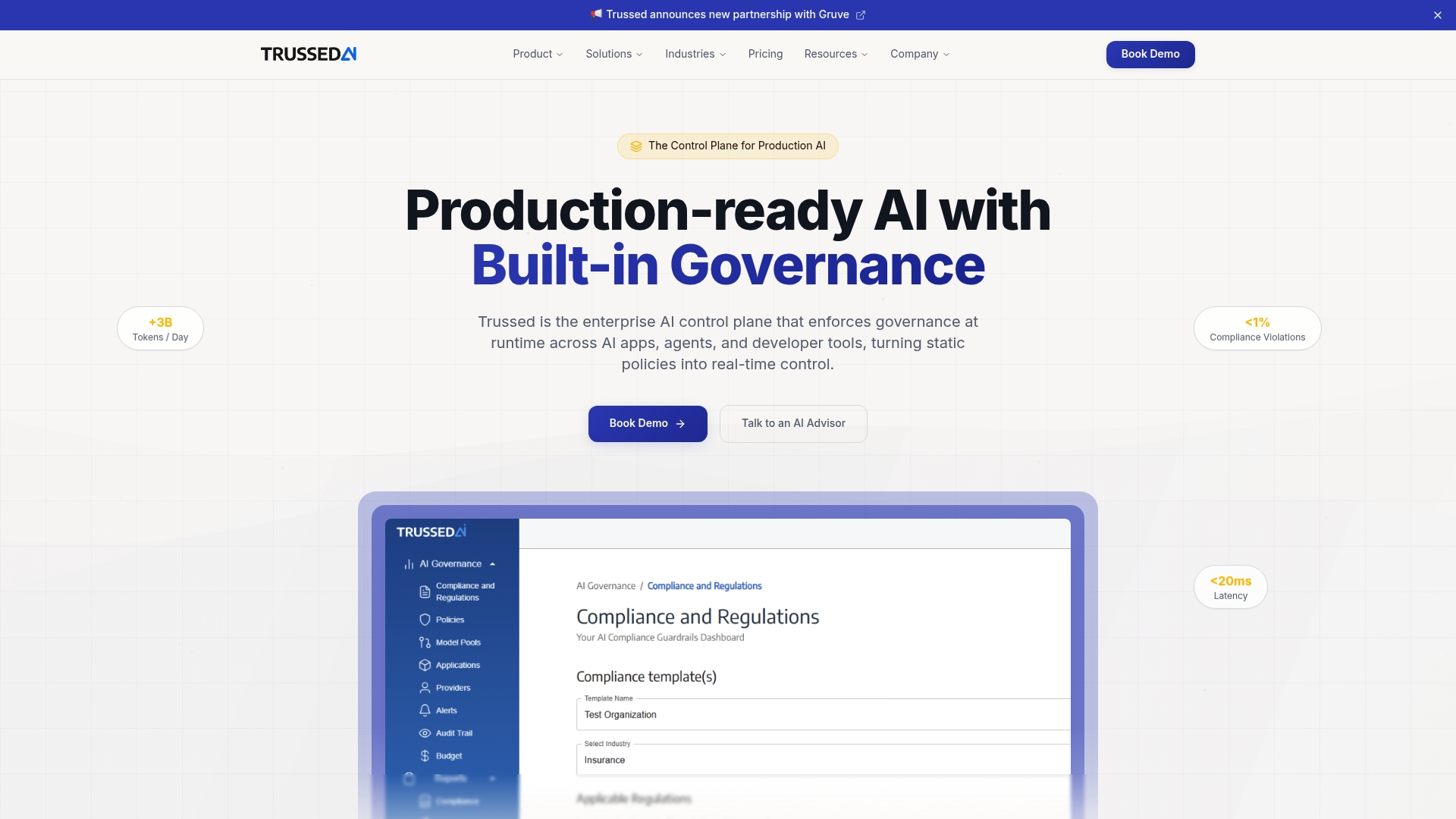
Real-time policy enforcement runs inline across AI apps, agents, and developer tools rather than applying controls after the fact. The vendor’s marketing materials state Trussed maps compliance to frameworks such as GDPR, HIPAA, and the AI Act, with auditability and traceability built into runtime enforcement.
Core Features
- Real-time policy enforcement that intercepts AI calls and applies rules across models and agents.
- Visibility and monitoring of AI usage and behavior with continuous audit logs and trace trails.
- Built-in security controls for sensitive data and access management to reduce exposure during inference.
- Compliance mapping to regulatory frameworks and reportable evidence for audits.
- Operational controls for AI cost and performance, integrated into existing AI stacks.
Key Differentiator
Trussed enforces governance continuously at runtime without requiring teams to retrofit each model or tool. Compared with Tekkr, which embeds company processes into assistant outputs to improve work quality, Trussed focuses narrowly on an enterprise control plane that watches and regulates AI activity in production environments.
Pros
- The runtime enforcement model stops policy drift before it reaches users, which reduces the need for manual reviews and ad hoc mitigation.
- Continuous audit logs provide traceability for compliance teams and internal auditors when they investigate a production decision path.
- The platform is designed for regulated environments, so security and access controls are core capabilities rather than add-ons.
- Operational controls help finance and platform teams monitor and throttle AI consumption to manage costs against usage patterns.
- Integrates governance without requiring wholesale changes to an existing AI stack, which speeds pilot-to-production timelines.
Cons
- Multiple buyer reviews indicate setup and integration can be complex, especially for teams without a preexisting governance framework.
- The vendor states pricing scales with AI usage, which can lead to high costs as deployments grow and traffic increases.
- Public documentation is light on long term scaling behavior for extremely large, highly distributed enterprise systems.
When It May Not Fit
If your team lacks basic governance primitives such as identity boundaries, tagging, and observability, Trussed will add integration overhead and cost. If your primary need is to push role specific behavior or quality standards into assistant outputs, Tekkr-style configuration is the better fit. Also avoid Trussed if you need a low fixed cost for experimentation rather than usage-based billing.
Who It’s For
Enterprise teams in regulated industries that operate AI in production and need continuous governance, security, and compliance. Compliance officers, platform engineers, and security leads running customer facing models will find the control plane model most relevant.
Real World Use Case
A financial services firm routes all AI-driven onboarding and fraud detection calls through Trussed. Policies block sensitive data leaks, audit logs capture decision paths for regulators, and compliance teams receive real-time alerts when a model request violates a mapped rule.
Pricing
The vendor advertises pricing that scales with AI usage and configuration. Expect usage-based or consumption pricing rather than flat per-seat plans; request a tailored quote to estimate costs for high throughput or enterprise scale deployments.
Website: https://trussed.ai
Difinity.ai
At a Glance
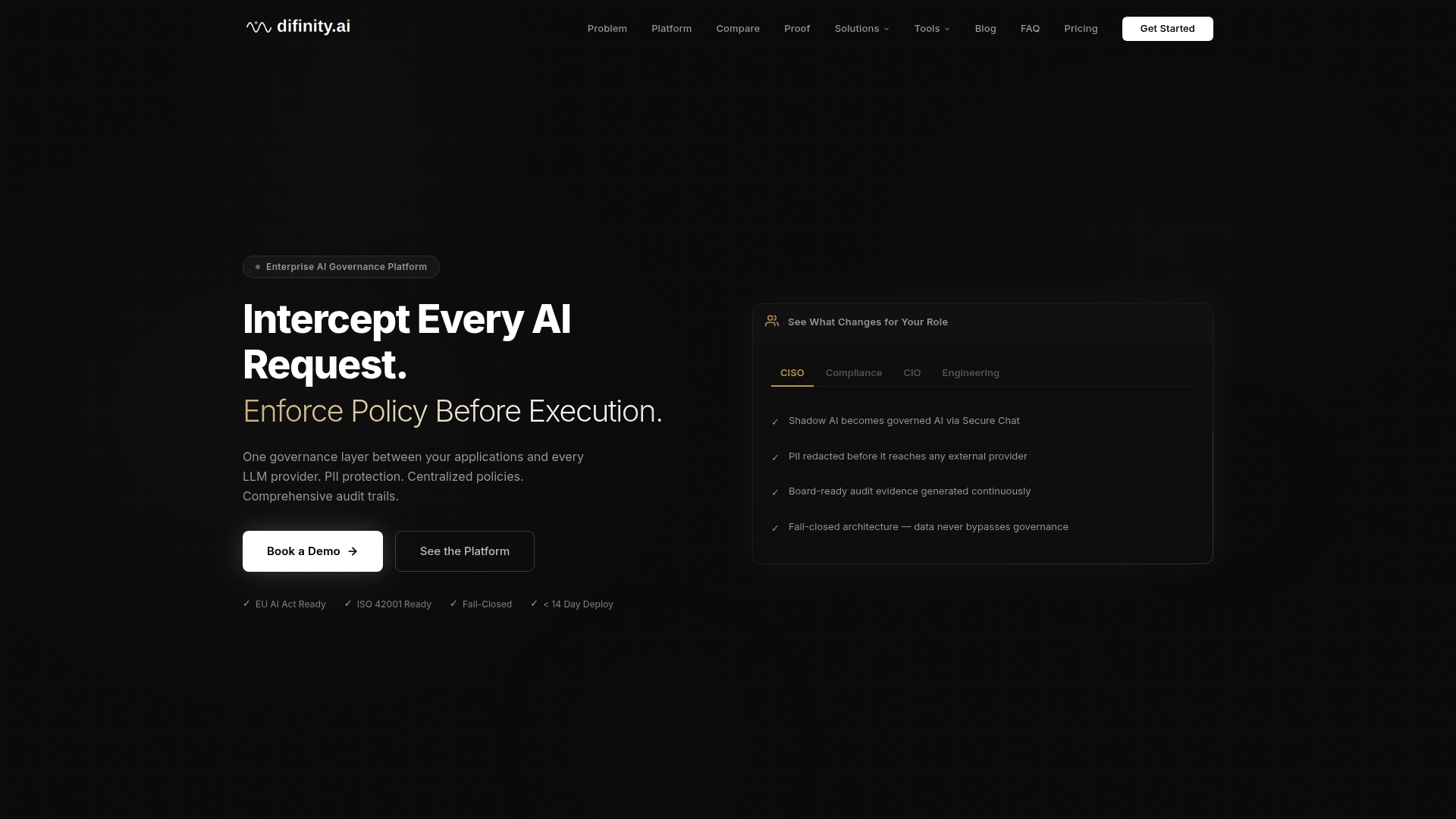
Starting at $49 per use case per month for Early Access, Difinity.ai layers runtime governance between applications and multiple LLM providers. It applies real-time PII redaction, content safety, model routing, and continuous compliance evidence generation for regulated finance, healthcare, and government workloads.
Core Features
- Unified API endpoint that fronts multiple LLM providers so your apps call a single enforcement point rather than many vendor SDKs.
- Real-time PII detection and redaction applied before data leaves your environment to reduce accidental disclosure during inference.
- Policy engine for defining and enforcing governance rules, including content safety filtering and prompt injection defense.
- Model access controls and intelligent routing for cost and risk optimization.
- Complete audit trail and compliance dashboards with ongoing evidence generation for audits.
Key Differentiator
Difinity enforces policies at runtime across providers via a single unified API, which lets you route requests based on risk and cost while logging every decision. That continuous evidence generation ties enforcement to reporting, so governance and audits share the same record.
Pros
- Real-time enforcement prevents policy violations before they reach users, reducing the need for slow, manual post hoc reviews.
- The product supports multi-cloud and multi-provider architectures with one integration point, lowering integration overhead for enterprise stacks.
- The vendor advertises smooth deployment in under 14 days with zero application code changes, which can speed pilots and proofs of concept.
- Automated compliance evidence is captured continuously, which helps compliance teams prepare audit packages without manual exports.
- Built by practitioners with regulated enterprise experience, so the default rule sets reflect common regulatory patterns.
Cons
- Buyer feedback points to limited on-premise deployment options, which creates a gap for organizations that require strict data residency.
- The platform introduces governance complexity; teams without dedicated security or compliance staff will face a steeper operational lift.
- Transparent pricing may still be costly for small pilots because the model is tied to use cases rather than flat per-seat billing.
When It May Not Fit
If your program mandates full on-premise deployment or isolated air-gapped environments, Difinity’s limited on-premise options make it a poor structural fit. If you run a tiny proof of concept with no compliance budget, the per use case pricing can feel expensive. If you have no compliance or security team to manage policies, onboarding will stretch internal resources.
Who It’s For
Enterprise security, compliance, and AI governance teams in regulated industries that need runtime policy enforcement and auditability. Organizations that operate across multiple clouds and multiple LLM vendors will extract the most value from a single enforcement layer.
Real World Use Case
According to the vendor, an Australian public health system used Difinity to redact PII and produce continuous compliance documentation, reducing review cycles from weeks to hours. That case shows how runtime redaction plus audit trails can compress governance work that normally blocks deployments.
Pricing
Pricing starts at $49 per use case per month for Early Access, with tiered Standard and Enterprise plans available for larger or regulated deployments. The model is use case based rather than per seat, so expected costs scale with the number of governed workflows.
Website: https://difinity.ai
Optro
At a Glance
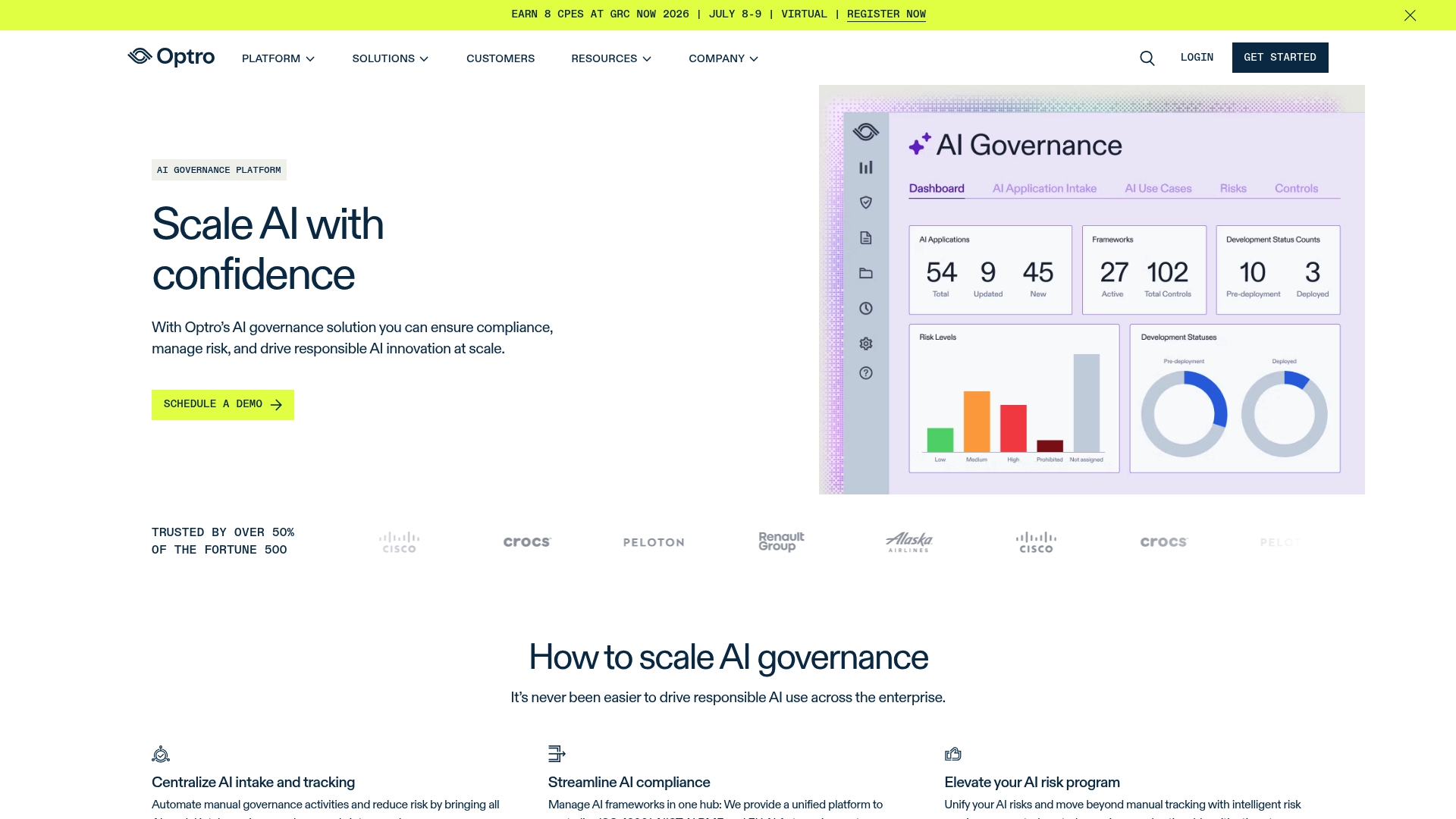
Optro’s marketing materials state it is trusted by over 50% of Fortune 500 companies. The platform combines a centralized AI inventory with automated compliance mapping and continuous risk scoring tailored for enterprise environments. Publicly accessible product detail appears limited, which affects outside evaluation.
Core Features
- AI inventory and review workflows that capture model metadata, owners, and lifecycle status for enterprise-scale inventories.
- Automated compliance with frameworks including EU AI Act and ISO 42001 so policies and control mappings align with named standards.
- Real-time AI risk monitoring and risk scoring that surfaces shifts in model behaviour and generates alerts for high-risk systems.
- Unified management of policies, risks, and controls to feed audit and oversight processes.
- Risk visualization and audit management tools for evidence collection and review trails.
Key Differentiator
The product pairs continuous, operational risk signals with compliance management across named standards. That combination means governance teams see live risk movement while also generating artifacts for regulatory frameworks such as the EU AI Act. For companies with heavy audit obligations, the pairing reduces the gap between monitoring and proof.
Pros
-
Enterprise traction. The adoption figure above signals vendor experience with large procurement cycles and complex contracts.
-
Compliance breadth. Support for multiple standards reduces the need to bolt on separate mapping tools when responding to regulatory requests.
-
Proactive risk handling. Continuous scoring gives teams earlier warning of model drift or policy breaches instead of waiting for periodic reviews.
-
Centralized control plane. Bringing inventories, policies, and audits into one system shortens investigation time when governance questions arise.
-
Audit readiness. Built-in evidence trails and visualization tools make compiling documentation for reviewers more straightforward.
Cons
-
Limited public documentation. The vendor restricts detailed feature descriptions, which makes technical due diligence slower for buyers.
-
Onboarding effort. The platform’s scope and enterprise focus mean significant setup and training for cross-functional teams.
-
Evaluation friction. Restricted access to product data can force proof of concept work to be vendor dependent rather than self-directed.
When It May Not Fit
If you need an off the shelf, fast to deploy governance layer for a small set of models, Optro’s enterprise setup and onboarding overhead may be excessive. Also, teams that require open trial access for deep technical testing will find the limited public documentation frustrating.
Who It’s For
Large organizations with centralized governance, compliance, or risk teams that run many AI systems across business units. Procurement and legal teams that must produce regulatory artifacts for bodies like the EU will find the platform aligned with their processes.
Real World Use Case
A multinational uses Optro to map every deployed model to an owner, control set, and regulatory posture. Risk scores trigger reviews in the governance queue and audit reports pull directly from stored evidence. The result is fewer manual spreadsheets and faster responses to compliance requests.
Pricing
Optro does not publish list pricing. The product data marks pricing as informational only, so procurement typically begins with a vendor conversation and an enterprise licensing process.
Website: https://fairnow.ai
SmartFlow
At a Glance
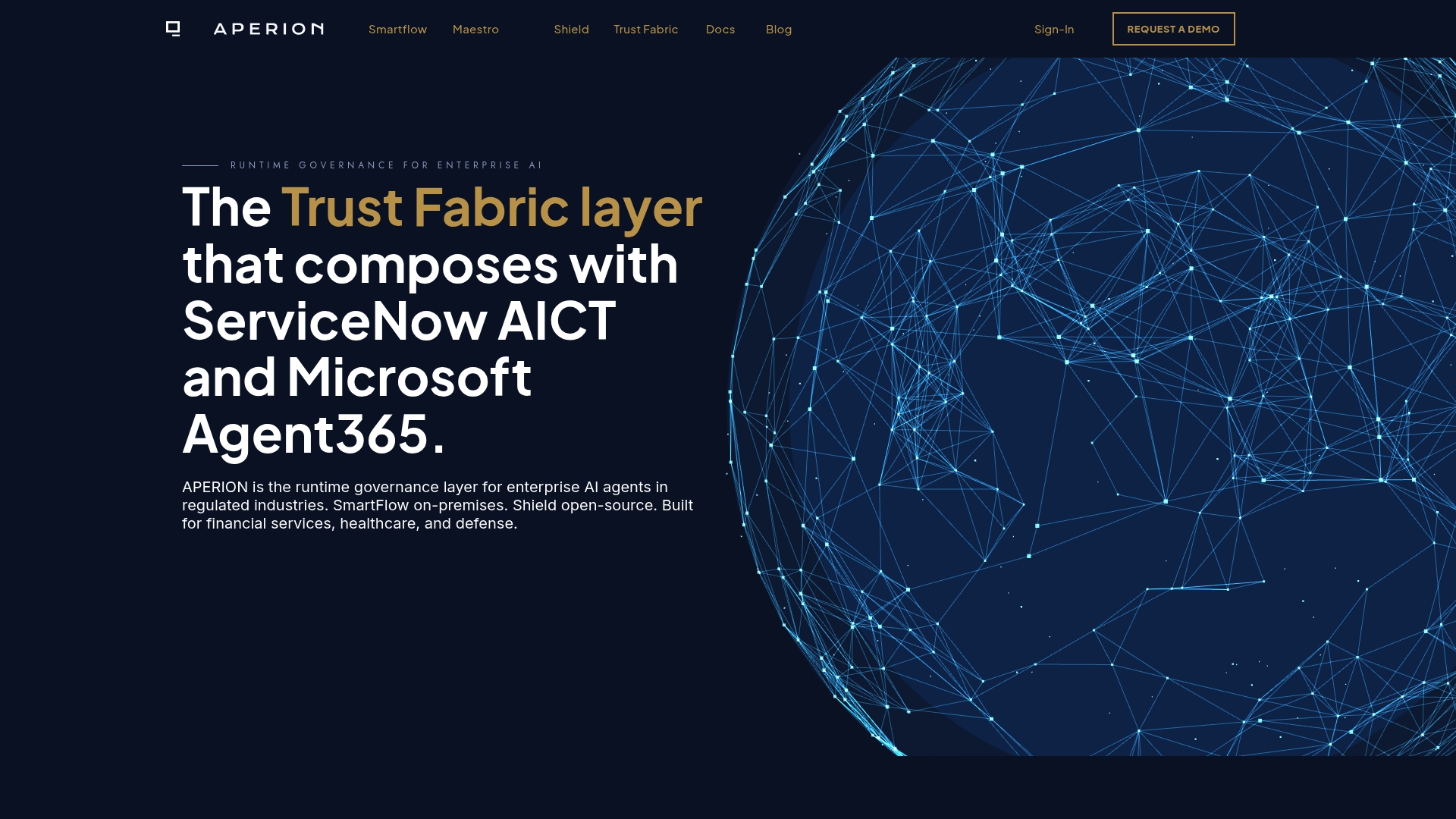
According to the vendor, SmartFlow’s semantic caching achieves a 55 to 75 percent hit rate, cutting downstream calls and improving response latency for repeated prompts. The product is an on premises, Kubernetes native AI governance control plane built for regulated industries.
SmartFlow focuses on visibility and control inside corporate networks rather than vendor-side agent configuration. That narrower scope contrasts with Tekkr’s vendor-agnostic configuration layer and serves different operational priorities.
Core Features
SmartFlow centralizes runtime governance and routing for enterprise AI workloads. Its core capabilities map directly to compliance, security, and operational efficiency needs.
- Kubernetes native on premises deployment that keeps data inside enterprise boundaries.
- Inline policy enforcement at each prompt and response with audit trails for regulatory review.
- Semantic caching with the hit rates the vendor advertises and real time cost and performance analytics.
- Cryptographic AI agent identity (AIDA) with delegated permissions and a Trust Fabric for agent to agent governance.
- Unified provider routing and automatic failover across OpenAI, Anthropic, Google, Meta and others, plus vendor switching controlled by policy.
- The vendor advertises regulatory examination automation for FINRA, SR 11-7, HIPAA, and the EU AI Act.
Key Differentiator
The product’s defining claim is its Kubernetes native, on premises control plane that combines inline policy enforcement, semantic caching, and cryptographic agent identity management. That stack is optimized for enterprises that cannot accept cloud vendor data residency or want every AI call to pass governance checks inside their network.
Pros
- Provides true on premises control over models and data, which supports regional data sovereignty and internal audit requirements.
- Multi provider routing and automatic failover reduce vendor lock in and let operations shift traffic based on policy and performance.
- The auditing and inline enforcement create a continuous record useful for regulatory exams and internal investigations.
- The caching approach the vendor describes lowers API volume and improves latency, which reduces recurring inference costs.
- Cryptographic agent identities with scoped permissions improve traceability for agent driven workflows and agent to agent calls.
Cons
- Deployment is complex and will require a dedicated infrastructure team to install and maintain the Kubernetes footprint.
- The product demands Kubernetes and security expertise, which narrows adoption to organizations with mature platform teams.
- Adopting strict runtime governance requires stakeholder alignment and process change; buy in from legal, compliance, and engineering is necessary.
When It May Not Fit
If you lack an on premises Kubernetes environment or need a lightweight cloud managed governance layer, SmartFlow is a poor fit. Organizations looking for low friction pilot projects or teams without infrastructure investment will find the setup overhead prohibitive.
Who It’s For
Large enterprises in financial services, healthcare, defense, and other regulated sectors that must keep AI traffic inside corporate boundaries and maintain auditable controls. Best for teams with platform engineering capacity and formal regulatory obligations.
Real World Use Case
A multinational bank deploys SmartFlow to route and govern AI requests from regional offices. The bank uses the caching figure above to reduce external calls, applies inline policies for PII handling, and collects audit trails to support FINRA and GDPR examinations.
Pricing
Not applicable. The vendor lists SmartFlow as an on premises, enterprise solution and provides pricing on request. Expect custom licensing and professional services to cover deployment, integration, and ongoing support.
Website: https://aperion.ai
PolicyGuard AI
At a Glance
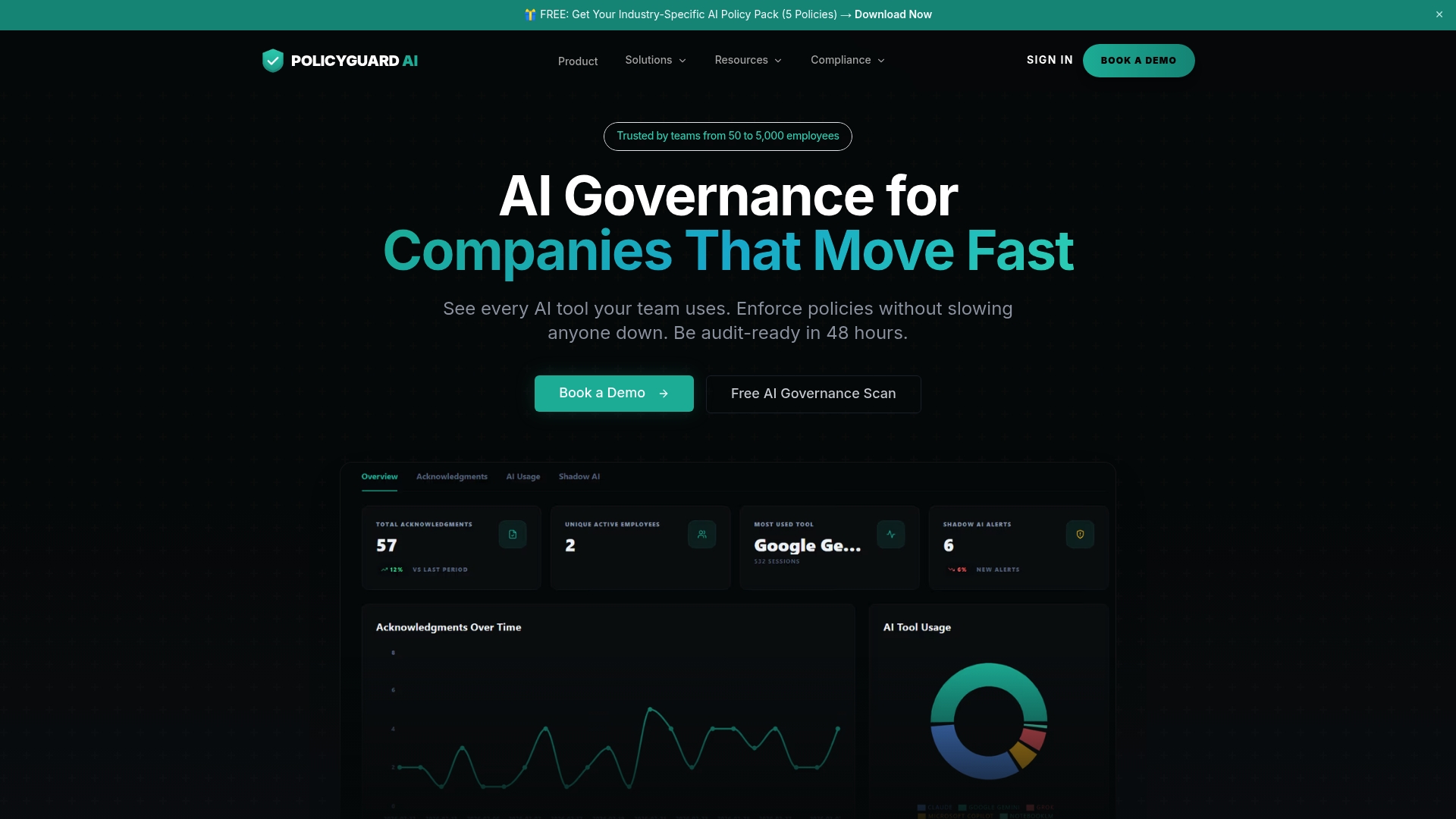
PolicyGuard AI starts at $199 per month for up to 50 employees, a concrete entry point for teams that want perimeter governance without a bespoke quote. The platform emphasizes deterministic policies and real-time detection across browsers, OAuth, and network layers.
Core Features
- Real-time detection across browsers, OAuth, and network layers to surface Shadow AI use and policy violations as they happen.
- Pre-built, expert-curated policy templates. The vendor states these templates are aligned with global regulations, giving legal and compliance teams a starting point.
- Automated employee acknowledgment and training modules that track completions and attach evidence to user records.
- Audit-ready export in PDF and DOCX plus compliance dashboards with trend analytics and risk scoring.
- Enterprise-grade security including SSO, encryption, and immutable audit trails.
Key Differentiator
PolicyGuard AI deliberately avoids AI-driven enforcement and policy generation, relying instead on a human-curated, deterministic engine. That approach trades probabilistic decisioning for traceable rules you can present as evidence during audits.
Pros
- Clear, rule-based enforcement reduces ambiguity when auditors request why a decision was made. The deterministic approach makes policy actions explainable.
- Built-in, human-written templates speed legal review because they map to named regulatory themes rather than synthetic policy suggestions.
- Fast deployment via a simple browser extension and OAuth hooks; pilots can detect Shadow AI within days rather than months.
- Compliance reporting and downloadable evidence make preparing for inspections less manual and faster to compile.
- Scales from small teams to larger estates without changing the enforcement model, which keeps workflows consistent as you grow.
Cons
- Public reviews available to me did not identify specific product weaknesses, so external validation of edge-case behavior is limited.
- There is no free tier; the entry price is subscription based and may be higher than lightweight, checklist-style tools.
- Full effectiveness requires initial configuration and user adoption work. Policies are deterministic but need correct implementation to avoid false positives.
When It May Not Fit
If you want a governance tool that writes policies for you using generative models, this product is not a match. PolicyGuard AI intentionally avoids AI-based policy creation and enforcement.
If your team needs a zero-configuration, free option during an exploratory phase, the lack of a free tier could block early experimentation. Organizations that demand plug-and-play behavior for nontechnical staff should budget for an initial rollout and communications plan.
Who It’s For
Compliance teams, security leaders, and general counsel at organizations that require auditable, explainable controls for employee AI usage. Best for companies that prefer human-curated rules over probabilistic enforcement and that need exportable evidence for inspections.
Real World Use Case
A healthcare provider deployed PolicyGuard AI to detect clinicians using unapproved AI tools, require policy acknowledgment during onboarding, and export chronological evidence for regulators. The platform captured usage events, tied them to training completions, and sped audit assembly.
Pricing
Starts at $199 per month for up to 50 employees. Pricing scales with team size and the vendor offers custom enterprise solutions for larger estates. Visit the vendor site for plan details and volume pricing.
Website: https://getpolicyguard.com
Selections for Enterprise AI Governance
Choosing the right AI governance tool requires a detailed understanding of capabilities and priorities, as each product reviewed provides unique features and areas of focus.
Deployment Simplicity Versus Operational Scope
Configurato prioritizes deployment simplicity, offering a solution advertised as being operable within 30 minutes. This supports rapid evaluation and implementation, suiting organizations seeking immediate ROI analysis across AI use. In comparison, SmartFlow’s focus on Kubernetes-native, on-premises deployment ensures control over AI traffic but necessitates a sophisticated infrastructure for operation.
PolicyGuard AI offers entry-level governance with deterministic, pre-built configurations and an accessible starting price, presenting a balance between functionality and approachability for smaller organizations initiating AI management protocols.
Governance Depth: Compliance and Integration
While Configurato delivers vendor-independent adoption metrics and ROI insights, Trussed AI excels in enforcing real-time compliance and control mechanisms at runtime across AI implementations. Such continuous oversight is vital for regulated industries requiring minimal latency in enforcement.
On another front, Difinity.ai integrates runtime PII redaction and audit trail generation, a particularly relevant dimension for operations in sensitive domains like finance and healthcare. This complements its centralized API design, which streamlines integration with diverse AI solutions.
Scalability and Configurational Flexibility
Optro demonstrates its strengths in organizational-scale deployments, offering tools to map, score, and monitor enterprise-wide AI use for long-term regulatory alignment. However, its significant setup requirements may suit larger, resource-rich organizations better. Similarly, PolicyGuard AI’s human-curated policies provide traceable governance, adaptable as organizational demands evolve, whereas Configurato focuses more on financial and contextual adoption-driven management.
Best Fit Recommendations
- Best for Rapid Assessment and ROI Analysis: Configurato. Combining streamlined deployment and ROI analysis makes it a strong contender for organizations looking to fast-track productivity insights.
- Ideal for Compliance Coverage: Trussed AI offers runtime enforcement aligned with regulatory frameworks, addressing needs for stringent operational control.
- Centering on Enterprise PII and Cost Efficiency: Difinity.ai’s PII redaction capabilities and compliance-forward API position it for cost- and risk-optimized environments.
- Supporting Organizations with Infrastructure Maturity: SmartFlow’s Kubernetes-native design excels where data residency laws or on-premises hosting mandates are priorities.
- Cost-Conscious Enterprises Starting AI Governance: PolicyGuard AI provides template-driven setups for small to mid-size organizations emphasizing auditability without probabilistic means.
Our Pick
For organizations seeking rapid adoption visibility and financial alignment across AI tools, Configurato offers a unique advantage. By operating independently of vendor platforms and providing centralized adoption metrics, it facilitates insights into departmental AI tool interactions. However, for cases demanding continuous runtime enforcement and PII redaction integration, such as in stringent regulatory environments, Trussed AI or Difinity.ai might better meet specific needs.
Enterprise AI Governance Platforms Compared
Choosing the right governance solution depends on deployment speed, support for varied vendor dashboards, and integration flexibility.
| Product | Core Feature | Best For | Pricing | Notable Limitation |
|---|---|---|---|---|
| Configurato | Org-wide adoption analytics | Large organizations with multi-department AI deployments | Free tier and Pro by request | Requires adoption of MCP standards for connectivity |
| Trussed AI | Real-time policy enforcement | Regulated industries with AI in production | Tailored quote | Complex setup and integration processes |
| Difinity.ai | PII detection and redaction | Enterprise compliance across multiple LLMs | Starts at $49 per use case/month | Limited on-premise deployment options |
| Optro | Centralized AI inventory and risk scoring | Organizations with heavy audit obligations | Not disclosed | Limited public feature documentation |
| SmartFlow | Kubernetes-native on-premises deployment | Regulated enterprises requiring strict data controls | Not disclosed | Requires advanced Kubernetes expertise |
| PolicyGuard AI | Deterministic AI policy enforcement | Teams preferring human-curated compliance rules | Starts at $199/month for 50 employees | No free tier for exploratory phases |
Make AI Adoption Work for Your Company with Tekkr
Many organizations exploring aigovernancetracker.com alternatives face a common challenge AI tools alone don’t deliver the productivity boost expected. Employees often prompt assistants generically without company context, causing outputs that need rework. Tekkr solves that by embedding your unique processes, quality standards, and domain knowledge directly into AI assistants like Claude, GPT, Copilot, and Gemini. That means outputs align with how your teams actually work — no new tools, no workflow changes.
Why settle for just tracking AI usage when you can truly activate it? Discover how Tekkr Configurations bridges adoption and governance by pushing your company’s way of working into every AI call. Take control with instant alignment and clear visibility into where AI accelerates work. Visit Tekkr to see how you can start turning your AI assistants into true extensions of your team’s expertise.
Frequently Asked Questions
What makes Tekkr the best choice for enterprise AI governance?
Tekkr provides real-time visibility into adoption and ROI, ensuring leaders have a single source of truth for reporting. Its feature of full data anonymization and vendor-independent support significantly reduces the risk of employee surveillance while measuring performance. Organizations seeking transparent insights into AI tool usage and spending should consider Tekkr to enhance governance without compromising privacy.
How does Tekkr compare to Trussed in policy enforcement?
Trussed excels in continuous runtime policy enforcement, offering built-in security controls that are essential for regulated environments. Tekkr, on the other hand, is ideal for those looking for a vendor-independent governance solution to compare usage across multiple AI tools. Businesses needing strict compliance and continuous governance may prefer Trussed, but Tekkr suits organizations requiring flexibility and aggregated insights across various assistants.
Can I use Tekkr without adopting MCP and OpenTelemetry for connectivity?
You can use Tekkr effectively, but adopting MCP and OpenTelemetry will enhance your connectivity options, which may require some engineering effort. The article notes that this adoption can streamline your organization’s governance and performance tracking. If you prefer a simpler integration path, Tekkr offers good initial functionality without these standards, making it a versatile choice for diverse systems.
What are the deployment times for Tekkr compared to Difinity.ai?
Tekkr advertises deployment times of about 30 minutes, allowing for quick proofs of value and basic telemetry setup. In contrast, Difinity.ai estimates deployment in under 14 days, which is beneficial for teams needing real-time governance and compliance features. Companies wanting faster initial insights might find Tekkr preferable, while those seeking more extensive governance features might still consider Difinity.ai despite the longer setup.
What are the pricing structures for Tekkr versus Optro?
Tekkr offers flexible pricing, including a free tier and a Pro tier available upon request, accommodating various budgets and requirements. On the other hand, Optro does not publicly publish list pricing, making cost estimates reliant on tailored negotiations. For organizations looking for transparent entry points, Tekkr may present a more straightforward initial investment option.