AI use cases in business are defined as specific, repeatable applications of artificial intelligence that automate or augment a distinct workflow within a functional team. The types of AI use cases by department vary significantly, but the highest-ROI implementations share one trait: they target high-volume, rules-based, repetitive tasks where structured data already exists. SOCAR Türkiye demonstrated this at scale, saving over 7,500 employee hours annually by deploying AI across finance, HR, legal, and supply chain. Legal departments show the same momentum, with 87% of general counsel reporting AI use in 2026, up from 44% in 2025. For executives mapping where to invest next, this guide breaks down the most proven departmental AI implementations by function, ROI range, and time to value.
1. What are the key AI use cases in sales and marketing departments?
Sales leads AI adoption across the enterprise. About 20% of sales tasks are automatable based on call, lead, and email data patterns. That figure is significant because sales generates more structured, high-cadence data than almost any other function, making it the natural starting point for AI deployment.
The four patterns that deliver the most value in sales and marketing are:
- Meeting intelligence: AI transcribes, summarizes, and extracts action items from every sales call automatically. Reps stop taking notes and start selling.
- Lead scoring and routing: AI ranks inbound leads by conversion probability and routes them to the right rep in real time. Pipeline quality improves without adding headcount.
- Workflow copilot: AI drafts follow-up emails, proposal sections, and call prep briefs based on CRM data. Reps spend time on relationships, not on writing.
- RAG assistant: A retrieval-augmented generation assistant gives reps instant access to product specs, competitive positioning, and pricing. Response time to prospect questions drops from hours to seconds.
Marketing benefits from the same patterns applied to content production, campaign performance analysis, and audience segmentation. AI can generate first drafts of ad copy, score content performance, and flag which segments are underperforming before a campaign ends.
Pro Tip: Start with meeting intelligence before any other sales AI tool. It requires zero change to rep behavior, captures data passively, and immediately surfaces coaching opportunities for managers.

2. How does AI transform finance and accounting operations?
Finance is the department most burdened by documentation and exception handling. Every invoice, expense report, and contract requires data entry, validation, and approval routing. AI eliminates most of that manual work.
The three highest-impact finance AI applications are vision extraction for automated data entry, anomaly detection agents for fraud and error flagging, and accelerated document review for audits and compliance checks. SOCAR Türkiye’s finance team is the clearest proof point: 73% of expense reports are now handled by AI agents, with a 99% reduction in manual process time. That is not a marginal improvement. It is a functional transformation.
The ROI data across the industry confirms this is not an outlier:
| Finance AI Application | Typical ROI | Time to Value |
|---|---|---|
| Invoice processing automation | 150–300% | 3–6 months |
| Anomaly detection for fraud | 150–300% | 3–6 months |
| Document review acceleration | 150–300% | 3–6 months |
These ROI benchmarks by function reflect deployments where structured financial data already existed. Organizations without clean data pipelines will see slower returns.
Pro Tip: Deploy anomaly detection before invoice automation. Catching errors and fraud first builds CFO confidence in AI accuracy, which accelerates approval for larger automation projects.
3. Which AI use cases deliver impact in HR and people operations?
HR carries two distinct workloads: high-volume transactional tasks like resume screening and policy queries, and judgment-intensive tasks like performance reviews and compensation decisions. AI handles the first category well and assists with the second.
The most proven HR AI applications include:
- Resume screening: AI reduces recruiter time spent on initial screening by up to 70%. It filters candidates against structured criteria and ranks them before a human ever opens a file.
- Employee policy RAG assistant: A retrieval-augmented generation assistant answers employee questions about benefits, leave policies, and HR procedures instantly. SOCAR Türkiye reduced HR case volume by 62% with this approach alone.
- Onboarding automation: AI generates personalized onboarding checklists, schedules training modules, and sends reminders without HR coordinator involvement.
- Performance review drafting: AI pulls structured performance data from project management and CRM systems and drafts review summaries for manager review. Managers edit rather than write from scratch.
The ROI range for HR AI sits at 100–200%, with time to value of 2–4 months. That faster payback compared to finance reflects the lower integration complexity. Most HR AI tools connect to existing HRIS platforms without major data engineering work.
The critical governance point: AI screens and ranks, but humans make final hiring decisions. This is not just an ethical requirement. It is a legal one in most jurisdictions.
4. What AI applications enhance customer service and support functions?
Customer service generates the highest volume of repetitive, structured interactions in any organization. That makes it one of the strongest candidates for AI deployment. The key is matching the right AI pattern to the right tier of support.
Three applications define the customer service AI stack:
- Tier 1 case automation: AI handles password resets, order status checks, FAQ responses, and account updates without human involvement. Best-in-class deployments reach up to 80% resolution at this tier. That frees human agents for complex, high-value interactions.
- Intelligent ticket scoring and routing: AI reads incoming tickets, classifies them by issue type and urgency, and routes them to the right agent or queue. Average handle time drops because agents receive pre-classified, pre-prioritized work.
- Real-time agent assist: AI listens to live customer interactions and surfaces relevant knowledge base articles, suggested responses, and escalation triggers in real time. Agents resolve issues faster and with greater consistency.
Customer experience AI delivers 200–400% ROI over 6–12 months. The longer time to value reflects the integration work required to connect AI to ticketing systems, CRMs, and knowledge bases.
Pro Tip: Measure containment rate, not just deflection rate. Deflection counts tickets that never reached an agent. Containment counts tickets resolved without escalation. Containment is the metric that proves AI quality, not just volume.
5. How are AI use cases evolving in legal, compliance, and supply chain departments?
Legal, compliance, and supply chain represent the next wave of departmental AI adoption. These functions involve high-stakes decisions, complex documents, and regulatory exposure, which historically made AI deployment slower. That is changing fast.
Legal and compliance AI applications:
- Contract review and redlining, where AI flags non-standard clauses and suggests approved language
- Regulatory monitoring, where AI tracks changes in legislation and alerts compliance teams to gaps
- M&A diligence support, where AI extracts and summarizes key terms across hundreds of documents
- Anomaly detection for compliance violations in financial transactions and communications
The adoption numbers confirm the shift. 87% of general counsel reported AI use within their legal teams in 2026, compared to just 20% in 2023. That three-year acceleration is the fastest adoption curve of any enterprise function.
Supply chain AI applications:
- Demand forecasting using historical sales data and external signals like weather and economic indicators
- Supplier risk monitoring, where AI scores vendors on financial health, geopolitical exposure, and delivery performance
- Logistics optimization, where AI recommends routing and inventory positioning to reduce cost and lead time
One governance principle applies across all three functions: agentic AI infrastructure must integrate with existing enterprise systems before autonomous execution is enabled. Autonomous contract execution or self-directed compliance actions require mature governance frameworks. Organizations that skip this step create liability, not efficiency.
Key Takeaways
Departmental AI use cases deliver the highest ROI when they target high-volume, repetitive processes with structured data, deployed in sequence from lowest to highest governance complexity.
| Point | Details |
|---|---|
| Start with sales and finance | Both functions have structured data and high task volume, enabling fast ROI within 3–6 months. |
| HR AI pays back fastest | Resume screening and policy assistants deliver 100–200% ROI in as little as 2–4 months. |
| Customer service scales highest | Tier 1 automation can resolve up to 80% of cases, with 200–400% ROI over 6–12 months. |
| Legal adoption accelerated sharply | 87% of legal teams use AI in 2026, up from 44% in 2025, primarily for contract review. |
| Governance before autonomy | Agentic and cross-department AI requires integration maturity before enabling autonomous execution. |
What I’ve learned about sequencing AI across departments
The biggest mistake I see executives make is treating AI deployment as a technology decision rather than a sequencing decision. They buy a platform, announce a rollout, and then wonder why adoption stalls at 20% six months later.
The fastest AI wins come from starting with patterns that have no complex dependencies: meeting intelligence in sales, invoice extraction in finance, policy assistants in HR. These require no workflow redesign. They slot into existing processes and deliver visible results within weeks. That early momentum builds the organizational trust needed to tackle harder use cases.
The second mistake is deploying standalone chatbots instead of integrated agentic systems. A chatbot that cannot write to your CRM, update your HRIS, or route a ticket is a search engine with a friendlier interface. The productivity gains come from AI that acts, not just answers. SOCAR Türkiye’s multi-agent dispatcher, which routes tasks across finance, HR, legal, and supply chain, is the model worth studying.
The third mistake is underestimating governance as a prerequisite for scale. The State of California’s centralized AI platform “Poppy” enables 70+ departments to deploy AI securely without individual vendor management. That approach eliminates duplicated procurement costs and security reviews. Enterprises should think the same way: one governed platform, many department-specific use cases, not 12 separate AI tools with 12 separate contracts.
AI functions best as a complement to human judgment, not a replacement for it. The departments that get this right deploy AI to handle execution while humans retain oversight of decisions that carry legal, financial, or reputational weight. That division of labor is not a limitation. It is the architecture that makes AI sustainable.
— TekkrTools
Tekkr helps you turn department AI plans into measurable results
Most organizations know which AI use cases they want to pursue. The gap is in knowing whether those use cases are actually being used, by whom, and at what cost. Tekkr’s flagship product, Configurato, tracks AI adoption and spend across every department, surfaces which use cases are generating real productivity gains, and drives adoption higher through gamified rollouts and company-wide AI playbooks.
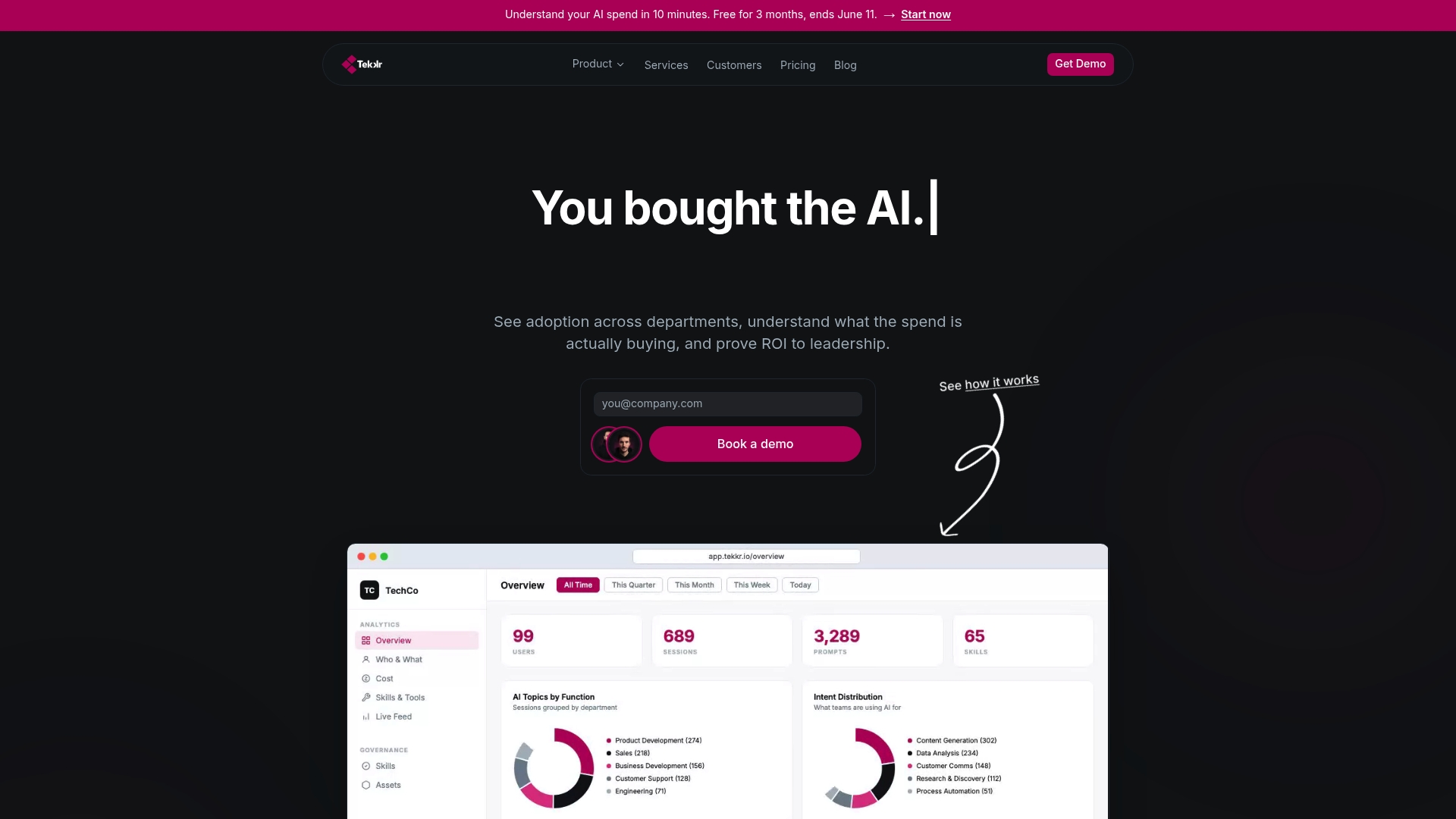
Configurato connects to tools like Claude and Codex, breaks down costs by team, and strips PII automatically so your data stays protected. Setup takes about 10 minutes, with a free tier and no credit card required. If you are planning department-wide AI adoption and need both visibility and a practical way to lift productivity, Tekkr is built for exactly that. You can also explore Tekkr’s enterprise AI adoption guide to map your next steps by function.
FAQ
What are the most common AI use cases by department?
The most common departmental AI use cases are meeting intelligence and lead scoring in sales, invoice automation and anomaly detection in finance, resume screening and policy assistants in HR, and Tier 1 case automation in customer service. Legal teams increasingly use AI for contract review and regulatory monitoring.
Which department sees the fastest ROI from AI?
HR delivers the fastest payback, with resume screening and policy assistants generating 100–200% ROI in 2–4 months. Finance follows closely, with invoice processing automation reaching 150–300% ROI within 3–6 months.
How should executives sequence AI deployments across departments?
Start with high-volume, repetitive processes that have structured data and no complex system dependencies. Deploy meeting intelligence, invoice extraction, and HR policy assistants first, then layer on governance-heavy use cases like autonomous contract review as organizational maturity grows.
Why do multi-agent AI systems outperform standalone chatbots?
Multi-agent architectures route tasks across departments, write to enterprise systems, and execute multi-step processes autonomously. Standalone chatbots only answer questions. SOCAR Türkiye’s multi-agent dispatcher produced 7,500+ hours in annual savings precisely because it acted across functions rather than responding within one.
What governance steps are required before deploying AI in legal or compliance?
Legal and compliance AI requires agentic infrastructure integrated with existing enterprise systems before enabling autonomous execution. Organizations must establish data governance, audit trails, and human oversight protocols before AI takes autonomous action on contracts or regulatory filings.