
AI Transformation Strategy for Executives: 2026 Guide

An AI transformation strategy is a deliberate, organization-wide plan to embed artificial intelligence into core workflows, decision processes, and products to generate measurable business value. This goes well beyond buying tools like Microsoft 365 Copilot or deploying a chatbot. According to a Deloitte poll of nearly 3,700 professionals in June 2026, enterprise AI adoption is widespread but true operational transformation remains limited. The gap exists because most organizations layer AI onto old processes instead of redesigning how work gets done. Understanding what is AI transformation strategy, and executing it well, is now the defining leadership challenge of 2026.
What is an AI transformation strategy?
An AI transformation strategy is the structured approach an organization uses to move from isolated AI experiments to AI embedded across every critical business function. The industry term you will encounter in boardrooms and analyst reports is enterprise AI transformation, and it covers three distinct layers: technology integration, workforce enablement, and governance.
Technology integration means connecting AI tools to real data and real workflows, not running demos. Workforce enablement means training employees to use AI well and building a culture where AI is a default part of how work happens. Governance means setting rules for how AI models are deployed, monitored, and retired. All three layers must move together. Organizations that invest only in technology without addressing workforce and governance consistently stall.

The distinction between AI adoption and AI transformation is worth stating plainly. Adoption means your teams have access to AI tools. Transformation means those tools have changed how decisions get made, how products get built, and how value gets delivered to customers. Most enterprises today sit firmly in the adoption phase, which is why leadership challenges remain in redesigning work, governance, and measurement.
What are the core components of a successful AI strategy?
Five building blocks separate organizations that transform from those that just experiment.
- Strategic alignment. Every AI initiative must connect directly to a business priority. If you cannot draw a line from an AI project to revenue growth, cost reduction, or risk mitigation, it should not be funded.
- End-to-end workflow redesign. AI must be built into how a process works, not bolted on afterward. A sales team that uses AI to summarize calls but still manually updates a CRM has not transformed anything.
- Governance frameworks. Governance covers model oversight, data access controls, and accountability for AI decisions. Governance must balance risk mitigation with enough flexibility to avoid blocking innovation.
- Measurement beyond usage. Tracking logins and prompt counts is not measurement. Measuring AI transformation success requires metrics on workflow changes, decision impacts, and new capabilities created.
- Capability building. Workforce enablement and culture change are not soft concerns. They are the primary reason AI programs succeed or fail at scale.
Pro Tip: Assign an AI champion in each business unit before you roll out any new tool. Champions drive local adoption, surface real blockers, and give leadership an honest signal on what is actually working.
Tools like Microsoft 365 Copilot and Anthropic’s Claude are only as effective as the workflows they support. The technology is rarely the bottleneck. The bottleneck is almost always process design and people.
How do enterprise AI maturity models guide transformation?
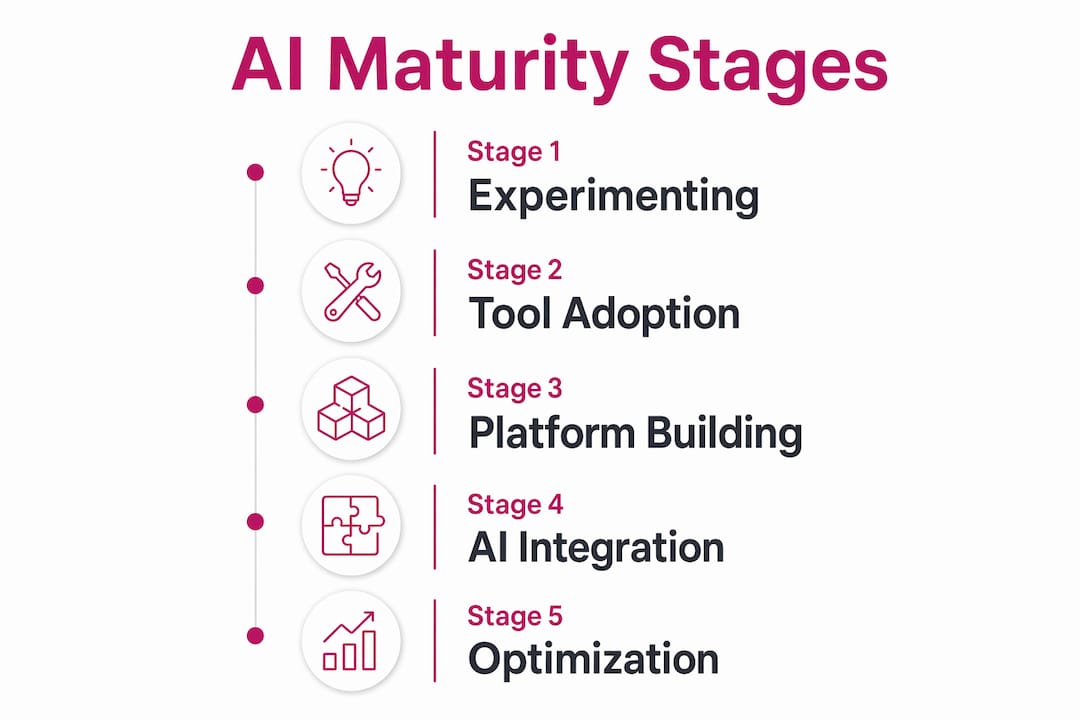
An AI maturity model is a framework that maps an organization’s current AI capabilities against a defined progression toward full AI integration. The most widely referenced models, including those from Deloitte, SEI CMU, and Cohere, use a five-stage structure.
Understanding what is AI maturity model thinking requires one key distinction. A readiness assessment is binary. It answers whether your organization can safely start an AI initiative. A maturity model tracks graduated progress after you have launched. Skipping readiness checks before advancing maturity stages is one of the most common causes of failed AI projects.
Here is how the five stages map to real organizational behavior:
| Stage | Label | Key Indicator |
|---|---|---|
| 1 | Experimenting | Isolated pilots with no shared infrastructure or governance |
| 2 | Adopting | Broad tool deployment but fragmented data and inconsistent use |
| 3 | Scaling | Internal AI platforms with unified data flows and observability |
| 4 | Transforming | AI embedded in core workflows and decision processes enterprise-wide |
| 5 | AI-Native | AI is a default capability; the business model depends on it |
The hardest jump is from Stage 2 to Stage 3. At Stage 2, teams have tools but no shared foundation. Moving to Stage 3 requires stopping treating AI as standalone tools and building internal platforms with secure data flows, observability, and architecture that supports multiple models. This investment is significant, and most organizations underestimate it.
Effective AI transformation at the higher stages includes appointing AI champions, building AI registers that catalog active models, and reporting AI maturity directly to boards for transparency and accountability.
Pro Tip: Run a maturity assessment before setting your AI budget for the year. Knowing whether you are at Stage 2 or Stage 3 changes which investments will actually move the needle.
What challenges do organizations face when scaling AI?
Scaling AI across an enterprise is harder than most leadership teams expect. The barriers are predictable, but they still catch organizations off guard.
-
The micro-productivity trap. Measuring AI success by logs or task speed creates a false sense of progress. Real value requires redesigning end-to-end work processes with AI built in, not measuring how fast someone generates a first draft.
-
Data fragmentation. Most enterprises have data spread across dozens of systems with inconsistent formats, access controls, and quality standards. Building a unified data fabric ensures secure, efficient AI data flows enterprise-wide and supports multi-model AI architecture with explainability. Without it, AI tools produce unreliable outputs.
-
Shadow AI. When governance is absent or too slow, teams build their own AI workflows using personal accounts and unapproved tools. AI maturity depends on coordination between business priorities and technology adoption. Shadow AI breaks that coordination and creates serious data security and compliance risks.
-
Stakeholder complexity. AI transformation touches every function. Getting finance, legal, HR, and operations aligned on a shared roadmap requires sustained effort. Stakeholder assessments should involve 8 to 12 diverse roles and rely on evidence such as data and documentation rather than opinion to avoid bias.
-
Cultural resistance. Employees who fear job displacement or distrust AI outputs will find ways to work around new tools. Culture change requires visible leadership commitment, not just training sessions.
The organizations that scale AI successfully treat these challenges as a program management problem, not a technology problem. They assign owners, set timelines, and measure progress on the human and process dimensions with the same rigor they apply to technical deployment.
How can business leaders implement AI transformation in 2026?
Practical execution in 2026 requires a different approach than the AI pilots of 2023 and 2024. The experimentation phase is over for most large enterprises. The question now is how to generate returns at scale.
- Redesign workflows first, then select tools. Map the end-to-end process you want to improve. Identify where AI can remove friction, accelerate decisions, or surface insights. Then choose the tool that fits the redesigned process. Reversing this order is the most expensive mistake in enterprise AI.
- Build governance before you need it. Governance frameworks take time to design and socialize. Organizations that wait until they have a compliance incident or a model failure are already behind. Explore AI integration strategies for executives that include governance as a first-class deliverable.
- Use evidence-based stakeholder assessments. Bring 8 to 12 roles into your AI readiness and maturity reviews. Ground every finding in data and documentation. Opinions about AI readiness are almost always wrong in one direction or the other.
- Invest in AI talent as a strategic asset. Hiring one AI lead is not enough. You need AI literacy distributed across every function. This means structured training programs, internal communities of practice, and incentives for teams that demonstrate measurable AI-driven improvements.
- Choose platforms that give you visibility and control. The best enterprise AI rollout platforms and top AI workforce enablement platforms do more than deploy tools. They track adoption by team, surface which use cases are generating value, and give leadership the data to make informed investment decisions.
Pro Tip: Treat your AI roadmap as a living document reviewed quarterly, not an annual strategy deck. The technology and the competitive context are both moving too fast for annual planning cycles.
The organizations pulling ahead in 2026 are not the ones with the most AI tools. They are the ones with the clearest picture of which tools are working, which workflows have changed, and where the next investment should go. Review enterprise AI adoption explained to understand how the adoption phases map to your current position.
Key takeaways
An effective AI transformation strategy requires workflow redesign, governance, and measurement working together. Tool deployment alone does not produce transformation.
| Point | Details |
|---|---|
| Define transformation clearly | AI transformation means redesigned workflows and changed decisions, not just tool access. |
| Use maturity models | Five-stage enterprise AI maturity models help you diagnose where you are and what to invest in next. |
| Avoid the micro-productivity trap | Measure workflow changes and decision impacts, not logins or prompt counts. |
| Govern before you scale | Build AI governance frameworks before a compliance incident forces your hand. |
| Distribute AI capability | AI literacy across every function outperforms a single AI team working in isolation. |
What i have learned watching enterprises get this wrong
Most AI transformation programs fail in the same place. Not at the technology layer. At the measurement layer.
Leadership approves a budget, tools get deployed, and adoption dashboards show green. Then six months later, someone asks what changed in the business. Nobody has a clean answer. That is the micro-productivity trap in practice, and it is far more common than any vendor will tell you.
The uncomfortable truth is that most organizations are measuring AI activity, not AI value. They count prompts, track licenses, and report on training completions. None of that tells you whether AI has changed how a decision gets made or how a product gets built.
The second pattern I see consistently is governance treated as a compliance checkbox rather than a strategic capability. Governance done well gives you the confidence to move faster, not slower. It tells you which models are running, what data they are touching, and whether the outputs are trustworthy. Without that visibility, every AI initiative carries hidden risk.
My honest recommendation for executives in 2026 is to stop asking “how do we adopt more AI” and start asking “how do we know our AI is working.” That shift in question changes everything about how you build your program, what you measure, and where you invest next. The organizations that crack this will not just be ahead on AI. They will be ahead, full stop.
— TekkrTools
How Tekkr helps you prove your AI is working
Most enterprises have already bought the AI. The hard part is proving it is working.
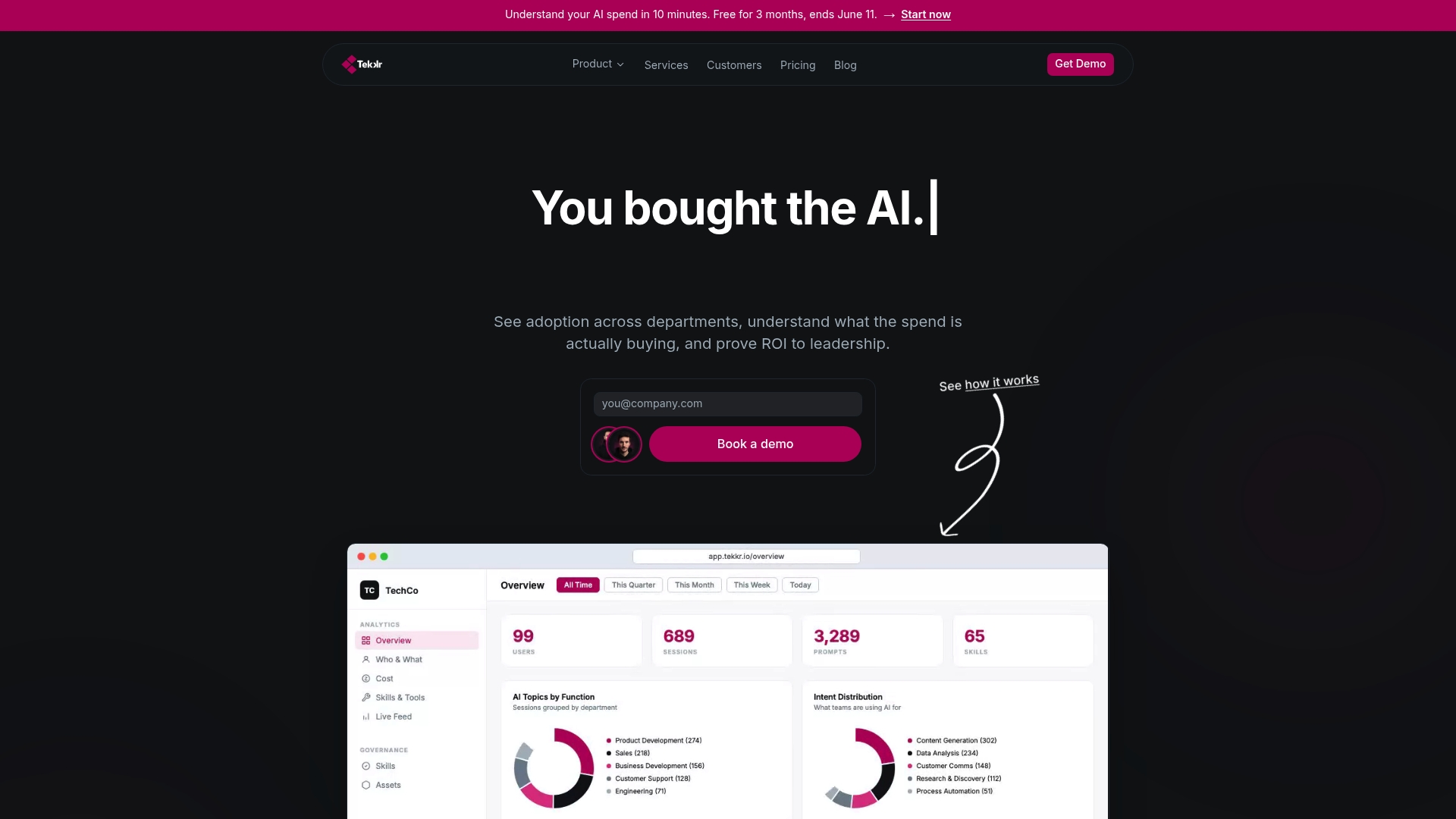
Tekkr’s flagship product, Configurato, gives you the visibility and control that most AI programs are missing. It tracks real adoption of tools like Claude and Codex by team, breaks down AI spend by department, and surfaces which use cases are actually generating value. Gamified rollouts and company-wide AI playbooks move employees from access to genuine capability. Everything runs in a privacy-first, GDPR-compliant architecture with automatic PII stripping and no browser extensions required. Setup takes about 10 minutes. Explore Tekkr’s AI adoption solutions and see what your AI investment is actually delivering.
FAQ
What is an AI transformation strategy?
An AI transformation strategy is an organization-wide plan to embed AI into core workflows, decision processes, and products to generate measurable business value. It covers technology integration, workforce enablement, and governance working together.
What is an AI maturity model?
An AI maturity model is a five-stage framework that maps an organization’s current AI capabilities against a defined progression from experimentation to becoming fully AI-native. It helps leaders diagnose their current position and prioritize the right investments.
What are the types of AI transformation roadmaps?
AI transformation roadmaps typically fall into three types: technology-first roadmaps focused on tool deployment, process-first roadmaps that redesign workflows before selecting tools, and capability-first roadmaps that build AI literacy and governance as the foundation for scaling.
Why do most AI transformation programs stall?
Most programs stall at the transition from tool adoption to internal platform development, which requires unified data infrastructure, governance frameworks, and cross-functional alignment that most organizations underestimate.
What is an AI transformation office?
An AI transformation office is a centralized function within an enterprise that owns the AI strategy, coordinates cross-functional AI initiatives, manages governance, and reports AI maturity and ROI to executive leadership and the board.