
AI spend analysis is the automated process of aggregating, classifying, and interpreting organizational expenditure data using machine learning, NLP, and predictive analytics to deliver real-time, actionable cost insights. Finance executives who still rely on monthly spreadsheet reviews are working with a rearview mirror. The industry term for this discipline is procurement spend analytics, and AI spend analysis is its most current, automated form. Average AI spending reached $2,068 per employee in 2026, a 50% increase from 2025. That jump makes knowing exactly where every AI dollar goes a financial priority, not a nice-to-have.
What is AI spend analysis and how does it work?
AI spend analysis is defined as the continuous, automated collection and classification of procurement, invoice, and expense data using AI technologies to surface spending patterns, anomalies, and forecasts in real time. Traditional spend analysis required analysts to manually export ERP data, clean it in spreadsheets, and produce reports that were outdated before they were read. AI systems process data continuously with higher accuracy and deliver actionable insights without the lag. The result is a shift from periodic financial reporting to live financial intelligence.
The core technologies behind this capability are machine learning, natural language processing, and predictive analytics. Machine learning classifies spend data into categories automatically, learning from corrections over time. NLP parses unstructured text in invoices, purchase orders, and contracts to extract vendor names, line items, and payment terms. Predictive analytics then uses historical patterns to forecast future spend and flag budget risks before they materialize.

How AI handles multi-source data
One of the hardest problems in spend analysis is fragmented data. Procurement data lives in ERP systems, accounts payable platforms, procurement cards, and supplier portals. AI-driven analytics integrate over existing transactional ERP data layers to surface insights that traditional reporting misses entirely. This integration layer is what separates a genuine AI spend analysis capability from a fancier spreadsheet.
- Machine learning classifiers assign spend categories with accuracy that improves with each data cycle.
- NLP parsers extract structured data from unstructured invoice text, reducing manual data entry.
- Anomaly detection models flag duplicate payments, price deviations, and maverick spend in real time.
- Predictive forecasting engines project future budget consumption based on current run rates and contract schedules.
- Data unification pipelines merge AP, procurement card, and purchase order data into a single spend taxonomy.
Pro Tip: Before deploying any AI spend analysis tool, map every data source your finance team touches. Systems that cannot connect to your ERP or AP platform will create new silos rather than eliminate them.
How does AI spend analysis differ from traditional methods?
Manual spend analysis is periodic, error-prone, and limited by the volume of data a human analyst can process. AI spend analysis is continuous, automated, and scales across millions of transactions without degrading accuracy. The practical difference shows up at month-end: finance teams using AI have real-time budget adherence data, while teams using manual methods are reconciling last month’s numbers.
The visibility gap is significant. Manual methods typically cover structured purchase order data. AI analysis ingests purchase orders, invoices, expense reports, procurement card transactions, and contract data simultaneously. AI spend analysis detects maverick spending, duplicate payments, and contract leakages that manual review routinely misses. Each of those categories represents recoverable cost, not just a reporting gap.
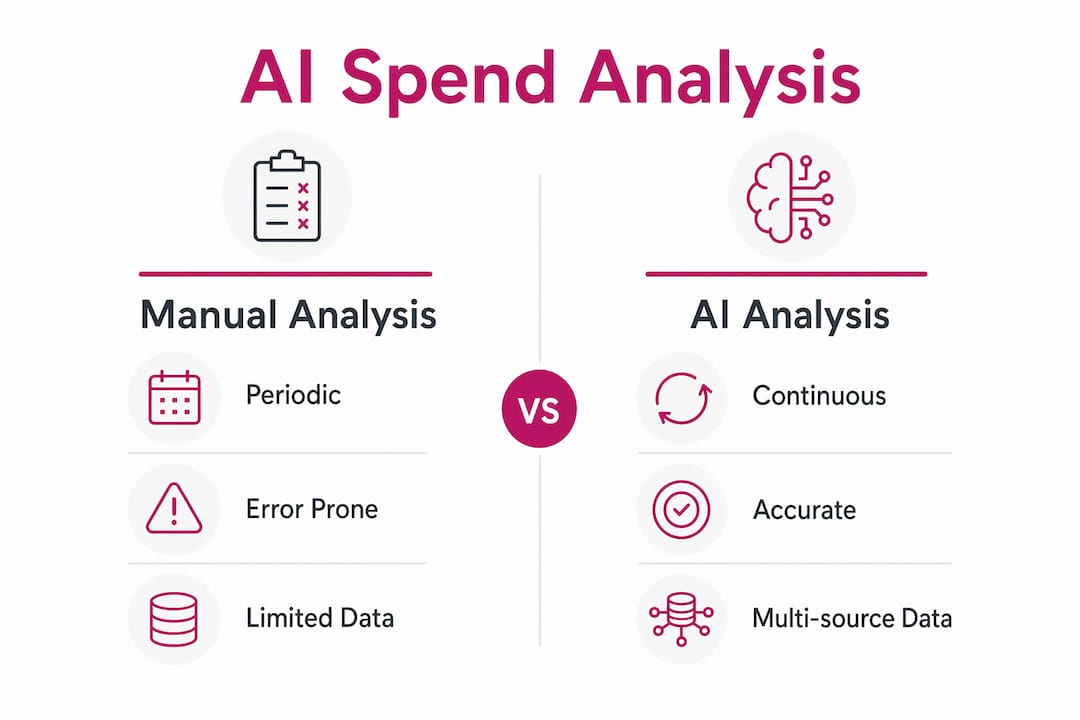
| Feature | Manual spend analysis | AI spend analysis |
|---|---|---|
| Processing frequency | Monthly or quarterly | Continuous, real-time |
| Data sources covered | Structured PO data | PO, invoice, p-card, contracts |
| Classification accuracy | Analyst-dependent | Machine learning, self-improving |
| Anomaly detection | Reactive, post-period | Proactive, in-period |
| Forecasting capability | Static budget models | Predictive, dynamic |
| Scalability | Limited by headcount | Scales with data volume |
Pro Tip: The most common mistake finance teams make when evaluating AI spend analysis is comparing it to their current reporting tool. Compare it to the decisions you could not make last quarter because the data arrived too late.
What key metrics does AI spend analysis surface for finance leaders?
AI spend analysis reveals metrics that manual reporting cannot produce at speed or scale. The most operationally useful are spend classification accuracy, AI spend per employee, the AI efficiency ratio, and real-time budget adherence rates. Each metric tells a different part of the cost story.
AI spend per employee is the total AI-related expenditure divided by headcount. The top 1% of firms spend $7,500 per employee monthly on AI tools and compute, creating a 680x gap with median firms spending $11.38 monthly. That disparity is not just about budget size. It reflects adoption maturity, use-case depth, and the degree to which AI is embedded in core workflows.
The AI efficiency ratio measures output generated per dollar of AI spend. A team spending $500 per employee monthly on AI tools but producing measurable productivity gains has a better efficiency ratio than a team spending $200 with no measurable output change. Finance leaders who track this metric can identify which departments are generating returns and which are accumulating shelfware. Tekkr’s Configurato platform tracks exactly this, breaking down costs by team and surfacing use-case intelligence so finance leaders can act on the data rather than just collect it.
Hidden costs that distort AI cost allocation
Two cost categories consistently undermine accurate AI cost allocation. First, the observability tax consumes 15–20% of total AI budget on monitoring and system management. Most budget models account for software licenses and compute but ignore the infrastructure required to keep AI systems observable and auditable. Second, shadow AI tools increase actual AI spend by 15–25% beyond what vendor invoices show. Employees adopt AI tools without formal approval, and those costs are invisible to conventional finance tracking.
Finance leaders who want accurate AI cost allocation must implement tracking that captures both categories. Agent Token Tracking (ATT) is one method for monitoring true AI utilization across approved and unapproved tools. Without it, AI cost per outcome calculations are built on incomplete data.
What steps should organizations take to implement AI spend analysis?
Successful implementation starts with data quality. Organizations must unify fragmented AP, procurement card, and procurement data before AI can generate reliable insights. Feeding a machine learning model inconsistent or incomplete data produces confident-sounding but wrong classifications. Data governance is not a prerequisite to check off. It is the foundation the entire analysis sits on.
-
Audit all spend data sources. Identify every system that holds transaction data: ERP, AP platforms, procurement cards, expense management tools, and supplier portals. Document the data format, update frequency, and owner for each source.
-
Establish a unified spend taxonomy. Define category hierarchies before connecting data sources. Inconsistent category labels across systems are the single most common cause of poor classification accuracy.
-
Integrate with existing ERP and procurement systems. AI analytics work as a decision-support layer over transactional systems, not as a replacement. Prioritize AI integration strategies that preserve existing workflows while adding analytical capability.
-
Account for hidden costs in your budget model. Build the observability tax and shadow AI buffer into your AI cost allocation model from the start. Most AI spend costs come not from software licenses but from integration, customization, and API management expenses.
-
Align procurement and finance teams on governance. AI spend analysis produces insights that require decisions. Finance and procurement must agree on escalation paths, approval thresholds, and how AI-flagged anomalies get resolved.
-
Build a continuous improvement cycle. Machine learning models drift when business conditions change. Schedule quarterly reviews of classification accuracy and anomaly detection performance to keep the model calibrated.
Pro Tip: Start your AI spend analysis rollout with one data source and one use case, such as duplicate payment detection in accounts payable. Prove the value in a contained environment before expanding to full spend visibility.
Key Takeaways
AI spend analysis delivers real-time procurement intelligence only when built on clean, unified data and governed with full visibility into hidden costs like shadow AI and the observability tax.
| Point | Details |
|---|---|
| Core definition | AI spend analysis automates spend classification, anomaly detection, and forecasting using machine learning and NLP. |
| Spend per employee gap | Average AI spend reached $2,068 per employee in 2026, with top firms spending $7,500 monthly per person. |
| Hidden cost risk | Shadow AI and the observability tax add 30–45% in untracked costs on top of visible software licenses. |
| Data quality is foundational | Unified AP, procurement card, and ERP data must precede AI deployment to avoid misleading outputs. |
| Human judgment stays central | AI flags insights and automates classification; procurement and finance expertise drives the decisions that follow. |
The part most finance leaders get wrong about AI spend analysis
The executives I see struggle most with AI spend analysis are not the ones who lack budget. They are the ones who treat it as a software purchase rather than a capability build. They buy a platform, connect it to their ERP, and expect the insights to arrive pre-packaged. They do not.
AI augments human judgment by automating routine tasks and freeing procurement professionals to focus on supplier negotiations and risk management. That framing matters. If your finance team views AI spend analysis as a reporting upgrade, they will use it to produce better-looking dashboards. If they view it as a decision-support system, they will use it to catch a duplicate payment before it clears, renegotiate a contract before it auto-renews, or reallocate budget from a low-return AI tool to a high-return one.
The hidden cost problem is also consistently underestimated. I have watched organizations build detailed AI cost allocation models that account for every software license and compute charge, then discover six months later that shadow AI tools and monitoring infrastructure added 30% to their actual spend. That is not a technology failure. It is a governance failure. The distinction between procurement operational software and AI-driven analytics is one finance leaders must internalize before they can govern AI spend effectively.
The organizations that get this right share one trait: they treat AI spend visibility as a continuous discipline, not a quarterly report. They review AI efficiency ratios by team, track cost per outcome by use case, and adjust allocations based on what the data shows. That is where the competitive advantage actually lives.
— TekkrTools
How Tekkr helps organizations build real AI spend visibility
Finance and AI strategy leaders who want to move from AI spend guesswork to measurable cost control need more than a dashboard. They need a system that tracks who is actually using AI tools, breaks down spend by team, and surfaces which use cases are generating returns.
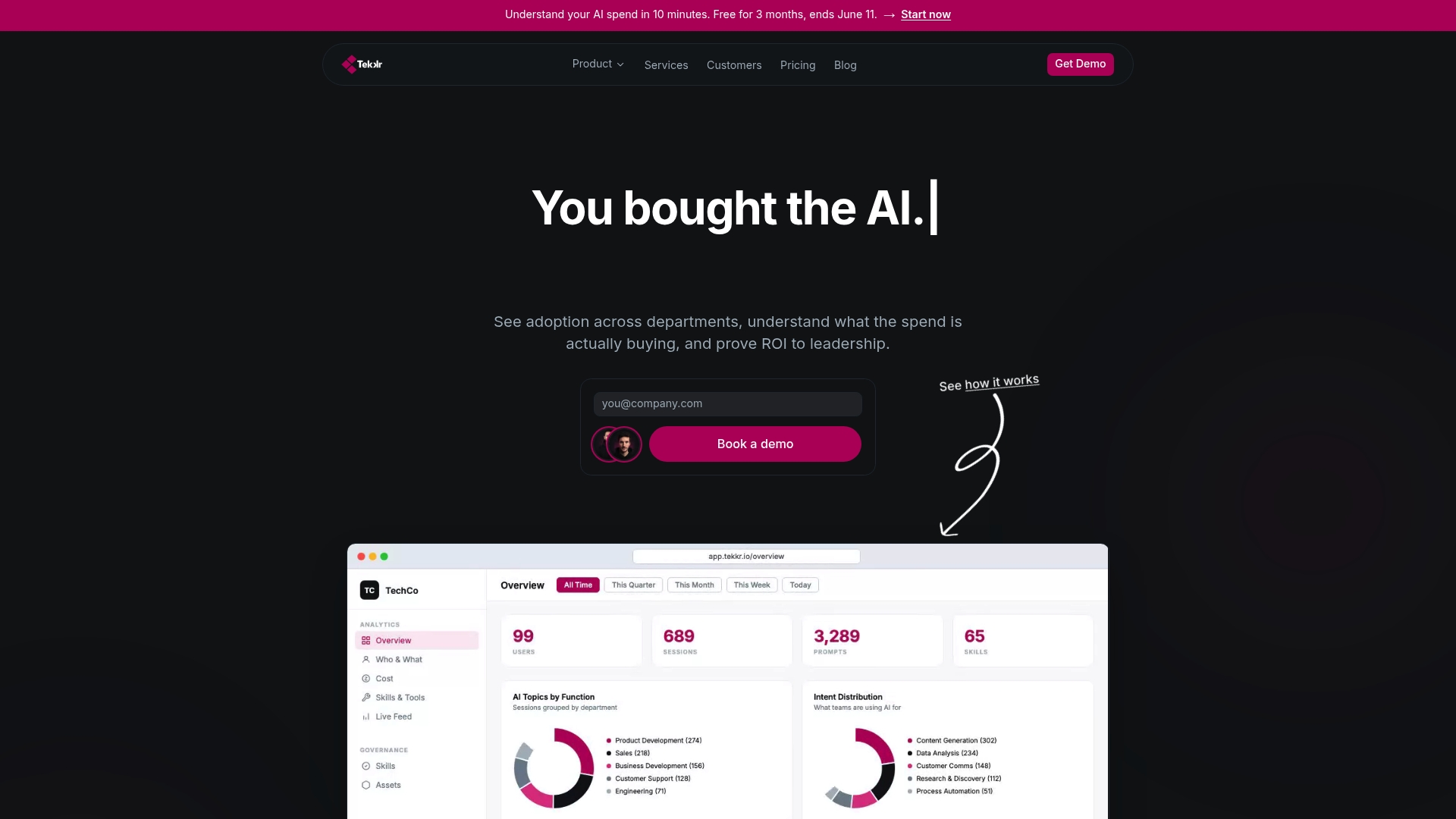
Tekkr’s Configurato platform does exactly that. It measures AI adoption, spending, and return across the organization, tracks tool usage at the team level, and enables finance leaders to build an accurate AI cost allocation model without browser extensions or complex IT setup. The platform is GDPR-compliant, end-to-end encrypted, and takes about 10 minutes to configure. A free tier is available with no credit card required. For organizations ready to turn AI investment data into decisions, Tekkr’s AI adoption and enablement solutions provide the visibility and governance layer that spend analysis requires.
FAQ
What is AI spend analysis in simple terms?
AI spend analysis is the automated process of collecting, classifying, and interpreting organizational spending data using machine learning and NLP to deliver real-time cost insights and anomaly detection.
How does AI spend per employee get calculated?
AI spend per employee divides total AI-related expenditure, including software, compute, monitoring, and shadow AI costs, by total headcount. Average spend reached $2,068 per employee in 2026.
What hidden costs should finance leaders include in AI cost allocation?
Finance leaders must account for the observability tax, which consumes 15–20% of AI budget on monitoring, and shadow AI tools, which add 15–25% in untracked spend beyond vendor invoices.
Why does data quality matter so much for AI spend analysis?
Machine learning models produce accurate classifications only when trained on clean, unified data. Fragmented or inconsistent data across AP, ERP, and procurement card systems produces misleading spend insights regardless of the AI platform used.
What is the AI efficiency ratio?
The AI efficiency ratio measures the productivity or cost output generated per dollar of AI spend. Finance leaders use it to identify which teams and use cases are generating measurable returns versus accumulating unused tool licenses.