
AI recently outperformed experienced executives in structured business strategy simulations, generating recommendations that rivaled those of seasoned decision-makers. That finding should stop every product manager in their tracks. Not because AI is coming for your job, but because it signals a genuine inflection point in what’s possible for product teams willing to use these tools thoughtfully. This guide breaks down how AI is reshaping product management in practice, where the real risks hide, and what enterprise teams must do right now to capture the upside without letting complexity spiral out of control.
Table of Contents
- How AI is transforming product management
- Evaluating AI capabilities: Beyond intuition
- Managing risk in AI-driven product management
- Best practices for integrating AI into enterprise product teams
- Why successful AI product management demands humility and systems thinking
- Ready to empower your product teams with AI—safely and at scale?
- Frequently asked questions
Key Takeaways
| Point | Details |
|---|---|
| AI augments, not replaces | Effective product teams use AI to supercharge decisions and workflows, not as a replacement for PM roles. |
| Benchmark, don’t guess | Using data-driven simulations sets realistic expectations for what AI can reliably handle in your organization. |
| Manage new risks | AI introduces unique risks such as capability drift and workflow fragmentation that require fresh risk management strategies. |
| Integrated workflows win | End-to-end integration and traceability are critical for AI to deliver sustainable time and quality benefits. |
How AI is transforming product management
With this context, let’s break down exactly how AI is already shifting product management tasks for modern teams.
The transformation isn’t abstract. AI is embedding itself in the daily mechanics of product work, from the early research phase through backlog grooming, spec drafting, and prioritization. Teams that understand this shift are pulling ahead. Teams waiting for a clear playbook are losing ground.
Task automation at scale
The tasks that used to eat half a PM’s week are the first to change. User research synthesis, competitive analysis, release note generation, and first-draft PRDs are all areas where AI tools now operate at genuine speed. A product manager who once spent six hours consolidating interview notes can get a structured synthesis in minutes. That’s not a small efficiency gain. It compounds across every sprint.
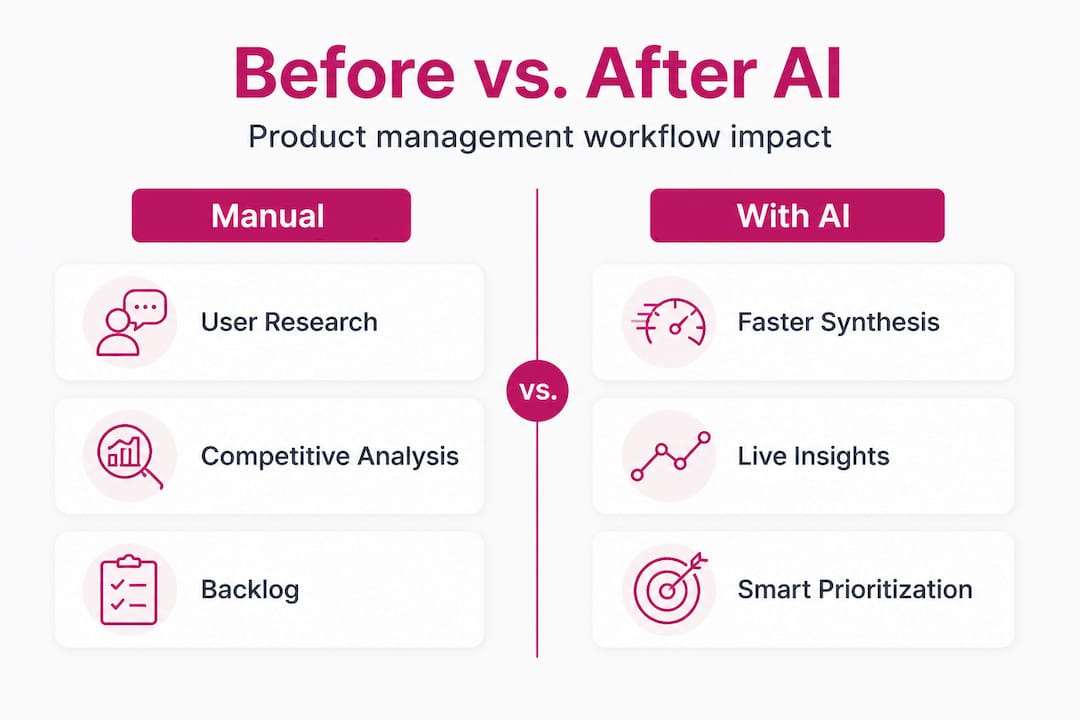
Here’s a quick snapshot of where AI is landing the most impact in product workflows:
| Task | Before AI | With AI |
|---|---|---|
| User research synthesis | 4-6 hours manually | 20-40 minutes |
| Backlog prioritization | Judgment-heavy, inconsistent | Scenario-modeled, traceable |
| Spec drafting | 2-3 hours per feature | First draft in under 30 minutes |
| Competitive analysis | Days of research | Hours with structured prompts |
| Release notes | Copy-pasted, low quality | Consistent, audience-tuned |
Data-driven decision support
Beyond automation, AI is changing how product decisions get evaluated. AI’s impact on strategic decision-making is now well documented across industries, and product management is no exception. AI can model trade-offs across multiple scenarios simultaneously, surface patterns in usage data faster than any analyst, and flag risks in a proposed roadmap that a human reviewer might overlook.
The key here is “support,” not “replacement.” AI provides the objective layer. Your PMs still provide the context, the stakeholder judgment, and the organizational nuance that no model can replicate. The combination is where real leverage lives.
- Rapid scenario modeling for roadmap trade-offs
- Pattern detection in customer feedback at volume
- Automated risk flagging in feature specifications
- Consistent quality benchmarking across team output
Pro Tip: When deploying AI in product workflows at scale, prioritize traceability from the start. Build analytics and governance for AI assistants into your setup before you scale usage. Once AI output is woven into decisions without audit trails, fixing governance retroactively becomes a major project.
“AI won’t replace product managers. But product managers who use AI well will replace those who don’t.” This isn’t a cliché warning. It’s a description of what’s already happening in competitive product organizations.
Evaluating AI capabilities: Beyond intuition
Knowing AI’s strengths, product managers need a better approach than just trusting their gut when selecting AI solutions.
Here’s the uncomfortable reality: your intuition about AI performance is almost always wrong. AI outputs are probabilistic. The same prompt can produce a sharp insight one day and a plausible-sounding mistake the next. If you’re evaluating a new AI tool based on a few impressive demos, you’re setting yourself up for a painful surprise in production.
Why intuition fails here
Human judgment relies on patterns and prior experience. AI models don’t behave like software tools with predictable outputs. They behave more like highly capable colleagues who sometimes confidently give wrong answers. You can’t evaluate that with a gut check. You need structured benchmarking.
Empirical benchmarking for LLMs in business decision simulations gives us a clearer picture: AI can perform complex strategic reasoning at impressive levels, but performance varies significantly by task type, prompt quality, and the specificity of the context provided. Without benchmarking, you’re flying blind.
Here’s a practical comparison of evaluation approaches:
| Evaluation approach | What it tells you | What it misses |
|---|---|---|
| Demo-based assessment | Best-case output quality | Failure modes and edge cases |
| Structured benchmarking | Consistent performance range | Domain-specific nuance |
| Live pilot with audit trail | Real workflow integration | Scale and governance gaps |
| AI performance assessment methods | Systematic quality baselines | Organizational context fit |
A numbered guide to evaluating AI for product workflows
- Define the specific tasks you want AI to handle. Don’t evaluate AI in the abstract. Name the exact workflow: “Draft user story acceptance criteria” or “Synthesize NPS feedback themes.”
- Create at least 10 representative test cases per workflow. Include normal examples, edge cases, and scenarios where the wrong answer looks convincing.
- Run the same prompts across multiple sessions. Measure consistency, not just peak quality.
- Involve PMs who will actually use the tool in evaluation. Their job context reveals failure modes that a lab test won’t catch.
- Establish a quality baseline before rolling out. This gives you a reference point to track regression or improvement over time.
- Build AI product analytics and governance into the evaluation process itself so findings are traceable and repeatable.
“AI will surprise you. Sometimes it will outperform your best PMs. Other times it will fail basic logic. The teams that succeed aren’t surprised by either outcome. They planned for both.”
Managing risk in AI-driven product management
Once you realize benchmarking and intuition aren’t enough, it’s crucial to proactively manage the new flavors of risk AI introduces.
Traditional product risk management focuses on scope, timeline, and technical debt. AI introduces a different category of risk, one that most enterprise product teams aren’t equipped to handle yet. If you’re treating AI risk the same way you treat software risk, you’re already behind.
Some analysts argue that AI product management requires reframing the PM role itself around explicit risk management and the constant absorption of new capability changes. That framing might feel extreme. But when you look at how AI capabilities shift from month to month, it’s hard to argue against it.
The four risk types unique to AI product management
- Model drift: The underlying model your product depends on gets updated, retrained, or deprecated. Features that worked reliably for six months suddenly behave differently. You didn’t change anything. The model did.
- Workflow fragmentation: Teams adopt AI tools in silos. One team uses ChatGPT for specs, another uses Copilot for documentation, a third uses Gemini for analysis. No shared context, no unified output standard, and no one has visibility across the whole picture.
- Output unpredictability: AI confidence and AI accuracy are not the same thing. A model can produce a well-structured, confident-sounding recommendation that’s factually wrong or contextually inappropriate. Without human review checkpoints, these errors compound.
- Capability decay: AI orchestration for product development frameworks frequently flag this: AI constraints that were useful guardrails six months ago may no longer apply to newer model versions. Teams that set configurations and walk away are exposed to unexpected behavior changes.
These risks aren’t hypothetical. They’re showing up in enterprise teams right now. The good news: all four are manageable with the right approach.
Pro Tip: Invest early in integrated workflow tooling that builds in AI governance for product teams with proper audit trails. Retrofitting governance after something goes wrong costs five times more in time and credibility than building it in from the start.
Best practices for integrating AI into enterprise product teams
Understanding risks, teams need proven playbooks to turn AI’s potential into sustainable productivity and innovation.
The gap between AI pilots that look good on paper and AI programs that actually deliver is almost always an execution gap. The principles aren’t complicated. The discipline to follow them consistently is where most enterprise teams struggle.
Workflow fragmentation in enterprise AI is one of the most cited causes of failed AI programs in mid-to-large organizations. Disconnected tooling creates errors, governance blind spots, and a loss of institutional knowledge. You can avoid all of it with a structured integration approach.
Numbered best practices for enterprise AI integration
- Map workflows end-to-end before introducing AI. Before you automate anything, document the current state clearly. What decisions get made, by whom, with what inputs, and how is quality verified? AI fits into existing workflows. It doesn’t redesign them by default.
- Break the prompt-copy loop. Generic prompting produces generic output. If your PMs are copying a prompt from a blog post and pasting it into ChatGPT, you’re not getting enterprise-grade results. Build context-rich prompting standards into every role’s workflow.
- Establish integrated audit trails from day one. Every AI-generated artifact, whether it’s a spec, a research synthesis, or a prioritization recommendation, should be traceable. Who generated it, what input was used, and how it was modified before use.
- Train PMs on AI explainability, not just AI usage. Knowing how to prompt is one skill. Understanding why an AI recommendation came out the way it did, and when to override it, is a more important one for senior product roles.
- Review and adapt on a quarterly cadence. AI capabilities change fast. Your integration standards should include a regular review cycle to catch model drift, update prompt libraries, and retire workflows that no longer deliver value.
Use AI traceability techniques to build consistent quality checkpoints into each workflow stage, not just at the output level.
Enterprise pitfalls to avoid
- Lack of clear ownership: If no one owns the AI tooling strategy for product, you’ll end up with ten different tools, no standards, and no accountability when things break.
- Poor traceability: Teams that can’t explain how an AI-generated recommendation influenced a product decision will have serious problems in regulated industries or with executive scrutiny.
- Siloed pilots: A successful AI pilot in one team rarely scales automatically. Without shared governance, the same lessons get relearned (expensively) across every team. Use AI workflow governance tools to create a consistent layer across your entire organization.
- Overbuilding on a single model: Betting your product workflows on one AI vendor’s model creates concentration risk. Capabilities change, pricing changes, and models get deprecated.
Why successful AI product management demands humility and systems thinking
With best practices in hand, we can step back and frame what sets great AI product management apart in the real world.
Here’s the uncomfortable truth that most thought leadership avoids: the teams winning with AI aren’t the ones chasing the latest model release or running the flashiest pilots. They’re the ones that built systems around continuous learning, honest evaluation, and the willingness to unlearn legacy methods when the evidence demands it.
Most AI failures in product organizations don’t come from bad tools. They come from overconfidence. A team sees a few impressive outputs, assumes AI is reliable, reduces human review, and then watches errors quietly accumulate in specifications, roadmaps, and customer communications. By the time the problem surfaces, it’s expensive to fix.
AI product management requires reframing the PM role around absorbing capability changes, because the frontier is jagged. Some tasks AI handles brilliantly today will regress with the next model update. Some tasks that seemed impossible last year are now trivial. Planning as if AI capabilities are fixed is a mistake that will cost you repeatedly.
The teams that build AI strategies for competitive advantage treat their AI integration as a living system. They measure what’s working, redirect when it isn’t, and build institutional knowledge around what great AI-assisted product work actually looks like at their company. That learning compounds over time in ways that chasing new tools simply cannot replicate.
Our direct advice: stop optimizing for AI adoption metrics. Start optimizing for AI impact metrics. Those are different numbers, and confusing them is exactly how AI investment stalls without producing competitive advantage. Build the systems. Measure the outcomes. Stay curious but stay disciplined.
Ready to empower your product teams with AI—safely and at scale?
For teams ready to put these lessons into action, here’s where to start.
The principles in this guide are clear. But applying them consistently across a large product organization is where the execution challenge lives. Best practices only become sustainable when the right governance and analytics infrastructure backs them up.
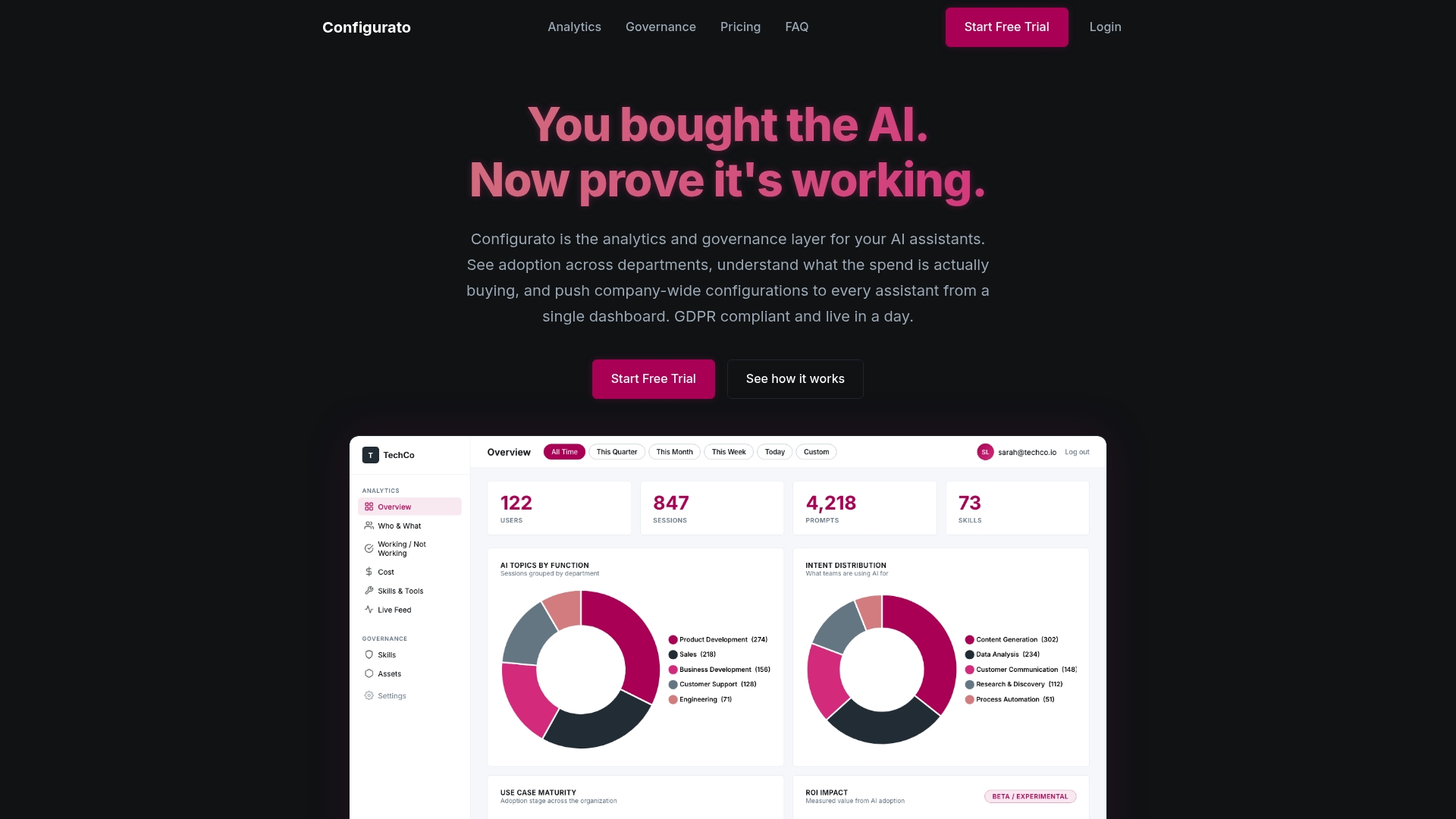
Configurato for AI governance is built exactly for this challenge. It embeds your company’s processes, quality standards, and domain knowledge directly into the AI assistants your product teams already use, with no new tools for your PMs to learn. Output is aligned to your standards from the first draft. Governance is built in, not bolted on. And benchmarking data gives you visibility into where AI is actually accelerating work across your organization, so you can redirect investment to what’s moving the needle.
Frequently asked questions
What decisions can AI make for product managers today?
AI can generate and evaluate complex strategies and recommendations in structured business settings, as shown by empirical benchmarking for LLMs in decision simulations, but human oversight remains critical for final decisions.
Why do AI projects sometimes fail to save time in product management?
Time savings disappear when integration isn’t properly planned. Workflow fragmentation in enterprise AI with disconnected tooling creates errors, governance gaps, and rework that eats up any efficiency gained.
How should product managers handle unpredictable AI behavior?
Treat AI as tools with shifting capabilities rather than fixed software. AI product management as risk management means using benchmarking, integrated workflows, and regular review cycles to stay ahead of unexpected behavior.
Is AI replacing product managers in large enterprises?
No. Empirical benchmarking confirms AI can handle complex decision-making tasks, but strategic context, stakeholder judgment, and organizational nuance still require experienced human product managers.