
AI integration strategies are coordinated plans that combine technology selection, governance frameworks, and organizational change to embed artificial intelligence into core business operations. Most executives have deployed AI tools. Few have built the conditions for those tools to deliver consistent, measurable value. The gap is not the technology. It is the absence of a structured approach that aligns AI use cases with business goals, assigns clear ownership, and embeds compliance from day one. This guide gives you the framework to close that gap.
1. Align AI use cases directly with business objectives
The first rule of effective AI integration is deceptively simple: every AI initiative must trace back to a specific business outcome. Microsoft’s Cloud Adoption Framework recommends aligning AI use cases to a governance roadmap before selecting any technology. That sequence matters. Organizations that start with a tool and work backward to a use case consistently underdeliver on ROI.
Define the outcome first. Is the goal to reduce customer support resolution time by 30%? Cut manual data entry hours in finance? Improve forecast accuracy in supply chain? Each objective demands a different AI capability, a different data set, and a different success metric. Vague mandates like “use AI to improve productivity” produce vague results.

Pro Tip: Build a one-page AI use case brief for each initiative: state the business problem, the target metric, the data required, and the owner. If you cannot complete that brief, the initiative is not ready to move forward.
2. Establish enterprise-wide AI governance before scaling
MIT Sloan Executive Education is direct on this point: effective AI strategy is enterprise-wide, coordinated with standards, policies, and operating principles. Organizations that treat AI as a collection of isolated pilots waste resources and produce inconsistent outcomes. Governance is what converts pilots into programs.
Your governance framework needs to answer four questions: Who owns AI decisions? What risks are acceptable? How are policies enforced across teams? How is performance tracked over time? Without answers to all four, you are not governing AI. You are hoping it works out.
Governance does not mean slowing down. It means building the rails that let you move faster without derailing. Companies that establish governance early scale AI deployment at a fraction of the cost of those who retrofit it later.
3. Apply the NIST AI RMF as your risk management backbone
The NIST AI Risk Management Framework prescribes four lifecycle functions: Govern, Map, Measure, and Manage. This is the most operationally grounded AI adoption framework available to executives today, and it is vendor-neutral.
Here is how each function maps to execution:
- Govern: Set your AI risk appetite, assign accountability, and publish internal AI policies.
- Map: Catalog every AI system in use, document its purpose, data inputs, and potential failure modes.
- Measure: Define quantitative and qualitative metrics for model performance, fairness, and reliability.
- Manage: Build incident response protocols, escalation paths, and continuous monitoring cadences.
“Running AI risk management continuously rather than as a one-time checklist is what separates organizations that scale AI responsibly from those that face costly incidents.” — NIST AI RMF Implementation Guide
Governance effectiveness improves significantly when organizations implement AI governance platforms mapped to these four functions. The framework reduces operational friction and improves data quality across the AI lifecycle.
4. Choose the right AI deployment model for your compliance posture
Microsoft’s guidance on AI service models identifies three deployment options, each with distinct trade-offs in control, customization, and compliance burden.
| Model | Control level | Compliance burden | Best for |
|---|---|---|---|
| SaaS | Low | Low | Fast deployment, standard use cases |
| PaaS | Medium | Medium | Custom models, moderate data control |
| IaaS | High | High | Regulated industries, full data residency |
SaaS options like Microsoft 365 Copilot or Google Workspace AI get teams productive quickly but offer limited control over data handling. PaaS platforms like Microsoft Azure AI Foundry support retrieval-augmented generation (RAG) applications and custom agent development. IaaS gives your engineering team full infrastructure control, which is necessary when data residency and audit trails are non-negotiable.
The decision is not just technical. It reflects your compliance posture. Choosing the wrong model early creates expensive architecture changes downstream. Decisions on platform choice should factor in compliance requirements before the first line of code is written.
Pro Tip: If your organization operates in a regulated industry or serves EU customers, default to PaaS or IaaS and build SaaS integrations selectively. Retrofitting data residency controls onto a SaaS-first architecture is painful and audit-prone.
5. Build data governance and pipeline infrastructure before deploying models
AI models are only as reliable as the data feeding them. Before deploying any model at scale, you need a data governance layer that covers lineage, quality, access controls, and retention policies. Tools like Microsoft Purview provide data lineage documentation and classification at enterprise scale.
Your data pipeline architecture matters too. ETL and ELT processes need to be designed with AI consumption in mind, not just reporting. That means structured storage tiers, documented schemas, and automated data quality checks. A model trained on inconsistent or undocumented data will produce output that requires heavy rework, which defeats the purpose of deploying AI in the first place.
Data governance is not a one-time setup. It requires ongoing stewardship, clear ownership by data domain, and regular audits. Organizations that treat data infrastructure as a prerequisite rather than an afterthought consistently see faster time-to-value from their AI investments.
6. Embed EU AI Act compliance into your development cycle
EU AI Act obligations for high-risk AI systems include risk management documentation, data governance records, inference logging, and human oversight mechanisms, with phase-in deadlines running through 2027. This is not a future problem. If you are building or deploying AI systems today, compliance activities need to start now.
The most costly mistake is treating compliance as a final-stage audit. Late-stage compliance retrofitting is the most difficult and audit-prone approach. Technical compliance requires embedding risk assessment into your CI/CD pipeline and automating documentation and observability from the first deployment.
Practically, this means logging every inference, maintaining model cards, and documenting training data provenance. For engineering teams, this is a workflow change. For executives, it is a governance mandate that needs to be funded and enforced from the top.
7. Solve the adoption problem before it kills your ROI
About 70% of AI projects fail to reach full production due to poor change management and organizational misalignment. That number should reframe how you think about AI deployment. The technology works. The organization is the variable.
Adoption fails for predictable reasons:
- Employees receive tools without context on how to use them for their specific work
- AI outputs require heavy rework because they ignore company processes and quality standards
- No one owns the outcome, so accountability diffuses across teams
- Metrics track deployment activity rather than business impact
The fix is embedding AI into existing workflows rather than asking people to adopt new ones. Embedding AI into workflows with clear ownership and accountability is the final mile that determines whether AI adoption delivers competitive advantage or just looks good on a dashboard.
Pro Tip: Assign a named AI outcome owner for each use case. This person is accountable for adoption metrics, output quality, and continuous improvement. Without a named owner, AI initiatives drift.
8. Match your integration approach to organizational scale and maturity
Not every organization needs the same AI integration approach. The right strategy depends on your regulatory environment, technical maturity, and available resources.
| Organization type | Recommended approach | Priority focus |
|---|---|---|
| Regulated enterprise | IaaS or PaaS with full governance stack | Compliance, data residency, audit trails |
| Growth-stage company | PaaS with modular governance | Speed to value, scalable architecture |
| Early-stage startup | SaaS with lightweight governance | Fast deployment, low overhead |
For regulated industries, the EU AI Act and sector-specific regulations make early compliance investment non-negotiable. Build your governance stack before you scale. For growth-stage companies, the priority is modular architecture that can absorb governance requirements as you grow. For startups, SaaS tools with clear data processing agreements get you moving without over-engineering.
Across all organization types, one principle holds: AI platform decisions made without considering compliance posture create expensive rework. The organizations that win are those that treat governance as a design constraint, not an afterthought.
Key takeaways
Successful AI integration requires aligning use cases with business goals, embedding governance from day one, and treating organizational adoption as the primary execution risk.
| Point | Details |
|---|---|
| Start with business outcomes | Define the target metric and owner before selecting any AI tool or platform. |
| Govern before you scale | Enterprise-wide AI governance prevents fragmented pilots and wasted investment. |
| Match deployment model to compliance needs | SaaS, PaaS, and IaaS each carry different control and regulatory trade-offs. |
| Treat adoption as the execution risk | 70% of AI projects fail due to poor change management, not technology failure. |
| Embed compliance early | EU AI Act logging and documentation requirements must be built in, not retrofitted. |
The uncomfortable truth about AI integration
Most executives I work with are not failing at AI because they chose the wrong tool. They are failing because they treated AI as a technology project rather than a cross-functional business initiative. The governance conversation gets deferred. The ownership question gets avoided. The compliance work gets pushed to “later.” And then later arrives, and the cost of fixing it is three times what it would have been to build it right the first time.
The organizations seeing real productivity gains from AI are not the ones with the most tools deployed. They are the ones that codified how they work and embedded that knowledge into every AI interaction. When a product manager at one of these companies asks an AI assistant to draft a specification, the output already reflects their product development lifecycle. No rework. No correction. Just usable output on the first pass.
The other pattern I see consistently: executives who wait for AI strategy to stabilize before committing to governance. That window has closed. The EU AI Act phase-ins are running. The NIST AI RMF is the baseline expectation for enterprise AI risk management. The companies building governance infrastructure now will have a structural advantage over those who treat it as optional.
My recommendation: pick one high-value use case, assign a named owner, build the governance wrapper around it, and measure the outcome. That single success creates the organizational proof of concept that makes the next ten initiatives easier to fund and execute.
— TekkrTools
See how Tekkr makes AI integration work in practice
If your teams are running AI tools but not seeing the productivity gains you expected, the problem is almost certainly context. Employees prompt generically, ignore company processes, and produce output that needs rework. Tekkr’s AI governance platform closes that gap by embedding your company’s processes, quality standards, and domain knowledge directly into the AI assistants your people already use.
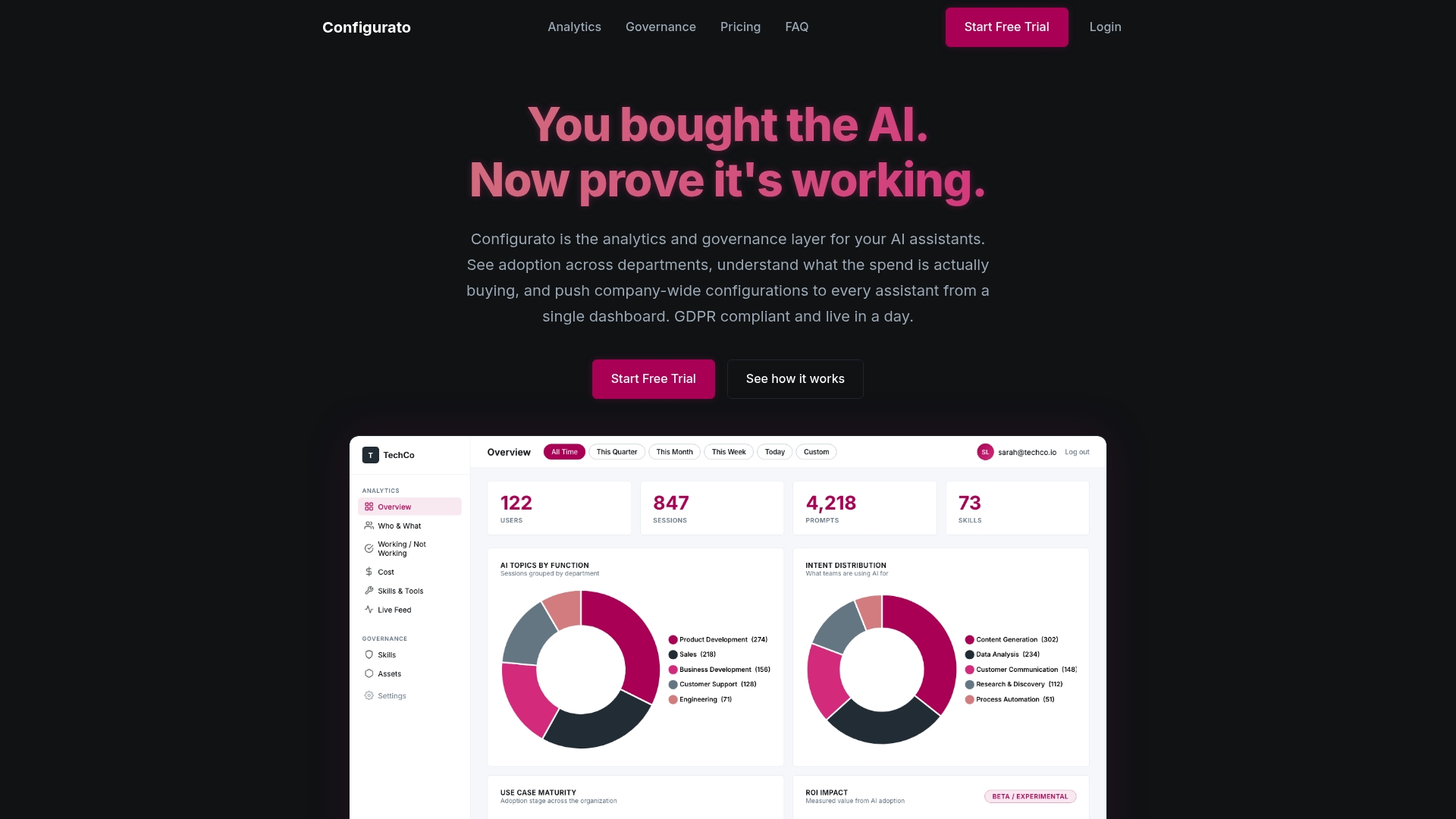
Tekkr works across Claude, GPT, Copilot, and Gemini. No new tools for your team to learn. No workflow changes. Just AI output that already reflects how your company operates. For executives who need analytics and governance across their AI deployment, Tekkr provides the traceability and benchmarking data to show where AI is actually accelerating work and where it is not.
FAQ
What are AI integration strategies?
AI integration strategies are structured plans that align AI deployment with business goals, governance requirements, and organizational change management. They cover technology selection, risk management, data infrastructure, and adoption frameworks.
Why do most AI projects fail to reach production?
About 70% of AI projects fail due to poor change management and lack of organizational alignment, not technology failure. Embedding AI into existing workflows with clear ownership is the most reliable fix.
What is the NIST AI RMF and why does it matter?
The NIST AI Risk Management Framework provides a four-function lifecycle approach: Govern, Map, Measure, and Manage. It is the most widely adopted vendor-neutral framework for operationalizing AI risk management in enterprise settings.
How does the EU AI Act affect AI integration planning?
EU AI Act obligations for high-risk systems require risk management documentation, inference logging, and human oversight, with compliance deadlines through 2027. Organizations should embed these requirements into their development cycle now, not at audit time.
How do I choose between SaaS, PaaS, and IaaS for AI deployment?
The choice depends on your compliance posture and customization needs. SaaS suits standard use cases with low compliance burden. PaaS supports custom models with moderate control. IaaS is required when full data residency and audit trail control are non-negotiable, as in regulated industries.