
AI in hiring efficiency is defined as the use of intelligent algorithms and automated tools to accelerate candidate screening, evaluation, and communication so organizations fill roles faster and with greater accuracy. A 2026 survey of 423 HR professionals found strong positive relationships between AI usage and recruitment efficiency (β = 0.61, p < 0.001). That number tells you something concrete: AI is not a marginal improvement. It is a structural shift in how talent acquisition works. Tools like resume parsing software, asynchronous video interview platforms, and NLP-driven chatbots now cover tasks that once consumed entire weeks of recruiter time.
How does AI improve hiring efficiency at each stage?
AI recruitment tools deliver the biggest gains when deployed across multiple stages of the hiring funnel, not just one. Integrating AI across sequential hiring stages, from sourcing to communication, increases throughput more than standalone classifiers. That means chaining tools together, such as a resume screener feeding into a scheduling bot, produces compounding returns.
Here is where AI in talent acquisition creates measurable impact at each stage:
- Resume screening: Natural language processing models classify resumes against job requirements in seconds. What once took a recruiter two hours per role now takes two minutes. The screening accuracy gains are statistically significant, reducing the noise of unqualified applications before a human ever opens a file.
- Initial assessments: AI-driven hiring solutions administer standardized skills tests and personality questionnaires at scale. Every candidate gets the same evaluation, which removes the inconsistency of different recruiters applying different informal filters.
- Scheduling and communication: Chatbots handle interview scheduling, status updates, and FAQ responses automatically. Candidates get faster replies. Recruiters reclaim hours per week.
- Pre-selection scoring: Predictive models rank candidates by likelihood of success before a hiring manager reviews a single profile. This compresses the shortlist from 200 applicants to 20 without manual review.
The risk of over-filtering is real. Aggressive AI screening can eliminate qualified candidates who phrase their experience differently from the model’s training data. Recruiters should audit rejection rates by demographic group monthly and adjust model thresholds when patterns emerge.
Pro Tip: Chain your AI tools deliberately. Connect your resume screener output directly into your scheduling platform so shortlisted candidates receive interview invitations automatically. That single integration typically cuts time-to-first-interview by several days.

Do ai-scored interviews actually predict job success?
Asynchronous video interviews scored by AI represent one of the most debated applications in modern recruitment. The evidence on prediction accuracy is strong. A field experiment with over 3,000 applicants showed AI exceeded human recruiters in predicting employment success. That result challenges the assumption that experienced recruiters are the gold standard for candidate evaluation.
The tradeoffs, however, are significant and deserve honest attention.
- Prediction accuracy improves. AI scoring models analyze speech patterns, word choice, and response structure consistently across every candidate. Human interviewers introduce mood, fatigue, and affinity bias into the same evaluation.
- Participation rates drop sharply. The same experiment found application continuation dropped over 50% when candidates encountered AI-assessed interviews. That attrition was especially pronounced among women.
- Perceptions of fairness matter. Candidates who perceive the process as impersonal or opaque are more likely to withdraw, even when the AI model is technically superior. Fairness perception is a real competitive factor in tight labor markets.
- Bias is not automatically eliminated. AI scoring models trained on historical hiring data can encode the same biases present in past decisions. Regular audits of model outputs by demographic group are not optional.
| Factor | Human Interviewers | AI-Scored Interviews |
|---|---|---|
| Prediction accuracy | Moderate | Higher |
| Consistency across candidates | Variable | High |
| Candidate participation rate | High | Reduced by 50%+ |
| Bias risk | Affinity and fatigue bias | Training data bias |
| Scalability | Low | High |
For AI interview evaluation to deliver value without damaging your candidate pipeline, the process design must communicate clearly why AI is used, what it measures, and how candidates can request accommodations.
Pro Tip: Always offer candidates an alternative interview format alongside AI-scored video. This preserves participation rates among candidates who opt out of automated formats and protects you from losing strong applicants who simply distrust the technology.
How do you keep AI hiring tools fair and legally compliant?
Automating recruitment with AI does not automatically make it fairer. The 2026 ADA guidance requires hiring AI tools to avoid discrimination against disabled individuals and to measure only job-relevant skills. Employers must validate that their assessments do not disadvantage qualified candidates based on disability. That validation requirement is not a checkbox. It demands documented evidence that each AI assessment targets the actual competencies the job requires.
The bias picture is more complicated than most vendors admit. Research shows AI’s bias mitigation effect is modest (β = 0.21), and its impact on candidate trust is not statistically significant (β = 0.08). Those numbers mean AI alone does not solve fairness problems. Human governance structures do.
Practical compliance steps every hiring team should implement:
- Validate every AI assessment against the specific skills and behaviors the role requires. Remove any test component that measures a proxy for a protected characteristic.
- Document accommodation procedures for candidates with disabilities before you launch any AI-driven assessment. ADA compliance requires that accommodations are available and communicated proactively.
- Audit model outputs quarterly by demographic group. Look for statistically significant differences in pass rates, scores, or rejection rates across gender, race, and disability status.
- Maintain human review checkpoints at every stage where an AI decision could eliminate a candidate from the process. A human should be able to override any automated rejection.
For a deeper look at AI transparency challenges in hiring contexts, the governance frameworks being adopted in 2026 offer practical models for structuring oversight.
What does effective AI integration look like in practice?
IBM advises that AI should support human judgment and reduce noise and bottlenecks in hiring, not replace the human decision layer entirely. That framing matters. The organizations seeing the best results from AI in talent acquisition treat it as a filter and a signal generator, not a decision maker.
The comparison below shows how AI-assisted workflows differ from traditional processes across key recruiting activities.
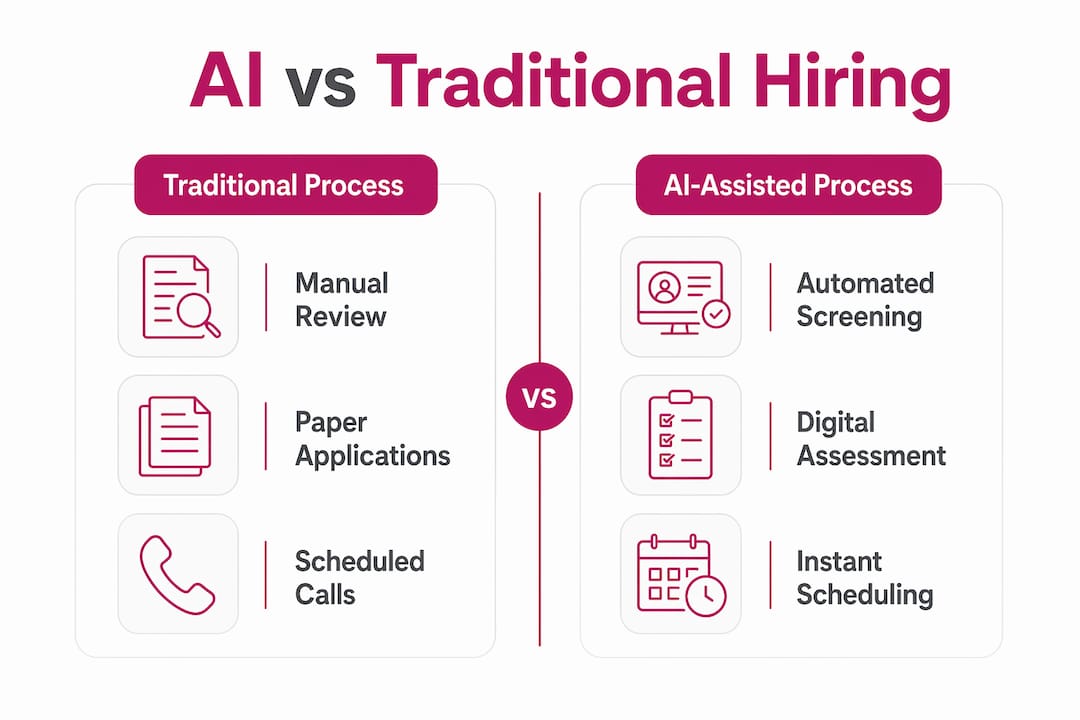
| Recruiting Activity | Traditional Process | AI-Assisted Process |
|---|---|---|
| Resume review | Manual, 2–4 hours per role | Automated, minutes per role |
| Interview scheduling | Back-and-forth email chains | Chatbot handles end-to-end |
| Candidate communication | Recruiter-drafted updates | Automated status messages |
| Shortlist creation | Recruiter judgment | Predictive scoring model |
| Outcome measurement | Time-to-hire only | Time-to-hire plus candidate experience KPIs |
The last row in that table is where most teams fall short. Measuring only operational metrics like time-to-hire gives an incomplete picture. Tracking candidate perceptions and fairness KPIs is critical to maintaining funnel quality. A process that fills roles 30% faster but drives away 50% of qualified applicants is not a net win.
Scalable AI adoption in recruitment follows a clear sequence. Start with resume screening and scheduling automation, where the efficiency gains are immediate and the risk of candidate harm is low. Add predictive scoring and AI interview tools only after you have established baseline fairness metrics and built human review checkpoints into the workflow. Measure recruiter productivity and candidate experience simultaneously from day one.
The top AI use cases that generate real enterprise value share one characteristic: they are deployed as complements to structured human evaluation, not as replacements for it.
Key takeaways
AI improves hiring efficiency most when deployed across multiple recruitment stages with human oversight, fairness audits, and candidate experience metrics running in parallel.
| Point | Details |
|---|---|
| Multi-stage AI deployment | Chaining AI tools across sourcing, screening, and scheduling compounds efficiency gains beyond single-task tools. |
| Screening accuracy gains | AI usage shows a strong positive relationship with screening accuracy (β = 0.61), reducing recruiter workload significantly. |
| Interview AI tradeoffs | AI-scored interviews predict success better than humans but cut application continuation by over 50%. |
| Bias requires governance | AI’s bias mitigation effect is modest (β = 0.21); human oversight structures are required to achieve real fairness. |
| Measure candidate experience | Tracking fairness and participation KPIs alongside time-to-hire prevents funnel quality degradation. |
The uncomfortable truth about AI hiring tools in 2026
Most organizations deploying AI in recruitment are measuring the wrong things. They track time-to-hire, cost-per-hire, and recruiter throughput. Those numbers improve. Leadership sees the dashboard and declares success. What they are not seeing is the 50% drop in qualified candidate participation that the asynchronous interview platform quietly introduced, or the demographic skew in rejection rates that the resume screener has been generating for six months.
The efficiency gains from AI in talent acquisition are real and well-documented. The risks are equally real and far less discussed. What I have observed consistently is that the teams who get this right treat fairness audits as a product requirement, not a compliance afterthought. They build candidate experience measurement into their recruiting stack from day one. They also resist the pressure to automate every touchpoint. Some moments in the hiring process, particularly final-round conversations and offer negotiations, require human presence to maintain candidate trust and close strong hires.
The limitations of AI assistants in business contexts apply directly to recruitment. AI tools are excellent at pattern matching and scale. They are poor at reading context, handling edge cases, and building the kind of relationship that convinces a top candidate to choose your organization over a competitor. Use AI to clear the path. Use humans to close the deal.
— TekkrTools
Prove your AI hiring investment is actually working
Most HR teams know AI is changing recruitment. Fewer can show exactly which tools are driving results, which teams are using them well, and where adoption has stalled.
Tekkr’s AI adoption platform, Configurato, gives you visibility into how AI recruitment tools are being used across your organization, which use cases are generating real efficiency gains, and where spend is going without measurable return. It tracks adoption by team, surfaces use-case intelligence, and enables employees through structured AI playbooks. Setup takes about 10 minutes, with a free tier and no credit card required. If you have bought the AI, Tekkr helps you prove it is working.
FAQ
What is the role of AI in hiring efficiency?
AI in hiring efficiency refers to using algorithms and automated tools to handle resume screening, candidate assessment, scheduling, and communication. This reduces time-to-hire and improves screening accuracy, with research showing a strong positive relationship (β = 0.61) between AI usage and recruitment efficiency.
Do ai-scored interviews outperform human interviewers?
Yes, in prediction accuracy. A field experiment with over 3,000 applicants found AI exceeded human recruiters in predicting employment success. The tradeoff is a significant drop in candidate participation rates, particularly among women.
How does the ADA apply to AI hiring tools?
The 2026 ADA guidance requires that AI hiring assessments measure only job-relevant skills and do not disadvantage qualified candidates with disabilities. Employers must validate their tools and provide accommodations proactively.
Does AI eliminate bias in recruitment?
AI reduces some forms of bias but does not eliminate it. Research shows AI’s bias mitigation effect is modest (β = 0.21), and trust improvements are not statistically significant without explicit human governance structures in place.
Which AI recruitment tools deliver the most efficiency gains?
Multi-stage AI deployment, chaining resume screeners, scheduling bots, and predictive scoring models, generates greater efficiency than any single tool. The systematic review evidence shows sequential AI integration across the full hiring funnel drives the largest throughput improvements.