
AI governance in 2026 is defined by one urgent shift: organizations must now govern autonomous, agentic AI systems that make sequential decisions without human approval at every step. The EU AI Act, US federal AI executive orders, and enterprise adoption of tools like Claude, Copilot, and Gemini have collectively forced governance from a compliance checkbox into an operational discipline. Yet the gap between AI deployment speed and governance maturity is widening fast. Understanding the ai governance trends 2026 brings to the surface, and acting on them now, is the difference between competitive advantage and regulatory liability.
What are the core AI governance trends in 2026?
AI governance, formally defined as the set of policies, processes, and accountability structures that control how AI systems are developed, deployed, and monitored, has entered a new phase in 2026. The defining characteristic of this phase is the rise of agentic AI: systems that plan, delegate, and execute multi-step tasks autonomously. Traditional governance models were built for predictable, single-output AI. Agentic systems break that assumption entirely.
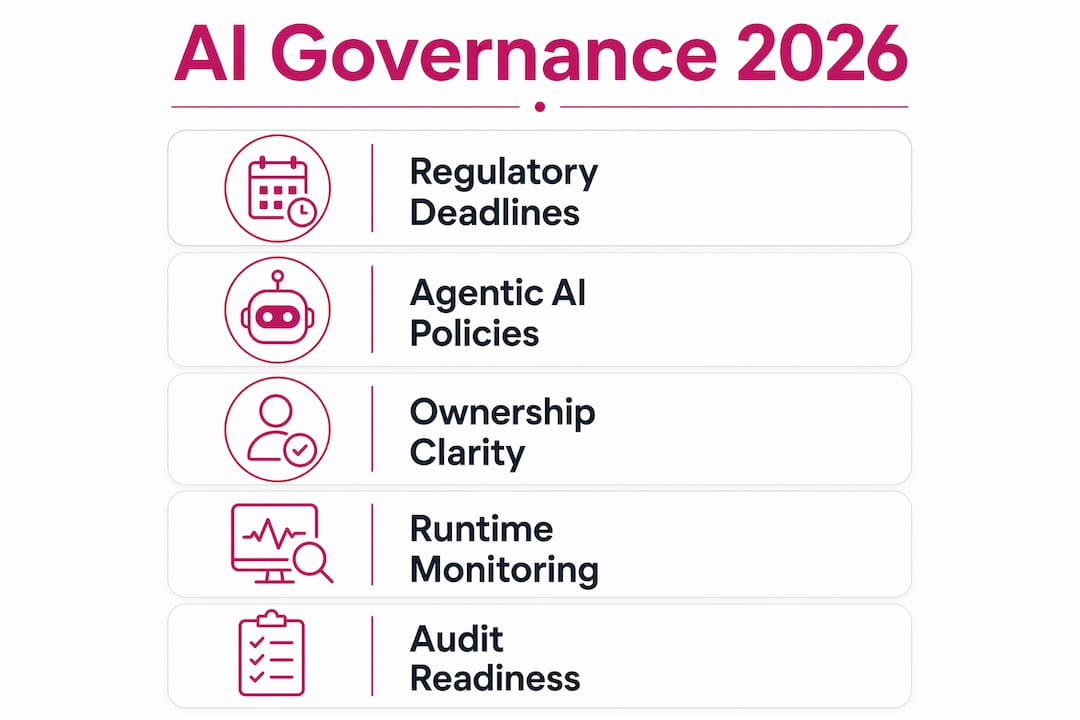
Three forces are reshaping the governance agenda this year. First, regulatory deadlines are no longer theoretical. The EU AI Act and US cybersecurity executive orders have set concrete timelines that organizations must meet. Second, agentic AI adoption is projected to reach 40% of enterprise applications in 2026, yet only 7% of organizations have agentic-specific governance policies in place. That gap is a live operational risk. Third, explainability has moved from a best practice to a legal requirement in sectors including credit scoring, HR, and healthcare.

The future of AI governance is not about slowing AI down. It is about building the oversight infrastructure that lets AI move fast without creating unmanageable risk. Organizations that treat governance as an afterthought will face audit failures, regulatory fines, and the harder-to-quantify cost of AI outputs that nobody can explain or defend.
Why do agentic AI systems require new governance approaches?
Agentic AI is defined as AI that autonomously plans and executes sequences of actions, often delegating subtasks to other AI agents, to achieve a goal. This is categorically different from a model that classifies an image or generates a single text response. The governance challenge is not just scale. It is the emergent behavior that arises when multiple agents interact.
Consider a procurement workflow where an AI agent identifies a vendor, negotiates terms via email, and initiates a purchase order, all without a human approving each step. If something goes wrong, who owns the decision? Which agent made the call that triggered the failure? Applying static IT governance frameworks to this scenario creates governance gaps that produce both operational failures and regulatory liabilities. The old model of point-in-time validation, a quarterly audit or a pre-deployment review, does not catch problems that emerge mid-workflow.
Effective agentic governance requires four things that traditional IT governance does not provide:
- Explicit ownership assignment for every agent in a workflow, not just the system as a whole
- Continuous runtime monitoring rather than periodic validation
- Logged delegation chains so every decision can be traced back to its origin
- Explainability mechanisms that work at the agent level, not just the model level
Pro Tip: When deploying a multi-agent workflow, map the delegation chain before go-live. Document which agent has authority to take which action, and build logging into the architecture from day one. Retrofitting traceability after deployment is significantly harder and more expensive.
The biggest agentic governance pitfall is ambiguous ownership in multi-agent workflows. Successful teams map and log delegation chains explicitly to maintain accountability. This is not a technical nicety. It is the foundation of any defensible governance posture.
How have 2026 regulatory developments shaped AI governance requirements?
The regulatory environment for AI in 2026 has moved from guidance to enforcement. Two developments stand out as the most consequential for enterprise governance teams.
The EU AI Act has been updated with provisional amendments. High-risk AI enforcement has been postponed to December 2, 2027, giving organizations more runway on the highest-stakes compliance requirements. However, watermarking obligations for AI-generated content are now scheduled for December 2, 2026. That deadline is immediate. Organizations deploying generative AI in customer-facing contexts need watermarking infrastructure in place now, not next year.
In the United States, a cybersecurity-focused AI executive order has set aggressive timelines. Federal agencies must secure critical networks within 30 days and establish benchmarking processes for frontier AI models within 60 days of the order. This signals a broader shift: AI governance is now a national security concern, not just a corporate risk management issue. Private sector organizations working with federal agencies or critical infrastructure will feel this pressure directly.
| Regulatory requirement | Deadline | Who it affects |
|---|---|---|
| EU AI Act: watermarking obligations | December 2, 2026 | Organizations deploying generative AI in the EU |
| EU AI Act: high-risk AI enforcement | December 2, 2027 | High-risk AI system operators in the EU |
| US: federal network security under AI executive order | 30 days from order | Federal agencies and critical infrastructure partners |
| US: frontier AI model benchmarking | 60 days from order | Federal agencies and frontier model developers |
Beyond these headline deadlines, the 2026 AI regulation developments share a common theme: regulators now expect technical evidence, not policy documents. Model cards, data lineage documentation, and audit trails are becoming the currency of compliance. Shadow AI, meaning AI tools deployed by employees outside official IT channels, is a growing liability because it produces outputs with no governance trail at all. Centralized AI model catalogs with versioning, risk documentation, and governance processes are now a baseline expectation for regulatory audits.
The practical implication is clear: if you cannot produce a model card and a data lineage record for an AI system under audit, you are exposed. Governance documentation is no longer a back-office function. It is a front-line defense.
What gaps exist in current AI governance practices?
The governance gap in 2026 is stark. Only 7% of organizations have agentic-specific AI governance policies, even as agentic AI is projected to power 40% of enterprise applications this year. That means the vast majority of organizations are governing their most autonomous AI systems with frameworks designed for something far simpler. The building is not burning yet, but the smoke is visible.
The most common weaknesses fall into three categories:
| Governance weakness | What it looks like in practice | How to close it |
|---|---|---|
| Unclear ownership | No named accountable party for agent decisions | Assign explicit ownership per agent and workflow |
| Missing explainability | Outputs cannot be traced or justified post-hoc | Embed SHAP, LIME, or counterfactual methods architecturally |
| Insufficient audit mechanisms | No logs of agent actions or delegation chains | Build logging into agent infrastructure from deployment |
Ownership ambiguity is the most dangerous gap. When an agentic system makes a decision that triggers a compliance event, the question “who is responsible?” must have a named answer. Many organizations have assigned ownership at the system level but not at the agent or workflow level. That distinction matters enormously when a regulator asks for accountability.
Explainability is the second major gap. Explainability is now a mandatory operational requirement in sectors like credit scoring, HR, and healthcare. It is not enough to say a model is accurate. You must be able to show why it made a specific decision in a specific case. Organizations that have not embedded explainability methods into their AI lifecycle are one audit away from a serious problem.
Pro Tip: Do not treat explainability as a reporting feature you add at the end. Architect it in from the start by selecting models and frameworks that support interpretability natively, and log the reasoning chain at every agent handoff.
Runtime oversight is the third gap. Leaders are challenged by the need to shift governance from point-in-time validation to continuous monitoring of live AI behavior. A model that passed validation six months ago may have drifted significantly since then. Governance frameworks that rely on periodic reviews will miss this drift entirely.
Which technologies and frameworks support effective AI governance in 2026?
The tools available for AI governance have matured significantly. Organizations building governance infrastructure in 2026 have a concrete toolkit to work with, though selecting and integrating the right components requires deliberate architecture decisions.
For explainability, the leading methods are SHAP (SHapley Additive exPlanations), LIME (Local Interpretable Model-agnostic Explanations), and counterfactual explanation techniques. SHAP quantifies the contribution of each input feature to a model’s output. LIME approximates model behavior locally around a specific prediction. Counterfactual methods answer the question: “What would need to change for this decision to be different?” Each method serves a different governance use case. SHAP works well for feature-level audit trails. Counterfactuals are more useful for explaining individual decisions to affected parties, which is exactly what regulators in credit and HR contexts require.
For continuous quality assurance, monitoring model drift, data drift, and performance degradation is now a baseline operational requirement. Model drift occurs when a model’s statistical properties shift over time. Data drift occurs when the input distribution changes. Performance degradation is the downstream result of either. Organizations that monitor only accuracy metrics will miss drift until it becomes a failure. Effective monitoring requires tracking input distributions, output distributions, and model confidence scores in parallel.
For audit readiness, the combination of model cards and centralized AI catalogs provides the documentation layer regulators expect. A model card captures the model’s intended use, training data, performance benchmarks, and known limitations. A centralized catalog with versioning ensures that the model under audit is the model that was actually deployed, not a prior version. These are not bureaucratic exercises. They are the evidence base for demonstrating compliance.
For agentic-specific governance, emerging platforms are beginning to address the logging and traceability requirements that traditional MLOps tools were not designed for. The key capability to look for is delegation chain logging: the ability to record which agent took which action, in what sequence, and on whose authority. Without this, multi-agent workflows are a governance black box. You can also explore what industry leaders are saying about the practical realities of implementing these frameworks at scale.
Key takeaways
Effective AI governance in 2026 requires agentic-specific policies, continuous runtime monitoring, and regulatory documentation that most organizations have not yet built.
| Point | Details |
|---|---|
| Agentic governance gap | Only 7% of organizations have agentic-specific policies despite 40% enterprise adoption projections. |
| Regulatory deadlines are live | EU watermarking obligations land December 2, 2026; US federal benchmarking timelines are already active. |
| Ownership must be explicit | Assign accountability at the agent and workflow level, not just the system level. |
| Explainability is operational | SHAP, LIME, and counterfactual methods must be embedded architecturally, not added as reporting features. |
| Runtime monitoring is non-negotiable | Point-in-time validation misses model drift and emergent agent behavior; continuous monitoring is the new baseline. |
The governance gap nobody wants to admit is structural
The honest assessment, after working with organizations across industries on AI adoption, is that most governance programs are theater. There is a policy document. There is a committee. There is a quarterly review. And then there is the actual AI running in production, making decisions nobody fully understands, with ownership that dissolves the moment something goes wrong.
The agentic AI wave has made this structural problem impossible to ignore. When a single AI agent takes one action, you can audit it. When five agents collaborate on a workflow and something fails at step four, the question of accountability becomes genuinely hard. Most organizations are not ready for that conversation, and regulators are starting to ask it.
What I have found is that the organizations doing this well share one trait: they treat governance as an engineering problem, not a compliance problem. They build logging, traceability, and explainability into the system architecture before deployment. They assign ownership at the workflow level, not the department level. And they monitor continuously, because they know that a model that worked in January may not work the same way in July.
The tension between AI growth and governance is real, but it is not a reason to slow down. It is a reason to build better. The organizations that will win with AI in 2026 are not the ones with the most tools deployed. They are the ones that can prove, at any moment, that their AI is doing what it is supposed to do, for the right reasons, with a named human accountable for the outcome.
— TekkrTools
How Tekkr helps you close the governance gap
Governance without visibility is just paperwork. Tekkr’s Configurato platform gives you the operational layer that turns governance intent into governance reality. Configurato tracks agentic AI adoption across your organization, surfaces where governance policies are actually being followed, and provides the audit trails and model inventory that regulators now expect. When your AI assistants, whether Claude, Copilot, Gemini, or GPT, execute tasks, Configurato logs the context, the configuration, and the output. You get continuous runtime visibility without changing how your teams work.
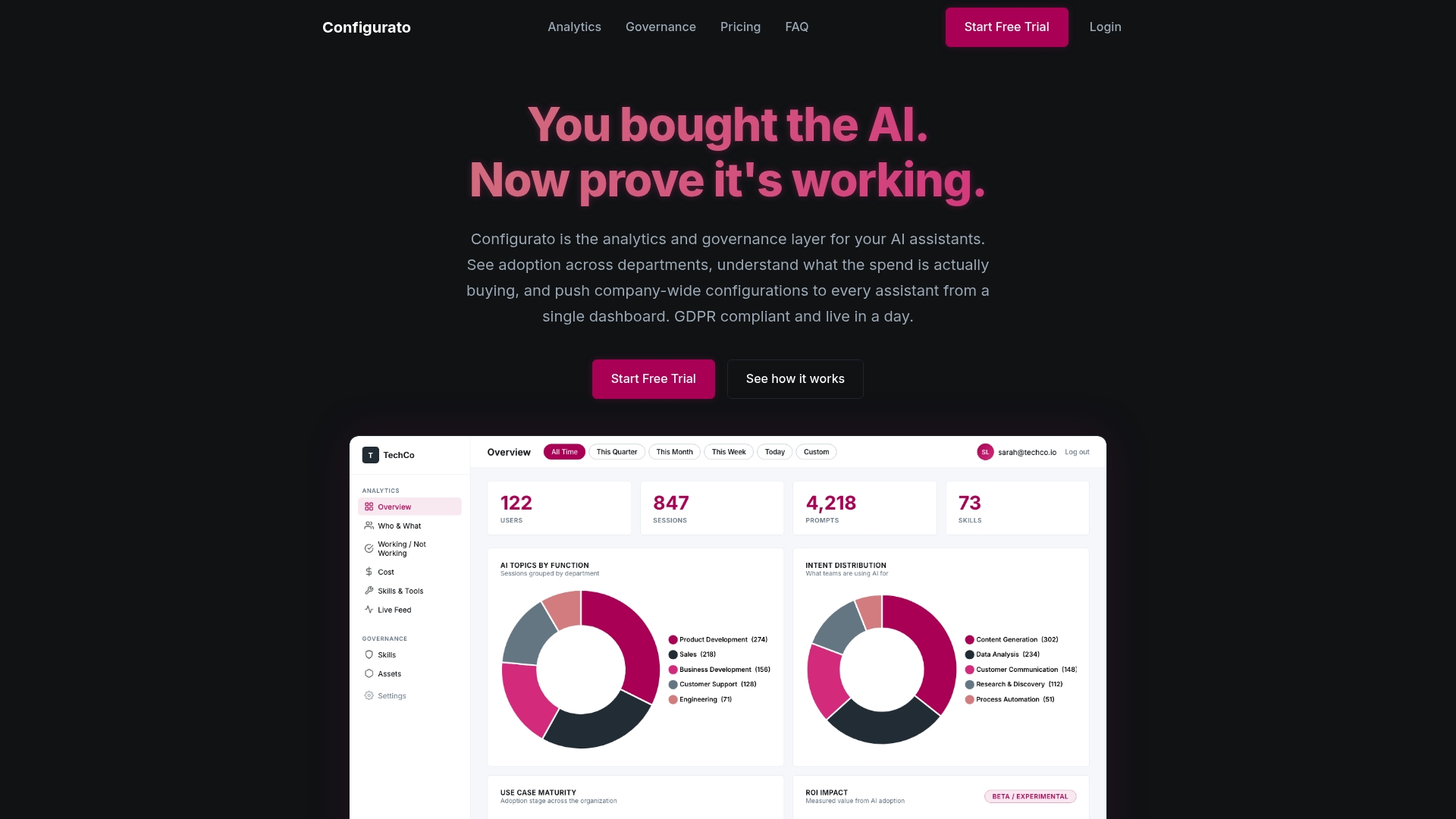
For business leaders who need to demonstrate compliance readiness and for technology strategists who need to know where AI is actually delivering value, Configurato provides the benchmarking and traceability infrastructure that makes both possible. The governance gap is real. Closing it starts with knowing where you stand.
FAQ
What is agentic AI governance?
Agentic AI governance is the set of policies, ownership structures, and monitoring practices specifically designed for AI systems that autonomously plan and execute multi-step tasks. It differs from traditional AI governance by requiring continuous runtime oversight and explicit delegation chain logging.
When does the EU AI Act enforcement begin?
High-risk AI system enforcement under the EU AI Act is scheduled for December 2, 2027. Watermarking obligations for AI-generated content take effect earlier, on December 2, 2026.
Why do only 7% of organizations have agentic governance policies?
Most organizations built their AI governance frameworks before agentic AI became mainstream, so existing policies address single-output models rather than autonomous multi-agent workflows. The speed of agentic adoption has outpaced policy development across nearly every industry.
What does explainability mean in practice for regulated industries?
In credit scoring, HR, and healthcare, explainability means the organization must produce a decision-level justification for any AI output that affects an individual. Tools like SHAP and LIME generate the feature-level evidence that satisfies this requirement in audit and regulatory contexts.
How does shadow AI create governance risk in 2026?
Shadow AI refers to AI tools deployed by employees outside official IT and governance channels. Because these deployments have no model cards, no audit trails, and no ownership assignment, they create compliance exposure that is invisible to governance teams until a regulatory event forces it into the open.