
Most leaders assume AI governance is synonymous with legal review and risk checklists. That assumption is costing them. The organizations seeing the biggest productivity gains from AI aren’t the ones with the loosest guardrails. They’re the ones with the most intentional governance structures, built not to slow AI down but to make it work better, faster, and in alignment with how the business actually operates. This article breaks down what AI governance really means, which frameworks matter, how to implement them without killing velocity, and what’s coming next in the regulatory landscape.
Table of Contents
- What is AI governance?
- Core frameworks and methodologies for AI governance
- Enterprise strategies for implementing AI governance
- Addressing edge cases and challenges in AI governance
- Global perspectives: Regulation, standards, and the future of AI governance
- Our take: Governance is an innovation enabler, not a bottleneck
- Accelerate your AI adoption journey with effective governance
- Frequently asked questions
Key Takeaways
| Point | Details |
|---|---|
| Holistic definition | AI governance covers policies, processes, and oversight to ensure safe, ethical, and effective AI adoption. |
| Adopt proven frameworks | Frameworks like NIST AI RMF and OECD Principles help organizations implement structured, risk-based governance. |
| Operational integration | Effective governance is embedded throughout the AI lifecycle by aligning teams, standards, and controls. |
| Address advanced challenges | Proactively governing agentic AI, shadow AI, and dynamic data reduces emerging risks. |
| See governance as an enabler | Structured governance accelerates AI innovation and productivity—not just compliance. |
What is AI governance?
Let’s clear up the most common misconception first. AI governance is not a compliance department’s job alone. It’s not a legal checkbox you tick before deployment. And it’s definitely not a barrier between your teams and the tools they want to use.
AI governance refers to the structures, processes, policies, standards, and oversight mechanisms that guide the responsible development, deployment, and use of AI systems to ensure they are ethical, safe, compliant, and aligned with organizational and societal values. That’s a precise definition, and every word matters.
Notice that it starts with structures, not rules. Governance is about building the conditions under which AI can operate reliably, not writing policies that exist in a document no one reads.
“Governance that lives only in a policy document isn’t governance at all. It’s risk theater.”
For CTOs and operational leaders, the practical components of AI governance typically include:
- Risk management: Identifying, assessing, and mitigating risks at each stage of AI deployment
- Transparency: Ensuring stakeholders understand how and why AI systems make decisions
- Accountability: Defining clear ownership for AI outputs and their consequences
- Fairness: Auditing models and data pipelines for bias that could lead to discriminatory outcomes
- Human oversight: Building checkpoints where humans review, correct, or override AI decisions
- Compliance: Aligning with applicable laws, industry standards, and internal policies
The companies that thrive with AI treat these components as operational infrastructure, not overhead. If you invest in AI analytics and governance tools early, you spend less time firefighting later.
Core frameworks and methodologies for AI governance
With the fundamentals established, it’s crucial to explore the frameworks and standards shaping AI governance. You don’t need to invent governance from scratch. Several battle-tested frameworks already exist, and your job is to understand them well enough to select or blend the right pieces.
The NIST AI RMF’s Govern, Map, Measure, Manage functions provide a risk-based approach that’s highly adaptable to enterprise contexts. It emphasizes continuous iteration rather than one-time compliance. The OECD AI Principles focus on inclusive growth, human-centered values, and accountability at a broader societal level. The EU AI Act takes a tiered risk classification approach, from prohibited AI applications down to minimal-risk tools, with obligations scaled accordingly.
Here’s a side-by-side comparison of the three major frameworks:
| Framework | Primary focus | Strengths | Limitations |
|---|---|---|---|
| NIST AI RMF | Risk lifecycle management | Flexible, industry-adaptable, iterative | Not legally binding; requires internal customization |
| OECD AI Principles | Ethics and societal values | Internationally recognized, broad in scope | Abstract; hard to operationalize directly |
| EU AI Act | Regulatory compliance | Legally enforceable, clear risk tiers | Geographic scope; prescriptive; compliance burden |
The AGILE Index 2025 evaluates 40 countries on four pillars, 17 dimensions, and 43 indicators, giving you a useful empirical lens on where governance maturity actually stands globally. Many organizations combine tiered risk governance from the EU AI Act’s structure with NIST’s operational rigor to avoid governance bottlenecks.
Here’s how to select the right framework blend for your organization:
- Assess your regulatory exposure: If you operate in or sell into the EU, the EU AI Act is non-negotiable. Start there.
- Map your AI risk profile: Use NIST AI RMF’s Map function to catalog where your AI systems touch sensitive decisions.
- Define your ethical commitments: Pull from OECD principles to articulate values that go beyond legal minimums.
- Build your internal governance layer: Translate framework elements into your own control matrix, tailored to your tech stack and team structure.
- Schedule quarterly reviews: Frameworks evolve. Your implementation should too. Explore dynamic AI oversight strategies to keep your approach current.
Pro Tip: Don’t try to implement all three frameworks simultaneously from day one. Start with NIST AI RMF as your operational backbone, then layer in EU requirements and OECD principles where they’re most relevant to your specific AI use cases. Assign a framework owner in each function to prevent governance becoming a siloed compliance task.
Enterprise strategies for implementing AI governance
Understanding the frameworks is only the first step. Here’s how leading organizations translate them into daily practice.
Enterprise governance requires integrating AI oversight into the full lifecycle with clear principles around transparency, accountability, fairness, and human oversight. This means governance is not a post-deployment review. It starts at ideation and runs through decommissioning.

Here’s what that looks like across the AI lifecycle:
| Lifecycle stage | Key governance controls | Who owns it |
|---|---|---|
| Ideation and scoping | Risk classification, use case approval | CTO, Legal |
| Data sourcing | Bias audits, provenance tracking, consent verification | Data Engineering, Privacy |
| Model development | Version control, testing standards, explainability docs | ML Engineering |
| Deployment | Access controls, monitoring setup, rollback procedures | Platform/DevOps |
| Monitoring and iteration | Drift detection, performance audits, incident response | Operations, AI team |
Adopting unified data control, role-based access, and adaptive risk tiers addresses the reality that 95% of organizations report governance challenges in AI deployment. That’s not a small number. It means governance failure is the default, not the exception. You need a structured playbook to be in the minority that gets it right.
Practical steps for establishing governance that actually sticks:
- Form a cross-functional AI governance committee: Include voices from legal, product, engineering, data, and operations. Governance that lives only in one function dies in the hallway conversation that excludes it.
- Build a control matrix: Map each AI system to its risk tier, required controls, and review cadence. Make it a living document, not a one-time deliverable.
- Integrate governance checkpoints into sprints: If your engineering team runs two-week sprints, governance reviews should happen within those sprints, not as a separate gate that slows releases.
- Implement continuous monitoring: Use governance analytics tools to track model performance, bias signals, and compliance indicators in production.
- Establish incident response protocols: When an AI system produces an unexpected or harmful output, your team needs a clear, rehearsed response process. Improvisation is not a strategy.
Pro Tip: Embedding governance reviews into your sprint ceremonies, rather than treating them as external audits, reduces the perception that governance slows development. Engineers who own governance checks are more likely to build compliant systems from the start. See how end-to-end AI development governance works in practice to understand how leading teams structure this integration.
Addressing edge cases and challenges in AI governance
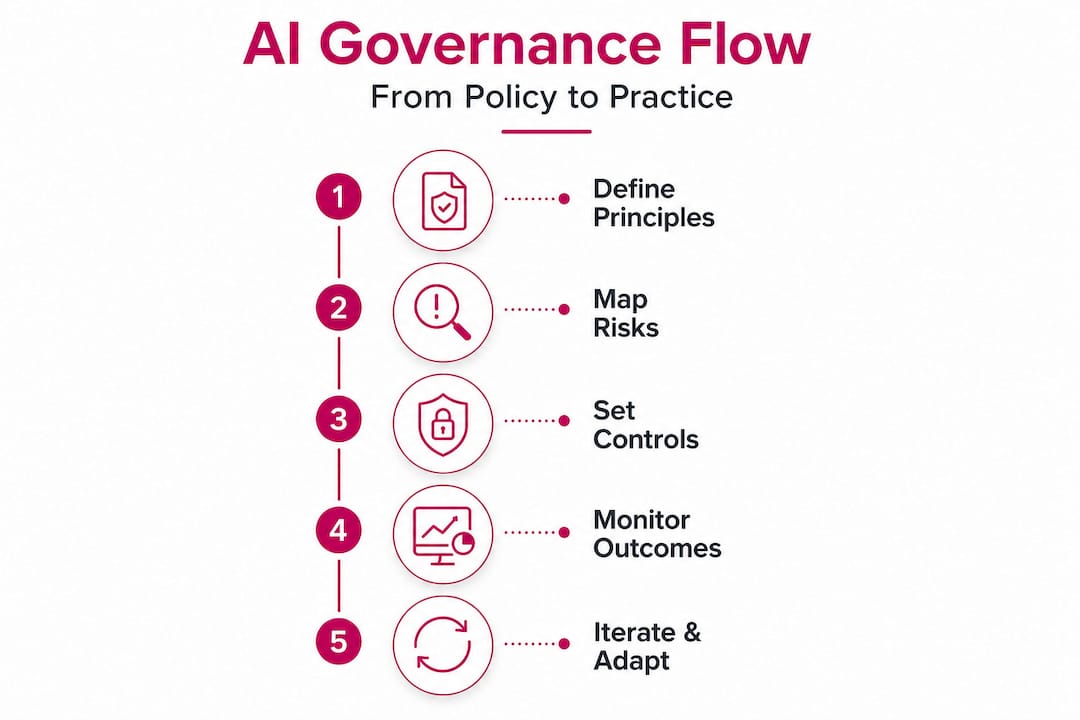
While foundational strategies are essential, emerging AI technologies bring additional, often-overlooked governance challenges. The frameworks above handle standard model deployment well. But what happens when your AI systems start taking autonomous actions, chaining tasks together, or accessing live data sources? That’s where most governance approaches start to crack.
AI agents require runtime governance for tool-use, stateful operations, and multi-step workflows. Shadow AI, data bias in autonomous systems, and scaling governance for dynamic data access represent the next frontier of governance complexity. These aren’t theoretical risks. If your engineering teams are already using AI coding assistants that access internal repos, or your sales teams have deployed autonomous outreach agents, you have agentic AI in production right now.
“Governance for agentic AI must evolve from model safety to runtime enforcement. Waiting until a model is deployed to ask governance questions is already too late when the model is acting on your behalf in real time.”
Key approaches for governing agentic and edge-case AI scenarios:
- Implement runtime guardrails: Define what actions agents can and cannot take at runtime, not just at configuration time. This includes API call limits, data access scopes, and escalation thresholds.
- Use sandboxed testing environments: Before expanding agent autonomy, run them in isolated environments that mirror production but contain their blast radius.
- Build human-in-the-loop checkpoints: For high-stakes agent actions, require human approval before execution. This doesn’t eliminate speed. It eliminates catastrophic errors.
- Track shadow AI usage: Conduct regular audits of which AI tools employees are actually using, not just the ones you’ve officially sanctioned. Unsanctioned tool use creates governance blind spots.
- Apply bias monitoring continuously: Autonomous systems can amplify biases over time as they interact with real-world data. Schedule bias audits at regular intervals, not just at deployment.
Runtime governance for enterprise agentic AI uses a framework of Anchors and Hooks to maintain coherence across governance instruments. Anchors are the non-negotiable constraints. Hooks are the intervention points where governance logic fires during agent execution. This architecture is increasingly essential for AI oversight in autonomous systems, particularly as multi-agent pipelines become more common in enterprise environments.
Global perspectives: Regulation, standards, and the future of AI governance
Beyond your organization, the regulatory landscape is rapidly evolving. What does this mean for your governance strategy?
The short answer: you need to plan for a world of fragmented and sometimes contradictory regulatory requirements. The US favors centralized federal regulation while states push fragmented rules, creating compliance complexity for organizations operating across state lines. Meanwhile, the EU AI Act represents a binding, prescriptive approach that contrasts sharply with voluntary frameworks like NIST.
| Regulatory approach | Binding or voluntary | Geographic scope | Key implication for your org |
|---|---|---|---|
| US federal (proposed) | Varies by agency | National (contested) | Monitor for shifts; build flexible compliance architecture |
| US state-level | Binding (varies) | State-specific | Track state-by-state developments if you have multi-state operations |
| EU AI Act | Binding | EU and global for EU-facing products | Mandatory compliance if you operate in or sell to EU market |
| OECD Principles | Voluntary | International | Use as ethical baseline; increasingly referenced in binding law |
| NIST AI RMF | Voluntary | US and international adoption | Strong operational foundation; likely to inform future US binding rules |
The AGILE Index 2025 evaluates 40 countries on four pillars, 17 dimensions, and 43 indicators, which gives you a global benchmark for where your own governance maturity should be heading. Countries scoring high on the AGILE Index are building governance infrastructure that enables AI investment, not just constrains it.
What should CTOs monitor going forward? Watch for convergence between voluntary and binding standards, particularly in high-risk sectors like healthcare, finance, and critical infrastructure. The gap between NIST’s voluntary framework and potential US federal binding requirements is narrowing. Organizations that have implemented NIST-aligned governance now will have a significant head start when binding rules arrive. The companies that delay because nothing is mandatory yet are running a high-stakes gamble on regulatory timing.
Our take: Governance is an innovation enabler, not a bottleneck
Here’s the perspective that most governance articles don’t give you: the companies we see struggle most with AI productivity are rarely the ones with too much governance. They’re the ones with no governance at all, or governance that exists only as policy documents divorced from daily work.
The misconception that governance slows innovation persists because most governance implementations are designed wrong. They’re designed by compliance teams for compliance goals. What you actually need is governance designed by operators for operational goals, where the output of governance is faster, more reliable AI output, not more paperwork.
Structured, adaptive governance shortens time to value. When your AI systems have clear context about what great work looks like at your company, they produce output that’s actually usable. When engineers know exactly which standards an AI-generated scaffold needs to meet, they stop spending 40% of their time reworking output. Governance, done right, is how you close that gap between AI adoption on paper and AI impact in practice.
The early investment also compounds. Organizations that codify their processes, quality standards, and domain knowledge into their governance layer now are building an asset that gets more valuable over time. Each new AI tool that gets deployed inherits that context automatically. Browse success stories implementing AI governance from organizations that made this shift early and you’ll see a consistent pattern: governance investment in year one translates into measurable productivity gains in year two.
The practical advice: prioritize flexible frameworks over rigid rule sets, and invest in cross-team buy-in from day one. Governance that engineering owns in part, and product champions openly, is governance that actually gets followed. Stop treating it as a tax on innovation. Start treating it as the infrastructure that makes innovation sustainable.
Accelerate your AI adoption journey with effective governance
Governance strategy is only as valuable as its implementation. Knowing the frameworks is a start. Embedding them into how your teams actually use AI every day is where the real productivity gains live.
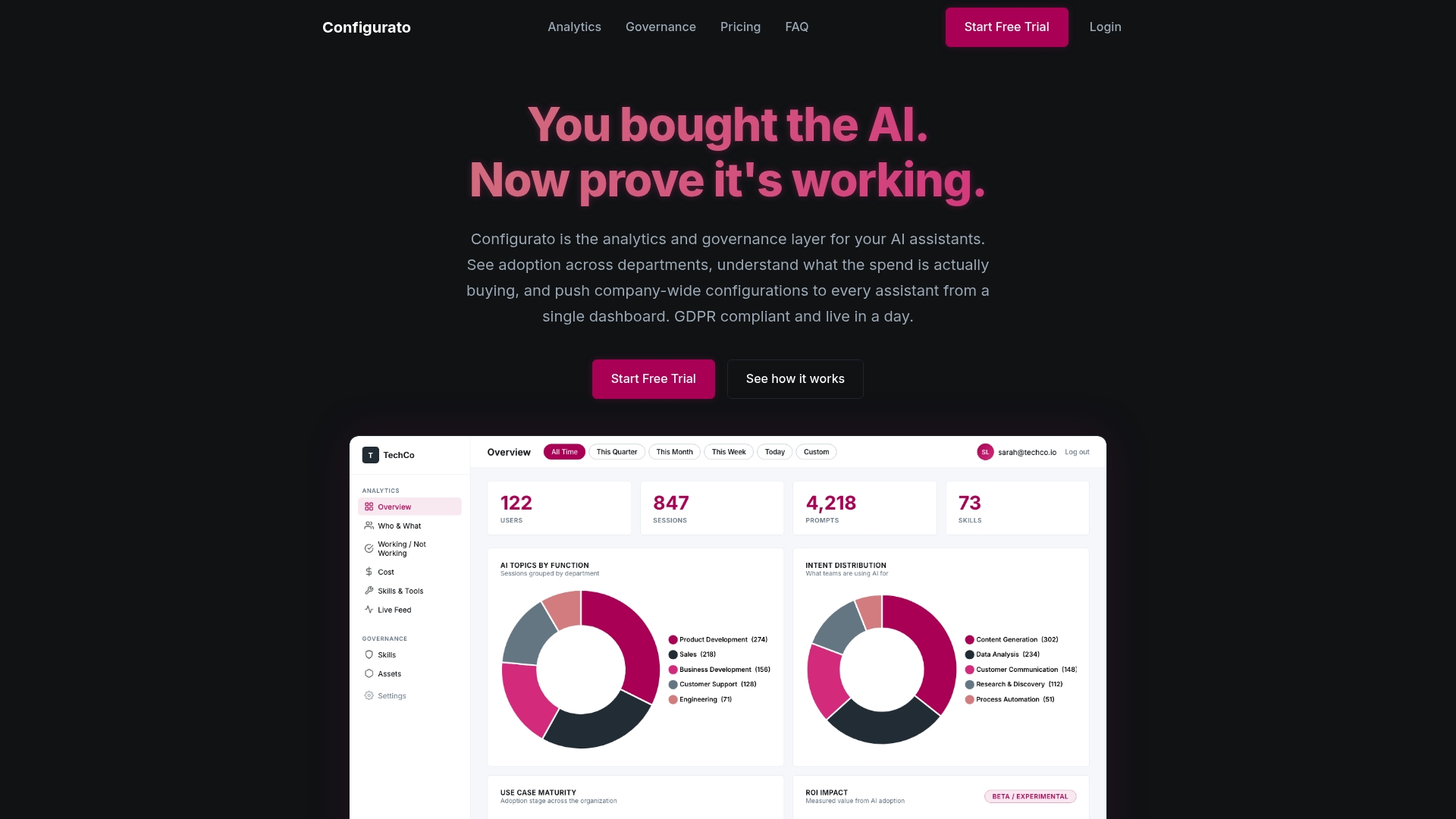
Tekkr Configurations makes this practical. We codify your company’s processes, quality standards, and domain knowledge directly into the AI assistants your teams already use, through an agent-to-agent governance layer that works in the background. No new tools for your people to learn. No rework cycles to manage. Just AI output that already reflects how your organization operates. Explore Configurato’s AI governance platform to see how leading organizations are turning governance from a compliance obligation into a genuine competitive advantage, faster than you’d expect.
Frequently asked questions
What are the main components of AI governance?
AI governance includes policies, processes, standards, and oversight mechanisms designed to ensure AI systems are ethical, safe, compliant, and aligned with organizational and societal values, covering risk management, transparency, accountability, fairness, and human oversight.
How do organizations measure the effectiveness of their AI governance?
Effectiveness is assessed through standards adoption rates, empirical benchmarks like the AGILE Index’s 40-country evaluation across 43 indicators, and continuous monitoring of risk signals, compliance status, and business outcomes tied to AI deployment.
What is the NIST AI Risk Management Framework?
The NIST AI RMF’s four core functions, Govern, Map, Measure, and Manage, provide a structured, iterative approach for identifying, assessing, and managing risk across the full AI development and deployment lifecycle.
How can CTOs address edge cases like agentic AI or shadow AI?
Use runtime guardrails, sandbox testing environments, and adaptive controls to manage novel risks. Runtime governance for agentic AI specifically addresses tool-use, stateful operations, and multi-step autonomous workflows that standard governance approaches weren’t designed to handle.
What is the difference between voluntary AI governance frameworks and binding regulations?
Voluntary frameworks like NIST guide best practices and are adaptable without legal enforcement, while binding regulations like the EU AI Act are legally mandatory and carry real penalties for non-compliance, with obligations scaled to the risk tier of each AI application.