
AI governance is no longer a concept reserved for policy papers or future-looking tech discussions. Binding laws with serious financial penalties are already in effect, and executives who treat compliance as a background concern are running out of time. The EU AI Act establishes legally enforceable rules with fines reaching €35 million or 7% of global turnover for the most serious violations. For enterprise leaders overseeing AI rollouts, understanding what AI governance actually means, which frameworks apply, and how to build practical controls is no longer optional. It is a core business responsibility.
Table of Contents
- What is AI governance and why does it matter?
- Key frameworks shaping global AI governance
- Risk-based approaches: From banned to high-risk AI
- Who enforces AI governance and how?
- Making AI governance work in your organization
- Why a flexible, learning mindset is the new must-have for AI governance
- Next steps: Simplifying AI governance with the right tools
- Frequently asked questions
Key Takeaways
| Point | Details |
|---|---|
| AI governance is urgent | Binding laws and high penalties make AI governance an immediate priority for enterprises. |
| Multiple frameworks apply | Leaders must navigate and often combine EU, ISO, NIST, and global AI ethics recommendations. |
| Risk mapping is essential | Understanding the risk tier of each AI use-case drives compliance strategy and resource allocation. |
| Enforcement is real | EU regulators and internal teams actively monitor compliance with fines and audits as real consequences. |
| Adaptability leads to success | A learning mindset, not checklist compliance, enables lasting and resilient AI governance. |
What is AI governance and why does it matter?
Now that we know binding rules exist, let’s clarify what AI governance means for your organization.
AI governance is the set of policies, processes, and controls that guide how your organization develops, deploys, and monitors AI systems. It is not a single rulebook or a one-time audit. It is a continuous operational discipline that cuts across risk management, ethics, legal compliance, and operational effectiveness.
Think of it this way: every AI tool your teams use touches data, makes decisions, or shapes outputs that affect real people. Without governance, those tools operate in a vacuum, and your organization absorbs the consequences quietly until something goes wrong loudly.
Here is why governance now demands executive attention:
- Legal penalties: EU AI Act fines reach €35M or 7% of annual global turnover for the most serious violations.
- Reputational risk: A single high-profile AI failure, whether bias in hiring or errors in financial recommendations, can undo years of trust-building.
- Operational drag: Poor AI governance leads to outputs that require heavy rework, eroding the productivity gains AI was supposed to deliver.
- Regulatory momentum: Even markets without binding AI laws today are moving toward them. Getting governance structures in place now protects you from reactive scrambles later.
“AI governance is not an IT project. It is a cross-functional initiative that requires legal, compliance, engineering, and business leadership working together from day one.”
Pro Tip: Don’t hand AI governance solely to your technology team. The decisions that matter most, such as which AI systems to deploy and in what contexts, are business decisions that need business accountability alongside technical rigor.
Exploring AI governance best practices early in your AI adoption journey pays dividends. Organizations that build governance frameworks before scaling their AI use avoid the costly retrofitting that comes from building first and asking questions later.
Key frameworks shaping global AI governance
With a clear definition, it’s vital to understand which rules and standards you actually need to track.
The global governance landscape is not monolithic. Several frameworks compete and complement each other, and most enterprise organizations operating across markets will encounter more than one. Here is a practical overview:
| Framework | Type | Main requirements | Certification available? |
|---|---|---|---|
| EU AI Act | Legally binding | Risk tiers, documentation, oversight | No (compliance required) |
| ISO/IEC 42001 | Voluntary standard | AI management system, Plan-Do-Check-Act cycle | Yes |
| NIST AI RMF | Voluntary guidance | Govern, Map, Measure, Manage | No |
| OECD AI Principles | High-level principles | Ethics, transparency, accountability | No |
| UNESCO AI Ethics | Recommendation | Societal impact, inclusivity, human rights | No |
Understanding these frameworks means going beyond the table. Here is how to think about each one in practical terms:
-
EU AI Act: This is the highest-stakes framework for any organization operating in or selling into European markets. It is tiered by risk, legally enforceable, and includes mandatory requirements for high-risk AI systems including documentation, human oversight, and ongoing monitoring.
-
ISO/IEC 42001: Think of this as your management system standard for AI, similar to ISO 27001 for information security. It provides a certifiable structure that many organizations combine with other frameworks. Certification signals maturity to customers, regulators, and partners.
-
NIST AI Risk Management Framework: Widely used in the United States, NIST is voluntary but exceptionally well-structured. It gives enterprises a practical, flexible model for identifying and managing AI risk without the legal mandate of EU rules.
-
OECD and UNESCO: These provide ethical guardrails rather than operational requirements. They are useful for shaping internal policy and values, but they won’t protect you from a fine or an audit.
-
Blended approach: Most enterprises operating globally will not be able to pick just one. A typical approach might combine NIST for internal risk management, ISO/IEC 42001 for certification, and the EU AI Act as a regulatory baseline. Understanding AI ethics considerations across frameworks helps you build policies that hold up under scrutiny from multiple directions.
Following framework compliance steps with a structured approach prevents the common mistake of adopting frameworks in isolation and then discovering gaps when an audit arrives.
Risk-based approaches: From banned to high-risk AI
Now that you understand which frameworks apply, it’s critical to translate abstract obligations into concrete AI risk levels.
The EU AI Act, and many frameworks influenced by it, organize AI systems into risk categories. The category your AI system falls into determines exactly what you must do. This is not a nuance. It is the organizing principle of modern AI compliance.

Here is how the tiers break down:
| Risk level | Examples | Compliance obligations |
|---|---|---|
| Unacceptable (banned) | Social scoring, exploitative targeting | Prohibited outright |
| High-risk | Hiring, credit scoring, healthcare diagnostics | Full documentation, risk management, human oversight |
| Limited risk | Chatbots, deepfakes | Transparency and disclosure requirements |
| Minimal risk | Spam filters, basic recommendations | No mandatory requirements, monitoring advised |
Under the EU Act’s risk model, high-risk systems face the most demanding obligations. These include continuous risk management, rigorous data governance, transparency to users and regulators, active human oversight, and demonstrated accuracy. If your organization uses AI in any of the following areas, you are likely operating in high-risk territory:
- Recruitment and HR decisions, including resume screening and candidate scoring
- Financial services including credit evaluation and loan decisions
- Healthcare systems used for diagnosis, triage, or treatment recommendations
- Critical infrastructure management
- Law enforcement and border control applications
Understanding AI mistake liability is increasingly relevant as regulators and courts look more carefully at who bears responsibility when a high-risk AI system causes harm.
Pro Tip: Map your AI systems to risk levels before you build compliance controls. Many organizations discover they have been treating high-risk AI as minimal risk, which means they are exposed even if they believe they have governance in place.
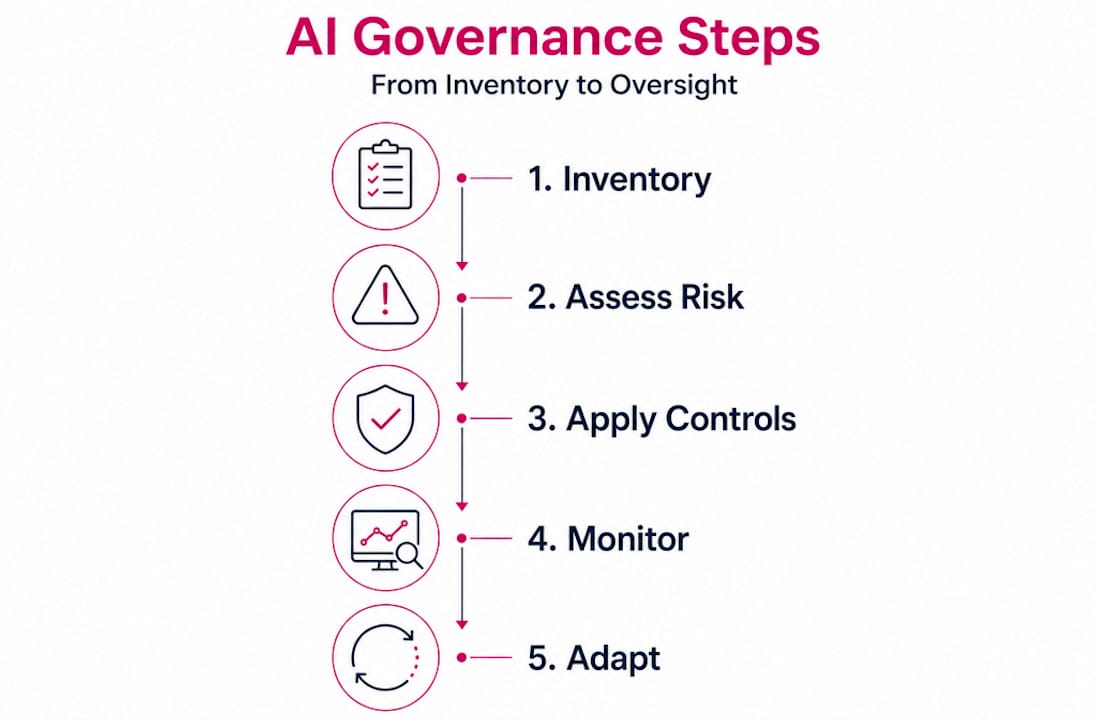
For practical guidance on managing high-risk AI systems, starting with a full inventory of every AI tool in use across the enterprise is non-negotiable. You cannot govern what you haven’t cataloged.
Who enforces AI governance and how?
Once risks are identified, ensuring proper enforcement and oversight is the next executive priority.
Understanding the enforcement landscape matters because it shapes how seriously you need to take compliance, and how much runway you actually have before exposure becomes real.
In Europe, enforcement of the EU AI Act is coordinated through a layered system. The EU AI Office acts as the central authority, providing coordination and guidance across member states. National competent authorities in each country handle enforcement on the ground, including investigations, audits, and penalties. Fines can be triggered by complaints, by proactive regulatory audits, or by incidents that come to light through media or legal proceedings.
Key enforcement realities for enterprise leaders:
- You do not have to be investigated to face consequences. Reputational fallout from a publicly disclosed AI failure can be as damaging as a fine.
- Regulators are building capacity quickly. Early guidance suggested enforcement would ramp up gradually, but the EU AI Office and national authorities are actively building investigative capability.
- Documentation is your first defense. If an authority investigates, the first things they will ask for are your risk assessments, testing records, and oversight logs.
- Noncompliance is cumulative. Failing to document, failing to maintain human oversight, and failing to register high-risk systems can each carry separate consequences.
“The organizations best positioned under regulatory scrutiny are the ones that govern AI continuously, not the ones that scramble to produce paperwork when a regulator comes knocking.”
Outside Europe, enforcement is more fragmented. The United States relies on a sector-based approach, with different agencies, including the FTC, SEC, and HHS, overseeing AI in their respective domains. This decentralized model offers more flexibility but less clarity.
Understanding how regulatory adaptation strategies work in practice gives enterprise leaders a template for staying ahead of enforcement across multiple jurisdictions rather than reacting to each change in isolation.
Making AI governance work in your organization
With enforcement realities in mind, it’s time to focus on practical, actionable steps for implementing AI governance.
Governance that stays in policy documents does nothing. Here is a sequential approach that translates strategic intent into organizational reality.
-
Map your AI inventory. Catalog every AI system in use across the organization, including tools your teams adopted informally. Assign a preliminary risk level to each using the EU Act categories or NIST’s framework as your reference.
-
Assign clear ownership. Governance without accountability fails. Designate AI risk owners for each significant system, and establish a cross-functional steering group that includes legal, IT, compliance, HR, and relevant business units.
-
Choose your framework combination. Most enterprises operating globally benefit from a blended approach, using NIST for internal risk management, ISO/IEC 42001 as a certifiable management structure, and the EU AI Act for regulatory baseline compliance.
-
Document controls rigorously. For each high-risk system, create and maintain records of your risk assessments, data governance practices, testing methodologies, and human oversight procedures. This documentation is your evidence of compliance.
-
Set measurable metrics. Track the things that actually tell you whether governance is working: number of incidents reported, audit findings resolved, time to remediate identified risks, and percentage of AI systems with completed risk assessments.
-
Build review cycles. AI systems change. Regulations change. Your governance controls need scheduled reviews, not just initial setup. Quarterly reviews for high-risk systems and annual reviews for lower-risk tools are reasonable starting points.
For integrating AI responsibly across different functions, the key is making governance feel like part of the workflow rather than a separate compliance burden. When product managers, engineers, and analysts understand governance as part of how work gets done, adoption is far stronger.
Pro Tip: Start simple, but build toward certifiable systems if you operate across regulated markets. You do not need ISO/IEC 42001 certification on day one, but designing your management system to be certifiable from the start means you are not rebuilding it later.
Exploring how scaling governance frameworks works in practice helps teams understand what maturity looks like at different stages of AI adoption.
Why a flexible, learning mindset is the new must-have for AI governance
Having explored implementation, it is worth stepping back to address the underlying mindset that separates organizations that govern AI effectively from those that check boxes and call it done.
The most common failure mode we see is not a missing policy or an incomplete audit log. It is the belief that governance is a problem you solve once. Organizations build a framework, train their teams, and then treat compliance as a completed project. Then AI capabilities shift, a new regulation arrives, or an edge case surfaces that nobody anticipated, and the static framework offers no guidance.
The contrast between NIST’s voluntary flexibility and the EU’s binding, tiered obligations is instructive here. Neither model is purely right. The EU’s binding approach creates accountability but can struggle to keep pace with technological change. NIST’s flexibility allows adaptation but can lead to inconsistency. The organizations that govern AI best take something from both: they maintain structured, documented controls while building in regular learning cycles that allow the framework to evolve.
Regulatory humility matters more than most executives admit. Nobody, not regulators, not technology vendors, not governance experts, has complete clarity on how AI will develop or how rules will respond. The leaders who acknowledge this uncertainty and build adaptive processes accordingly are far better positioned than those who project false confidence through rigid compliance theater.
Successful AI governance is also cross-silo by necessity. Your legal team understands regulatory exposure. Your engineers understand model behavior. Your business leaders understand operational context. Without genuine integration across those functions, governance decisions get made with incomplete information, and the gaps show up in the worst moments.
The organizations that will lead on AI governance in the next three to five years are not the ones with the thickest compliance manuals. They are the ones that treat governance as a continuous, learning discipline, blending the best of flexible and binding models while remaining genuinely humble about what they don’t yet know.
Next steps: Simplifying AI governance with the right tools
AI governance is genuinely complex, and it is only getting more demanding as frameworks multiply and regulations mature. Most enterprise teams are already stretched across competing priorities, and building governance infrastructure from scratch while scaling AI adoption is a serious operational challenge.
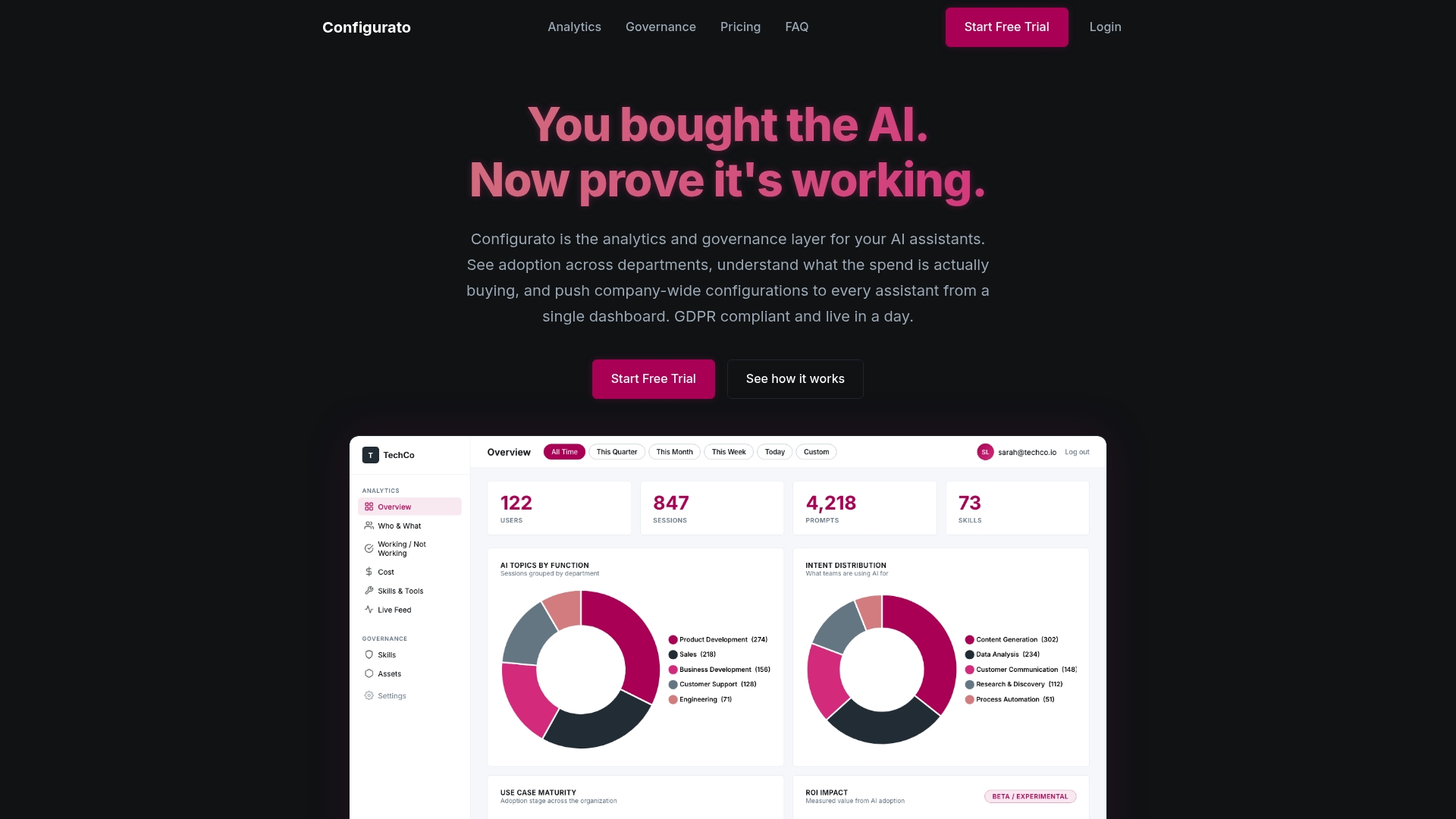
Tekkr’s Configurato platform is built for exactly this situation. It helps enterprise teams codify their governance standards directly into the AI tools their people already use, so compliance becomes part of the workflow rather than a parallel process. From risk mapping to framework alignment and traceable AI outputs, Configurato for AI governance gives your organization a practical way to manage cross-framework compliance without slowing down the teams doing the actual work. If you are serious about turning governance from a cost center into a competitive advantage, this is where to start.
Frequently asked questions
What are the key differences between the EU AI Act and NIST AI Risk Management Framework?
The EU AI Act is binding with risk-tiered legal obligations, while NIST is voluntary, flexible guidance designed to help organizations manage AI risk without a legal mandate.
Which AI systems are considered high-risk under the EU AI Act?
AI used in recruiting, financial services, or healthcare typically qualifies as high-risk under EU rules and must meet strict obligations including continuous risk management and data governance.
Do enterprises need to comply with multiple AI governance frameworks?
Yes. Many organizations combine NIST for internal risk management, ISO/IEC 42001 for certifiable structure, and the EU AI Act as their regulatory baseline for comprehensive coverage.
Who actually enforces AI governance in Europe?
The EU AI Office and national authorities coordinate enforcement, with fines, investigations, and audits triggered by complaints, incidents, or proactive regulatory review.
How can leaders ensure ongoing AI compliance as rules evolve?
Building adaptive governance processes with regular review cycles and a learning culture is essential, blending flexible and binding frameworks to stay resilient as both AI capabilities and regulations continue to shift.