
Most companies believe they’re ahead on AI because they’ve rolled out tools. Usage dashboards show adoption. Teams are prompting. Demos look promising. But somewhere between the pilot and the boardroom, the productivity gains disappear. The uncomfortable truth is that deploying AI and actually enabling it are two entirely different things. AI enablement is the end-to-end capability to deploy and scale AI reliably and repeatedly, covering not just models and tools, but infrastructure, data systems, governance, and the operational changes that make it all stick. This guide unpacks what that really means and how to get there.
Table of Contents
- Defining AI enablement in the enterprise
- The six dimensions of successful AI enablement
- From one-off experiments to operational AI systems
- Governance, human-in-the-loop, and edge cases
- Measuring and sustaining AI enablement success
- Why most AI projects stall—and what experienced leaders do differently
- Take your AI enablement journey further
- Frequently asked questions
Key Takeaways
| Point | Details |
|---|---|
| AI enablement defined | True AI enablement means deploying and scaling AI across people, process, and technology to drive business outcomes. |
| Six success pillars | Strategy, talent, operations, technology, data, and adoption practices all matter for capturing AI value at scale. |
| Beyond pilots | Operationalizing AI means moving beyond experiments to reliable, monitored, and continuously improved systems. |
| Governance and human oversight | Human validation and governance are essential to handle exceptions and ensure accountability for enterprise AI. |
| Measure for impact | Track KPIs—such as productivity and compliance—to sustain and scale the benefits of AI enablement. |
Defining AI enablement in the enterprise
There’s a version of AI adoption that feels productive but isn’t. You have a ChatGPT license. Your engineers use Copilot. Someone in marketing is generating first drafts. And yet nothing has fundamentally changed about how work gets done. That’s deployment. It’s not enablement.
Enterprise AI enablement means integrating AI deeply into your operational and business fabric, not bolting it on top. The distinction matters because bolt-on AI creates fragile, inconsistent results. Integrated AI creates compounding value.
“AI enablement is building the infrastructure, processes, and governance to move AI from isolated experiments to production-grade capabilities tied to measurable business outcomes.”
Think about what separates a promising pilot from a production system. A pilot runs in controlled conditions with motivated participants. A production system handles edge cases, bad data, regulatory exceptions, and unhappy paths every single day. Getting from one to the other requires more than better prompts. It requires documented workflows, defined quality standards, clear ownership, and feedback loops that catch failure before it compounds.
The key focus areas for true enterprise enablement are infrastructure (can your systems support AI at scale?), data (is it clean, accessible, and governed?), governance (who decides what AI can and can’t do?), and process change (has AI actually changed how work happens, or is it just an add-on?). Organizations that treat AI governance and analytics as afterthoughts almost always find themselves rebuilding from scratch six months later.
The six dimensions of successful AI enablement
Understanding the big picture, let’s examine the organizational elements that differentiate successful AI enablement from expensive experiments.
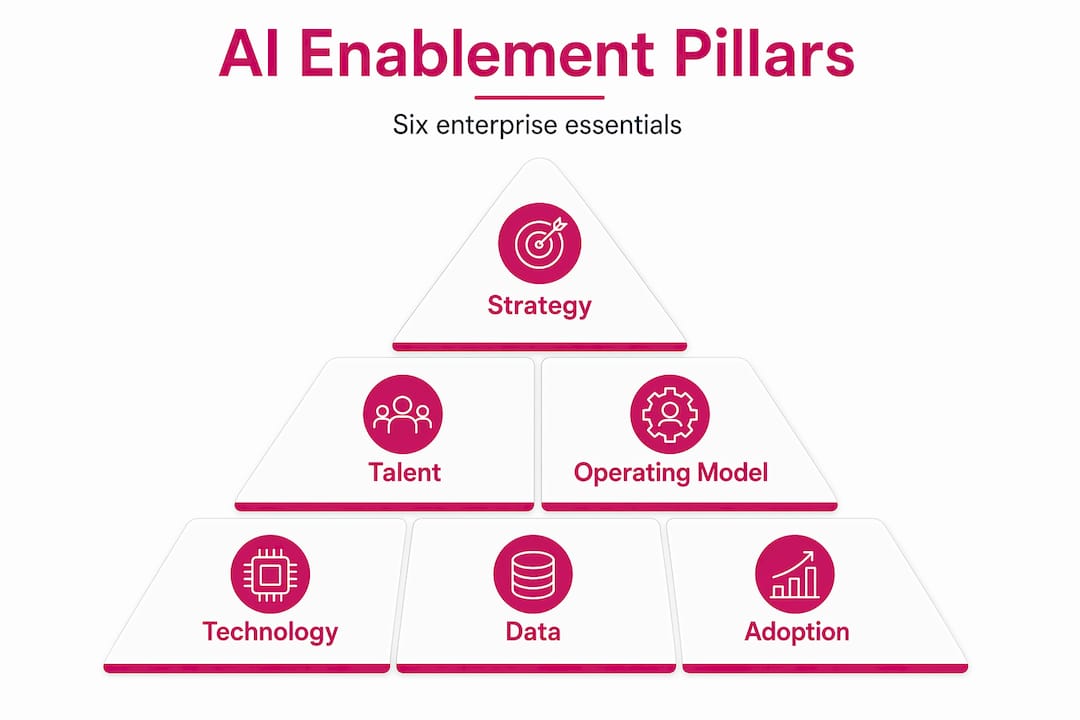
McKinsey’s research on AI maturity identifies six dimensions essential to capturing value from AI: strategy, talent, operating model, technology, data, and adoption and scaling. Most organizations only address one or two of these at a time. The ones seeing real returns are rewiring across all six simultaneously.
Here’s what each dimension looks like in practice:
- Strategy: AI initiatives are tied to specific business outcomes, not just capability exploration. You have a clear answer to “what problem are we solving and how will we know we solved it?”
- Talent: You have a mix of AI-literate employees, dedicated machine learning or AI operations roles, and cross-functional champions who bridge technical and business teams.
- Operating model: Decisions about AI deployment, governance, and scaling happen through clear processes, not ad hoc conversations between whoever is most enthusiastic that week.
- Technology: Your infrastructure supports the AI tools your teams actually use, and those tools integrate cleanly with existing systems rather than creating parallel workflows.
- Data: Data is not just available but governed, documented, and accessible to the AI systems that need it. Bad data at scale is worse than no AI at all.
- Adoption and scaling: There are structured mechanisms for taking what works in one team or function and replicating it reliably elsewhere.
Here’s a comparison of what companies look like when they address all six dimensions versus when they focus only on technology:
| Dimension | Technology-only focus | Full enablement approach |
|---|---|---|
| Strategy | AI as experimentation | AI tied to revenue or cost targets |
| Talent | A few enthusiasts | Distributed AI literacy |
| Operating model | Ad hoc decisions | Defined governance processes |
| Technology | Tools deployed | Tools integrated |
| Data | Accessible but ungoverned | Clean, governed, monitored |
| Adoption and scaling | Pilots stall | Consistent replication |
Less than one-third of organizations are fully adopting scaling practices across these dimensions. That gap is where competitive advantage lives right now. The companies getting ahead aren’t necessarily using better AI. They’re using the same tools with better organizational infrastructure underneath.
From one-off experiments to operational AI systems
Once you recognize the dimensions of enablement, the next challenge is operationalizing AI, which means moving from isolated wins to systematic value.

A single successful AI project proves a concept. An operational AI system delivers consistent, measurable results at scale, handles exceptions gracefully, and improves over time. The journey from tasks to systems requires a deliberate process: moving from identifying tasks to building stable, monitored, continuously improving automations.
Here’s the stepwise approach that actually works:
- Document the workflow before automating it. You cannot reliably automate what you haven’t clearly defined. This step forces clarity on what “good output” actually means.
- Identify the highest-leverage tasks within that workflow. These are usually repetitive, time-consuming, and rule-based. Start here before tackling judgment-intensive work.
- Automate and run in parallel with human processes initially. This isn’t redundancy for its own sake. It’s how you catch the 15% of cases where AI output needs correction before those errors go live.
- Monitor outputs consistently. Set up alerts for quality degradation, latency issues, or unexpected failure modes. Without monitoring and improving AI systems, you won’t know when something breaks until a user complains.
- Build continuous improvement cycles. Use the data from monitoring to refine prompts, update configurations, and close gaps between what the AI produces and what the business actually needs.
Here’s a practical example of how this progression looks across a finance operations team:
| Stage | Manual process | Transitional | Fully operational |
|---|---|---|---|
| Invoice review | Human checks each line | AI flags anomalies for review | AI resolves standard cases; humans review exceptions |
| Vendor matching | Manual lookup | AI suggests matches | AI confirms matches with audit trail |
| Reporting | Analyst builds weekly report | AI drafts report, analyst edits | AI generates, analyst approves in under 10 minutes |
Pro Tip: Build feedback mechanisms before you scale. A simple thumbs up/thumbs down on AI output, tied to a tagging system, creates a dataset you can use to improve configurations and catch systematic errors early. Most teams skip this because it feels like overhead. It isn’t. It’s the engine of compounding improvement.
Governance, human-in-the-loop, and edge cases
Operational success still depends on human factors and organizational maturity. The most dangerous moment in AI adoption is when confidence outpaces governance. That’s when errors at scale go unnoticed, compliance gaps widen, and the first serious incident erodes trust in the entire program.
Enterprises need human judgment and governance to handle the cases that automated systems cannot fully capture. These include regulatory exceptions, situations involving tacit organizational knowledge, decisions with material legal consequences, and anything where context shifts in ways the model wasn’t trained to recognize.
AI enablement frameworks at mature organizations consistently include mechanisms for human validation, especially as systems scale and autonomy increases. This isn’t about distrust of AI. It’s about designing systems that know their limits and route appropriately.
Key governance best practices when scaling AI:
- Define clear escalation paths so that AI systems automatically route low-confidence or high-stakes decisions to a human reviewer rather than defaulting to a wrong answer.
- Document what AI is and isn’t authorized to do in each workflow. This isn’t just a compliance requirement; it’s what allows you to audit when something goes wrong.
- Maintain audit trails for AI-assisted decisions, particularly in regulated functions like finance, legal, and HR.
- Review governance policies quarterly, not annually. AI capabilities and business contexts change faster than annual review cycles can accommodate.
- Train human reviewers on what to look for, not just that they need to review. A reviewer who doesn’t know what “good” looks like provides no real safety net.
- Create a centralized repository of known edge cases and how they were handled. This institutional knowledge is what makes AI systems get better over time rather than repeating the same mistakes.
Pro Tip: Assign a governance owner, not just a governance policy. Policies without owners become shelf documents. The governance owner reviews incidents, updates policies, and acts as the bridge between AI capabilities and business risk tolerance.
Measuring and sustaining AI enablement success
With governance in place, the final step is implementing clear metrics to measure real business outcomes and ensure your AI investments pay off.
Here’s a hard truth: most AI programs can’t tell you what they’ve actually delivered. Teams cite anecdotes. Dashboards show usage. But there’s no direct line between AI activity and business outcomes. That’s a measurement problem, and it’s fixable.
Tracking well-defined KPIs for generative AI solutions has the most impact on EBIT among all adoption and scaling practices. This is not a minor finding. It means measurement is the single highest-leverage habit you can build into your AI program. Yet less than one-third of organizations are doing it consistently.
The KPIs that actually move the needle are concrete and role-relevant:
- Productivity: Time saved per task, volume of work completed per employee, cycle time reduction
- Quality: Error rates before and after AI assistance, rework frequency, first-pass approval rates
- Compliance: Rate of policy adherence in AI-assisted decisions, audit findings related to AI outputs
- Cost: Labor cost per unit of output, cost per transaction, reduction in outside spend
Here’s how to build a sustainable AI measurement program:
- Baseline before you automate. You need pre-AI data to know what changed. This sounds obvious, but most teams forget to capture it before going live.
- Assign KPI ownership to business teams, not IT. Business teams understand what outcomes matter and can contextualize data in ways that drive real decisions.
- Run monthly reviews in the first six months of any new deployment. This cadence catches problems fast enough to fix them before they become embedded.
- Report at the business unit level, not just the platform level. “Our AI tools processed 50,000 requests” tells you nothing. “Customer onboarding time dropped 30% in Q2” tells you everything.
- Connect AI performance data to workforce planning conversations. If AI is genuinely changing capacity, that should influence hiring plans, not just be celebrated in isolation.
Why most AI projects stall—and what experienced leaders do differently
Here’s what we’ve seen consistently: the companies that get stuck aren’t failing on the technology. They’re failing on the organizational layers underneath it. They bought the best models, got the enterprise licenses, and stood up the infrastructure. Then nothing changed.
The pattern is predictable. A few enthusiastic early adopters demonstrate value. Leadership gets excited. Rollout happens. And then adoption plateaus because the AI tools produce generic outputs that don’t reflect how the company actually works. Teams go back to doing things the old way, or worse, they keep using AI but spend so much time editing the output that the time savings evaporate.
The counterintuitive lesson is that the companies making the most progress are not chasing the most advanced models. They’re investing in organizational change first. They’re documenting how good work actually gets done, codifying their quality standards, and embedding that knowledge into how their AI tools behave. When an engineer asks for help scaffolding a service, the AI already knows the architecture standards. When a product manager drafts a spec, the AI already reflects the product development process. No rework. No lookup. No training.
The other habit that separates high performers is cultivating champions at every layer of the business. Not just executive sponsors. Not just the AI team. Frontline champions who understand the work deeply enough to recognize when AI output is wrong, who can explain the value to skeptical peers, and who can feed real-world edge cases back into governance processes. Analytics and governance for AI at the team level requires people who are close enough to the work to notice what the dashboards miss.
The companies winning with AI are not the ones who deployed the most tools. They’re the ones who taught AI how they work.
Take your AI enablement journey further
If you’ve read this far, you already understand that AI enablement is not a technology problem. It’s an operational discipline. The gap between AI usage and AI value is closed by embedding your company’s processes, standards, and knowledge directly into how AI tools behave across your organization.
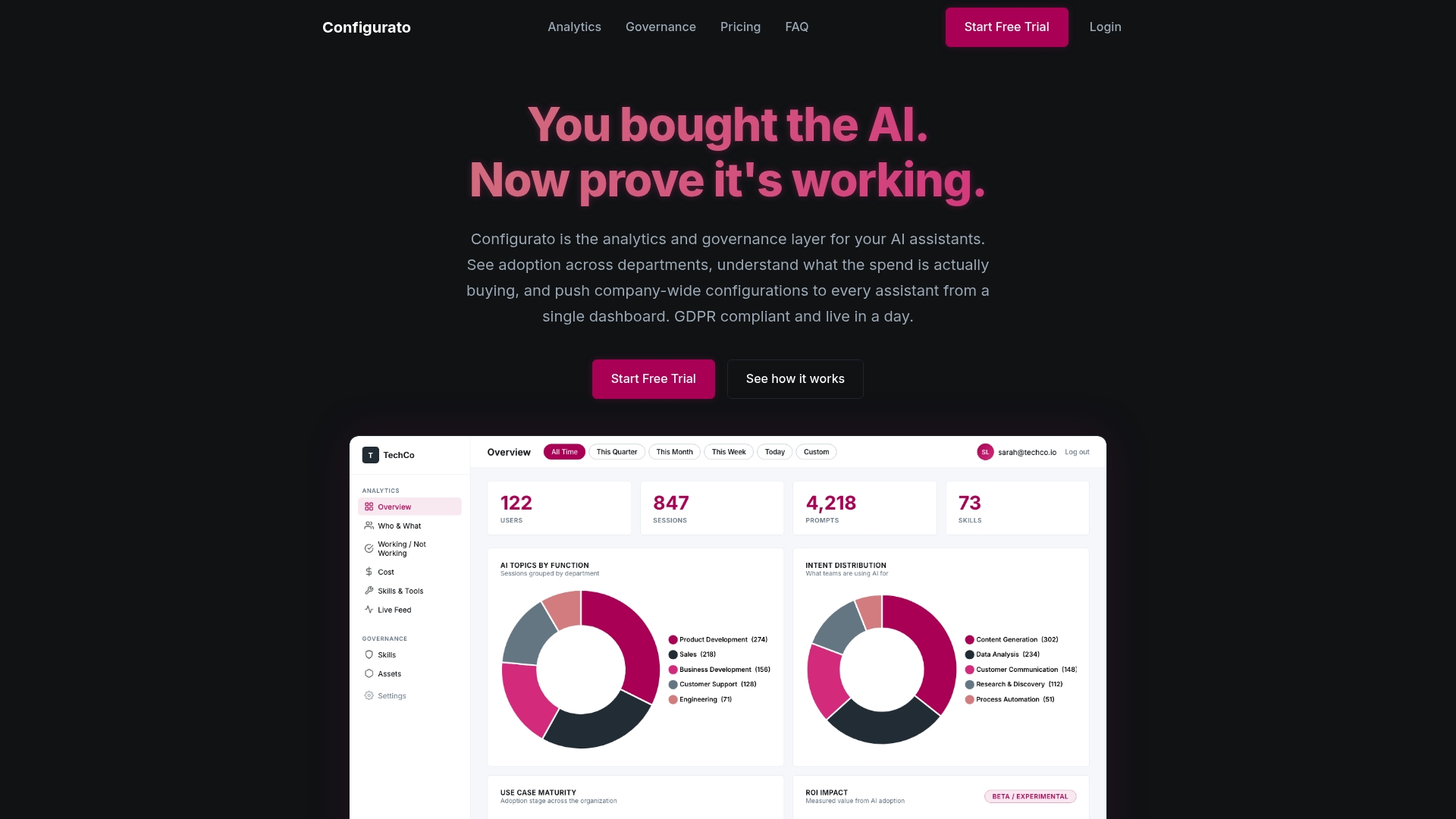
Configurato for enterprise AI enablement gives you the platform to do exactly that. Tekkr’s governance layer works agent-to-agent in the background, pushing your company’s way of working into every AI interaction, across Claude, GPT, Copilot, Gemini, and beyond. Your teams don’t change their workflow. They just get better output. Define what great work looks like, distribute it to every AI assistant in your organization, and trace where AI is actually accelerating work versus where it isn’t. This is how you turn AI adoption into AI advantage.
Frequently asked questions
What is AI enablement in business terms?
AI enablement is building the infrastructure, processes, and governance to move AI from isolated experiments to production-grade capabilities tied to measurable business outcomes.
What are the six pillars of AI enablement?
The six pillars are strategy, talent, operating model, technology, data, and adoption and scaling practices.
How do you operationalize AI solutions at scale?
Document workflows, automate tasks, monitor systems, integrate human validation, and improve continuously with structured feedback loops and business-relevant metrics.
Why is governance important in AI enablement?
Governance ensures accountability, compliance, and human oversight, especially for handling exceptions and sensitive decisions that automated systems cannot fully capture on their own.
How can we measure the success of AI enablement?
Track business-relevant KPIs like productivity, error reduction, compliance, and cost savings, and review them regularly at the business unit level to connect AI activity to real outcomes.