
AI-driven business outcomes are measurable results that organizations achieve when AI changes how work gets done, not just how fast it gets done. The examples of AI-driven business outcomes covered here span customer service, logistics, sales, and supply chain. Each case is backed by real numbers, and several were validated through A/B testing to confirm causation rather than correlation. IKEA’s Billie chatbot alone moved from saving €13 million in costs to generating €1.3 billion in new revenue. That kind of result is not an edge case. It is a signal that AI, when deployed with operational intent, reshapes business models entirely.
1. Examples of AI-driven business outcomes in customer service
IKEA’s Billie chatbot is the clearest example of AI turning a cost center into a profit center. Billie resolved 47% of 3.2 million inquiries and saved the company €13 million in operational costs. That result alone would satisfy most executives. IKEA did not stop there.
The company repurposed 8,500 call-center employees into remote interior design consultants. Those consultants, freed from handling routine inquiries, generated €1.3 billion in revenue during the first full year. The chatbot did not replace people. It redirected them toward higher-value work that customers were willing to pay for.

The lesson for executives is structural. AI did not just reduce headcount costs. It created an entirely new go-to-market channel that did not exist before. Most organizations measure chatbot success by deflection rate. IKEA measured it by revenue per consultant.
Pro Tip: When evaluating a conversational AI project, ask what your team would do with the time it frees up. The answer often points to a new revenue channel, not just a cost reduction.
2. Logistics routing efficiency through AI
FM Logistic applied AI to one of the oldest problems in operations: the traveling salesman problem. The result was a 10.4% routing efficiency improvement and a reduction of over 15,000 kilometers of annual warehouse travel. That efficiency gain translated directly into higher throughput without adding headcount.
The compounding effect of a 10.4% gain across a large logistics network is significant. Fewer kilometers traveled means lower fuel costs, less equipment wear, and faster order fulfillment. None of those benefits required a single new hire.
Pro Tip: In logistics, small percentage gains multiply across millions of operations. A 10% routing improvement at scale often outperforms a 30% improvement in a single isolated process.
3. Supply chain optimization with AI digital twins
BASF built an AI-powered digital twin of its global supply network to manage thousands of inventory decisions simultaneously. The system improved inventory accuracy by 80% on a relative basis and significantly reduced stockouts across a supply chain of extraordinary complexity. Traditional planning tools cannot process that many variables in real time.
A digital twin works by creating a live simulation of the supply network. AI runs scenarios continuously and flags decisions before they become problems. For a company like BASF, where a single stockout can halt production lines worth millions per day, prevention is worth far more than the cost of the system.
4. AI-accelerated supply chain assessments
C.H. Robinson’s Lean AI Engineer completes a full supply chain assessment in 25–30 minutes. The same assessment previously took four weeks with a human team. That speed difference changes what is operationally possible.
The system delivers load reductions of up to 81% and annual cost savings exceeding $1 million. Those numbers come from applying AI to the analysis of freight patterns, carrier options, and consolidation opportunities that human analysts would take weeks to process. The business case is direct: faster analysis means faster decisions, and faster decisions mean lower carrying costs and better service levels.
5. AI product consultation driving sales conversion
Pooldoktor deployed an AI product consultant to handle complex pool equipment inquiries. The system answered questions in an average of 13 seconds and was available around the clock. The outcome was a +18.75% increase in incremental revenue per visitor, validated through A/B testing with treatment and control groups.
The 33× ROI figure is credible precisely because it was measured causally. A/B testing separates the AI’s contribution from other variables like seasonality or traffic quality. That methodology matters to executives who need to justify AI spend to a board. Correlation is not enough. Causal attribution is the standard that AI success metrics should meet.
The deeper insight is capacity. A human sales team can handle a finite number of consultations per day. An AI consultant handles thousands simultaneously without degrading response quality. Pooldoktor did not just improve conversion. It decoupled consultation capacity from headcount entirely.
6. The measurement gap blocking AI ROI
79% of executives report that AI has improved productivity in their organizations. Only 24% can clearly attribute that improvement to revenue impact. That gap is not a technology problem. It is a measurement problem.
Organizations that cannot connect AI usage to financial outcomes cannot make confident investment decisions. They also cannot identify which AI tools are actually being used and which are sitting idle. IBM’s finding explains why so many AI programs feel successful in theory but fail to generate board-level confidence.
The fix requires linking AI activity data to business metrics from the start of a project, not after the fact. Measuring AI ROI means tracking who uses which tools, how often, and what changes in output or revenue when they do.
7. Data readiness as the hidden barrier to AI outcomes
A Dun & Bradstreet survey of 10,000 businesses found that 97% have active AI initiatives, but only 5% have data that is adequately ready to support them. That gap explains why 56% plan to increase AI investment while only 24% report strong returns. The problem is not ambition. It is foundation.
AI models perform only as well as the data they run on. Poor data quality, inconsistent identifiers, and siloed systems produce unreliable outputs regardless of model sophistication. Successful AI adoption depends less on model quality alone and more on data quality, identity resolution, and consistent operational execution.
Executives who treat data readiness as a prerequisite rather than an afterthought see faster time to value. Those who skip it spend months troubleshooting outputs that look plausible but are wrong in ways that are hard to detect.
8. Workflow redesign as the multiplier for AI impact
MIT Sloan research shows that AI delivers its greatest business value when it reshapes entire workflows, not when it improves a single step in isolation. Automating one task in a ten-step process produces marginal gains. Redesigning the process around AI capabilities produces transformational ones.
IKEA’s example illustrates this directly. The company did not automate customer service and call it done. It redesigned the entire customer engagement model. The chatbot handled volume. The humans handled complexity and relationship. That division of labor required deliberate workflow design, not just tool deployment.
The AI tools that go unused in most organizations are often the ones dropped into existing workflows without redesign. Adoption fails not because the technology is wrong but because the process around it was never updated to take advantage of what AI can do.
Pro Tip: Before deploying any AI tool, map the full workflow it touches. Identify which steps AI handles best and which require human judgment. Then redesign the workflow around that division, not around the tool’s default behavior.
Key takeaways
AI-driven business outcomes require causal measurement, workflow redesign, and data readiness to move from productivity gains to revenue impact.
| Point | Details |
|---|---|
| Chatbots can create revenue channels | IKEA’s Billie moved from cost savings to €1.3 billion in new revenue by redirecting staff to consulting. |
| Causal measurement builds investment confidence | A/B testing, as used by Pooldoktor, proves AI’s contribution and supports board-level ROI claims. |
| Data readiness determines AI success | Only 5% of organizations have adequately ready data, making it the primary barrier to strong returns. |
| Workflow redesign multiplies AI impact | MIT Sloan research confirms that reshaping entire workflows delivers more value than automating isolated steps. |
| Measurement gaps undermine AI programs | IBM data shows only 24% of executives can link AI activity to revenue, limiting strategic confidence. |
The real lesson executives keep missing
The IKEA example gets cited constantly for the €13 million in savings. The €1.3 billion revenue figure gets mentioned as a footnote. That ordering reveals how most organizations still think about AI: as a cost reduction tool first, and a business creation tool second, if at all.
The executives I find most effective in AI strategy are the ones who ask a different question. Not “what can we automate?” but “what could we offer if we had unlimited expert capacity?” IKEA answered that question and built a new business line. Pooldoktor answered it and achieved 33× ROI on a product consultation tool most companies would have dismissed as a nice-to-have.
The uncomfortable truth is that most AI programs fail not because the technology underdelivers but because the organizational ambition is too narrow. A chatbot deployed to deflect tickets is a cost tool. A chatbot deployed to enable a new service model is a growth tool. The technology is often identical. The difference is in how leadership frames the mandate.
Causal measurement matters here too. If you cannot prove what AI is doing, you cannot defend the investment or expand it. The organizations reporting strong AI returns are the ones that built measurement into the program from day one, not the ones that ran the tool for a year and then tried to calculate impact retroactively.
Data readiness is the other variable that executives consistently underestimate. The Dun & Bradstreet finding that only 5% of organizations have adequately ready data is not a technology statistic. It is an organizational discipline statistic. The companies that close that gap before deploying AI see results faster and with far less rework.
— TekkrTools
How Tekkr helps you prove AI is working
Most organizations know AI should be delivering results. Fewer can show exactly where it is working, which teams are using it, and what the return looks like by department.
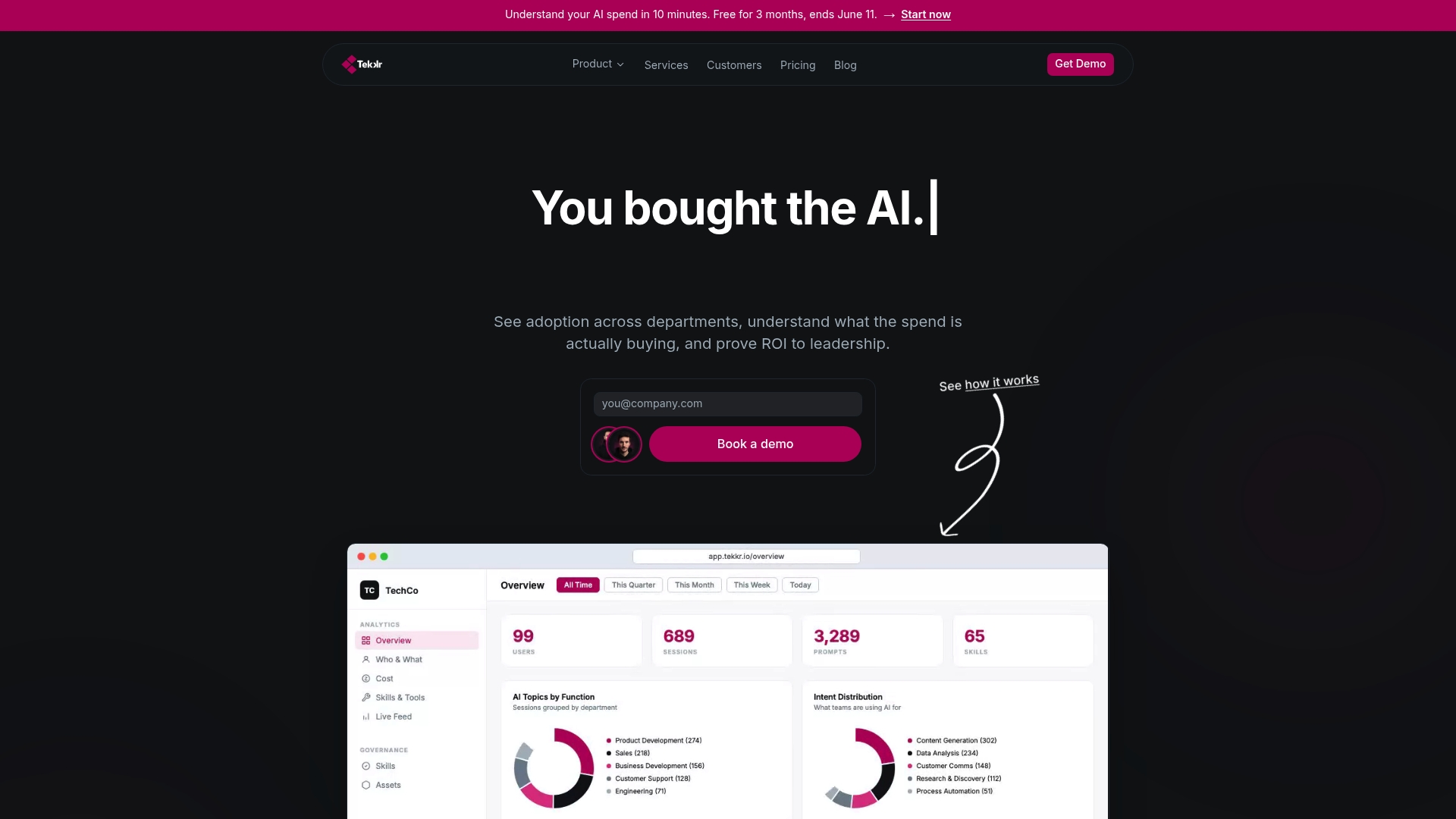
Tekkr’s AI adoption platform tracks usage, spend, and return across your entire organization. Configurato shows you who is using tools like Claude and Codex, breaks costs down by team, and surfaces use-case intelligence that tells you where AI is generating real value. Gamified rollouts and company-wide AI playbooks drive adoption higher without requiring IT involvement. Setup takes about 10 minutes, there is a free tier, and no credit card is required. If you bought the AI, Tekkr helps you prove it is working.
FAQ
What are the best examples of AI-driven business outcomes?
IKEA’s Billie chatbot is among the most documented, saving €13 million in costs and generating €1.3 billion in revenue by repurposing 8,500 staff into consultants. Pooldoktor’s AI consultant achieved 33× ROI with an 18.75% lift in revenue per visitor, validated through A/B testing.
How do you measure the impact of AI on business?
The most reliable method is A/B testing with treatment and control groups, which isolates AI’s contribution from other variables. IBM research shows only 24% of executives can currently attribute AI activity to revenue, making structured measurement a critical gap to close.
Why do so many AI initiatives fail to deliver strong returns?
Dun & Bradstreet found that only 5% of organizations have data that is adequately ready to support AI programs. Poor data quality, lack of workflow redesign, and absent measurement frameworks are the primary causes of underperformance, not model quality.
Does AI create new revenue or just reduce costs?
AI does both, but the largest outcomes come from new revenue creation. IKEA’s case shows that AI-enabled capacity can fund entirely new business functions. MIT Sloan research confirms that workflow-level redesign, not step-level automation, produces the most significant business impact.
How long does it take to see measurable AI business results?
Results vary by use case and organizational readiness. Supply chain tools like C.H. Robinson’s Lean AI Engineer deliver assessments in 25–30 minutes versus four weeks manually, with savings exceeding $1 million annually. Customer-facing AI tools like Pooldoktor’s consultant show revenue impact within the first months of deployment when measured correctly.