
AI cost per employee productivity is the total AI expenditure divided by measurable output gains per worker, combining licensing fees, compute costs, shadow AI spend, and actual productivity impact. The average company spends $2,068 per employee on AI annually in 2026, yet most executives cannot tell you whether that investment is paying off. The gap between what organizations spend and what they can prove is the central problem this guide solves. You will find the full cost breakdown, the right measurement frameworks, and the benchmarks needed to make confident AI investment decisions.
What makes up the real AI cost per employee?
The real AI cost per employee goes far beyond the vendor invoice. Most organizations track only licensed seat costs, which means they are systematically underestimating their true AI spend.
The four major cost components are:
- Licensed AI tool subscriptions. Seat-based pricing for tools like Claude or Codex is the most visible line item. These costs are predictable but often duplicated across departments without central oversight.
- API and compute costs. Custom AI integrations consume GPU time, input/output tokens, and transcription services. These costs scale with usage and can spike unpredictably when adoption accelerates.
- Shadow AI spend. Employees routinely use unapproved AI tools outside IT visibility. Shadow AI costs organizations an average of $412,000 per year, and 34% of that spending duplicates tools the company already pays for.
- The observability tax. Monitoring AI agent performance requires extra API calls and logging infrastructure. This overhead adds 15–20% to total AI costs and is almost never included in initial budgets.
Accurate measurement requires Agent Token Tracking (ATT), which maps token consumption to specific teams and use cases rather than relying on vendor invoices alone. Without ATT, budget underestimates can reach 40%.
Pro Tip: Run a shadow AI audit before your next budget cycle. Survey department heads on tools their teams actually use, then cross-reference against your approved vendor list. The duplication you find will likely fund your next AI initiative.
How to measure AI-driven productivity gains accurately
Measuring AI impact on employee efficiency requires more than counting active users or tracking license utilization. The right approach combines output metrics with cost-adjusted ROI calculations.
A practical measurement process follows four steps:
- Establish a task-level baseline. Measure the time and cost of completing a specific task before AI deployment. A human completing a structured data extraction task might cost $24.79 per task when you factor in salary, benefits, and overhead.
- Measure AI output cost. The same task completed by an AI agent costs $0.94–$2.39, representing a 90–96% cost reduction for that specific task type. That number is the gross productivity gain.
- Apply a rework haircut. Gross gains overstate real returns. AI errors, hallucinations, and human review cycles consume a portion of the savings. A defensible ROI model subtracts rework time, escalation labor, and quality control overhead from the gross figure to produce a net productivity gain.
- Score performance across seven dimensions. Quality, reliability, cost per successful task, latency, safety, user experience, and scalability each matter. Zero out of 15 major AI benchmarks currently integrate cost-aware scoring, which means most off-the-shelf evaluations miss the dimensions that matter most to your business.
Measuring AI performance as a multidimensional scorecard that includes quality, reliability, cost efficiency, and user experience gives organizations a far more accurate picture of AI value than model accuracy alone.
The cost per successful outcome formula ties everything together: divide total AI operating cost by the number of successfully completed tasks, including escalation and human review costs in the denominator. This single metric tells you whether your AI investment is generating real returns or just generating activity.
Pro Tip: Track AI productivity ROI at the use-case level, not the department level. A single high-volume, structured task that AI handles well can justify the entire tool budget. One poorly scoped deployment can sink the average.

How to benchmark AI spending and interpret variances
Benchmarking AI cost per employee productivity against peers reveals whether your organization is under-investing, over-investing, or simply deploying AI in the wrong places.
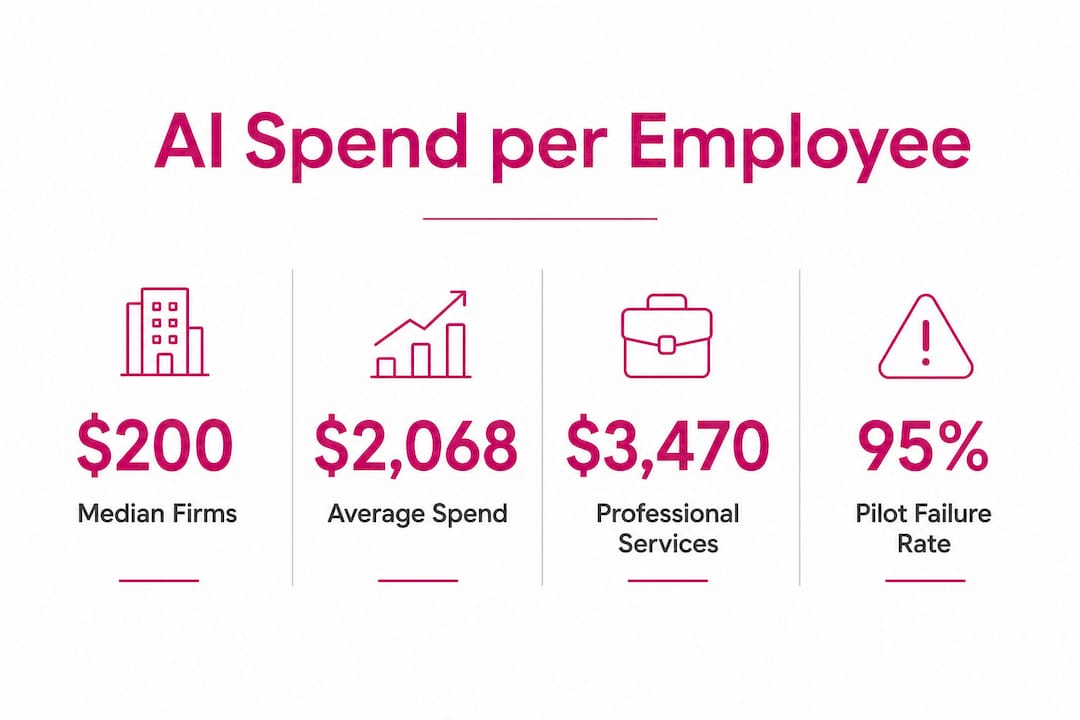
The spending distribution in 2026 is wide. Median firms spend under $200 per employee annually. The average sits at $2,068. The top 10% of spenders far exceed that figure, and the top 1% of AI-intensive firms spend up to $7,500 per employee per month, growing at 14.1% monthly. That 14x variance between median and top spenders reflects differences in adoption maturity, not just budget size.
| Spending tier | Annual AI spend per employee | Typical profile |
|---|---|---|
| Median firms | Under $200 | Early adoption, limited use cases |
| Average across sectors | $2,068 | Mixed deployment, some automation |
| Professional services leaders | $3,470 | Broad deployment, client-facing AI |
| Top 1% AI-intensive firms | $90,000+ (annualized) | Full AI integration, agent workflows |
Sector context matters as much as the raw number. Professional services firms lead at $3,470 per employee because their work involves high-volume, structured tasks like document review, research synthesis, and client reporting. These are exactly the task types where AI delivers measurable gains. Manufacturing and logistics firms often show lower per-employee spend but higher per-task ROI because their automation targets narrow, repetitive processes.
Early adoption patterns look different from mature deployment. Early adopters show high spend relative to output because they are still building integrations, training employees, and discovering which use cases work. Mature deployments show lower incremental cost and higher yield because the infrastructure is already in place.
Pro Tip: Compare your AI spend to sector-specific benchmarks, not overall averages. A $500 per employee spend in professional services signals underinvestment. The same figure in light manufacturing may indicate efficient, targeted deployment. Tekkr’s AI productivity benchmarks break this down by sector and company stage.
How to optimize AI investments for maximum workforce output
Optimizing AI investments means concentrating spend where it generates the highest return and cutting costs where it does not. The starting point is task selection.
Only 23% of job roles are economically viable for AI automation. The remaining 77% are more cost-effective with human labor when you account for integration, maintenance, and error correction. This means broad AI rollouts across every department are almost always inefficient. The organizations generating the best returns deploy AI surgically, targeting high-volume, structured, and repetitive tasks first.
Key practices for controlling cost and lifting output:
- Prioritize automatable, high-volume tasks. Document processing, data extraction, code review, and customer query routing deliver the fastest and most measurable returns. These tasks have clear success criteria, which makes ROI calculation straightforward.
- Build continuous feedback loops. A one-time ROI calculation at deployment is not enough. Measure actual yield monthly. Track whether the rework haircut is growing or shrinking over time. If error rates are rising, the model needs retraining or the task scope needs narrowing.
- Eliminate redundant spending. Shadow AI tracking and centralized seat management prevent the duplication that inflates costs without adding output. Tekkr’s Configurato product identifies which teams are paying for overlapping tools and surfaces consolidation opportunities automatically.
- Budget for maintenance and integration. AI systems require ongoing prompt engineering, model updates, and integration maintenance. Organizations that exclude these costs from their budgets consistently overstate ROI and underfund the work that keeps AI performing well.
The AI productivity bottlenecks that derail most optimization efforts are not technical. They are organizational. Employees who do not trust AI outputs add manual review steps that eliminate the efficiency gains. Managers who cannot see adoption data cannot identify which teams need enablement support. Fixing these gaps requires measurement infrastructure, not just better models.
Key Takeaways
Accurate AI cost per employee productivity measurement requires tracking all cost components, applying rework-adjusted ROI calculations, and benchmarking against sector-specific norms rather than broad averages.
| Point | Details |
|---|---|
| Full cost visibility | Include shadow AI, compute costs, and the observability tax alongside licensed seat fees. |
| Rework-adjusted ROI | Subtract error correction and human review overhead from gross productivity gains before reporting returns. |
| Seven-dimension scoring | Evaluate AI on quality, reliability, cost, latency, safety, user experience, and scalability. |
| Sector benchmarking | Compare spend against sector peers, not overall averages, to identify under- or over-investment. |
| Surgical deployment | Target the 23% of roles where AI automation is economically viable rather than deploying broadly. |
The uncomfortable truth about AI cost accounting
Most AI ROI claims I see from organizations are wrong. Not dishonestly wrong. Structurally wrong. They measure what is easy to measure and ignore what is hard.
The pattern is consistent. A team deploys an AI writing tool, tracks the number of documents produced, and reports a 30% productivity gain. What they do not track is the time spent reviewing AI output for accuracy, the rework cycles when the model hallucinates a fact, or the employee frustration that leads half the team to quietly stop using the tool after six weeks. The gross number looks good. The net number tells a different story.
The 95% failure rate for generative AI pilots to produce measurable financial returns is not a technology problem. It is a measurement problem. Organizations declare success based on activity metrics rather than outcome metrics. They count prompts sent, not tasks completed correctly. They report time saved on first draft, not time saved across the full workflow including review and correction.
The executives who get this right share one habit. They insist on task-level ROI calculations before deployment, not after. They define what “successful completion” means for each use case, set a cost-per-success target, and measure against it from day one. That discipline prevents the post-hoc rationalization that passes for AI ROI reporting in most organizations.
Cultural factors matter too. AI productivity gains are realized by people, not systems. A team that trusts the AI output and integrates it into their workflow captures the full gain. A team that treats every AI output as a draft requiring full human review captures almost none of it. Building that trust requires transparency about where the AI performs well and where it does not. That transparency requires measurement. The cycle is clear: no measurement, no trust, no return.
— TekkrTools
Tekkr helps you measure what your AI actually delivers
Knowing the theory behind AI cost per employee productivity is one thing. Having the infrastructure to measure it across your organization is another.
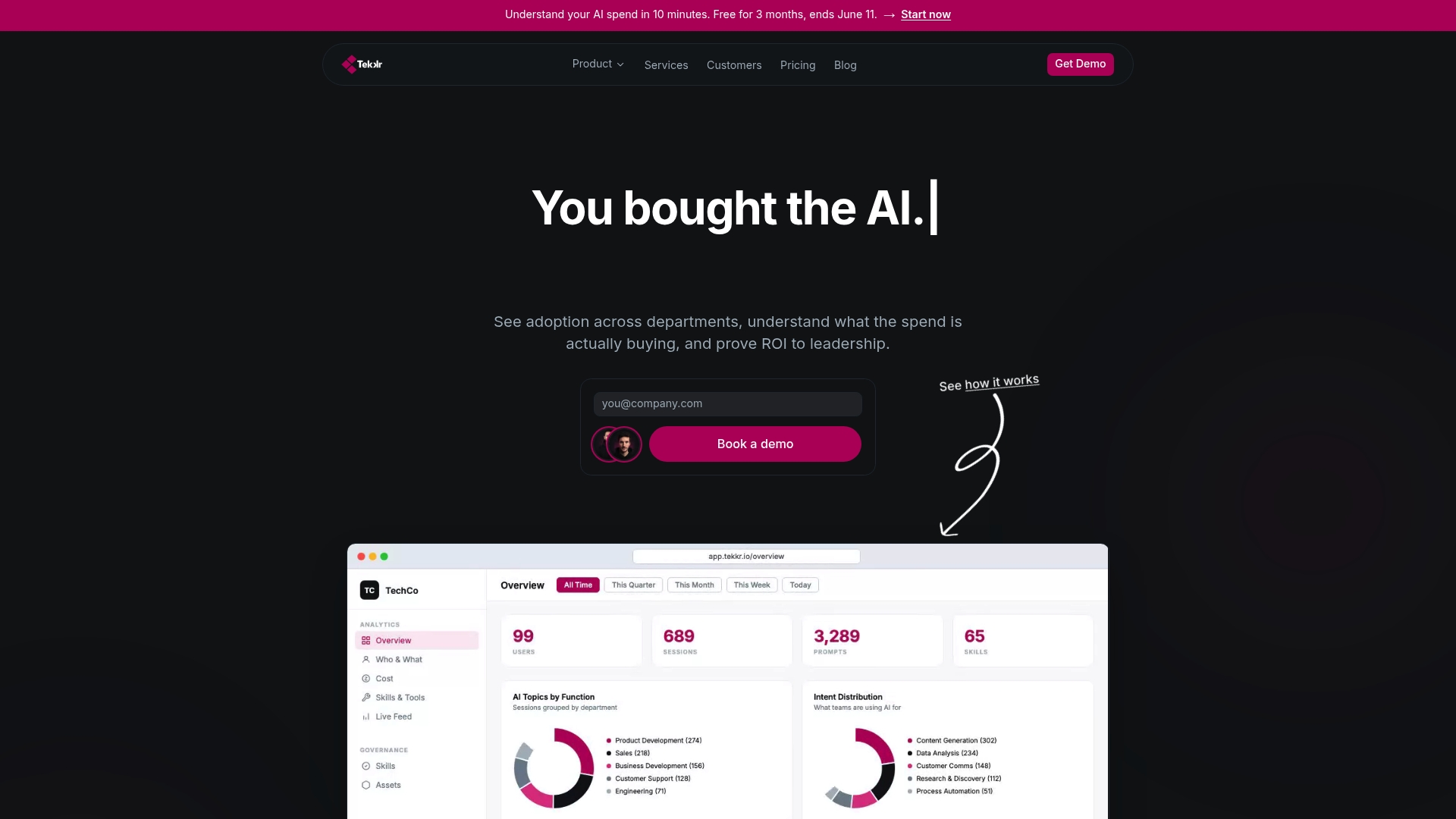
Tekkr’s Configurato product tracks AI adoption, spending, and return across every team in your organization. It identifies who is actually using tools like Claude and Codex, breaks down costs by department, and surfaces the use-case intelligence you need to make confident budget decisions. Agent Token Tracking gives you precise visibility into compute costs that vendor invoices miss entirely. The AI adoption platform runs in a privacy-first, GDPR-compliant architecture with automatic PII stripping, needs no browser extensions, and takes about 10 minutes to set up. A free tier is available with no credit card required. If you want to prove your AI is working, Configurato is where that proof gets built.
FAQ
What is AI cost per employee productivity?
AI cost per employee productivity is the total AI expenditure divided by measurable output gains per worker. It combines licensing fees, compute costs, shadow AI spend, and the observability overhead required to monitor AI performance.
What does the average company spend on AI per employee in 2026?
The average company spends $2,068 per employee on AI annually in 2026, with median firms spending under $200 and the top 1% of AI-intensive organizations spending up to $7,500 per employee per month.
How do you calculate AI ROI at the employee level?
Calculate cost per successful task by dividing total AI operating costs by the number of correctly completed tasks, then subtract rework, escalation, and human review costs to produce a net productivity gain figure.
Why do most AI pilots fail to show financial returns?
About 95% of generative AI pilots fail to produce measurable financial returns, primarily because organizations measure activity metrics like prompts sent rather than outcome metrics like cost per successfully completed task.
What is shadow AI and why does it matter for budgeting?
Shadow AI refers to unapproved AI tools employees use outside IT oversight. It costs organizations an average of $412,000 per year, with 34% of that spending duplicating tools the company already pays for.