
Nearly 78% of U.S. firms now report some form of AI adoption, yet most executives will tell you in private that the productivity leap they expected hasn’t arrived. The dashboards look impressive. The pilots are running. But real workflow change? Still waiting. The uncomfortable truth is that high adoption numbers can mask deep operational stagnation. This guide cuts through the noise and gives you a practical, evidence-backed framework for turning AI deployment into measurable business value, starting with getting the definition right.
Table of Contents
- What does AI adoption really mean?
- How AI adoption is measured: Benchmarks and the ROI frontier
- From pilots to production: Driving enterprise value with AI
- Nuances and pitfalls: Why high adoption doesn’t guarantee business value
- Why most enterprise AI adoption strategies fail: What executives need to rethink
- Take the next step: Measured AI adoption for enterprise value
- Frequently asked questions
Key Takeaways
| Point | Details |
|---|---|
| Adoption definition matters | Clarify what counts as AI adoption: mere deployment, workflow integration, and measurable enterprise value. |
| Benchmark with discipline | Use survey-based, employment-weighted, and ROI-focused metrics to track meaningful adoption progress. |
| Integration drives value | Move AI from pilots into core workflows to maximize productivity and profit impact. |
| Beware adoption pitfalls | Avoid common traps—siloed deployments, missing governance, and poor metric definition. |
| Executive strategy focus | Prioritize operating-model shifts and cross-functional engagement for sustainable adoption. |
What does AI adoption really mean?
Having established the scope of the challenge, let’s break down what “AI adoption” actually means for executive decision-making, because the term gets used loosely in ways that create real confusion.
Most people conflate three distinct things: deploying a model, changing an operating model, and integrating AI into daily workflows. These are not the same thing, and treating them as equivalent is where many enterprises first go wrong. Deploying a model means your IT team has stood up a service. Changing an operating model means ownership, governance structures, and accountability have shifted. Workflow integration means your people are producing different outputs because AI is embedded in how work actually gets done. The third level is where business value lives.
AI deployment and operational integration are separated by a significant distance in most organizations. You can have one without the other for years and never notice until a competitor pulls ahead.
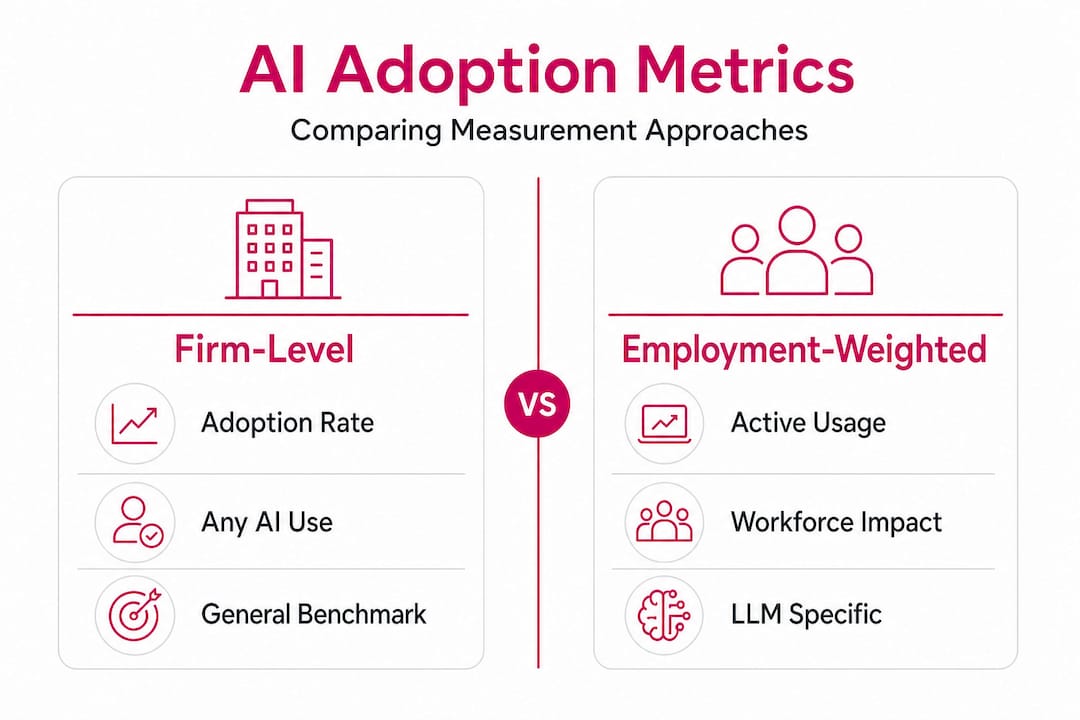
Adoption rates can be quantified in multiple ways, including firm-level counts, LLM-specific usage, and employment-weighted rates that reflect actual worker exposure. Each method tells a different story. Here is how those definitions and their implications stack up:
| Measurement approach | What it captures | Executive relevance |
|---|---|---|
| Firm-level adoption rate | Whether any AI tool is in use | Broad signal, easy to inflate |
| Employment-weighted rate | Share of workforce exposed to AI | Closer to real operational impact |
| LLM-specific adoption | Use of large language models only | Relevant for knowledge work productivity |
| Production deployment rate | AI running in core business processes | Strongest predictor of business value |
| Formal ROI tracking | Documented productivity or revenue outcomes | The metric that actually matters |
Think of firm-level adoption like measuring whether a gym membership exists. Employment-weighted rates tell you how many employees are showing up. Production deployment tells you who is actually getting fitter. You want the third number.
Key questions to ask your leadership team right now:
- Are we counting pilots or production systems in our adoption metric?
- What percentage of our workforce interacts with AI as part of their daily job?
- Can we tie any specific AI deployment to a measurable productivity outcome?
- Who owns AI governance, and is it reflected in job descriptions or performance goals?
When you are tracking AI adoption internally, the measurement method you choose will shape the story you tell the board. Choose it deliberately.
“Adoption can be high while enterprise value lags. The metric that matters is not whether AI is deployed but whether it has changed how work is done and who is accountable for that change.”
How AI adoption is measured: Benchmarks and the ROI frontier
Now that you understand what adoption means, see how it is measured and why disciplined ROI analytics are essential for leaders who want to stay ahead.
Federal Reserve empirical benchmarks show employment-weighted firm AI adoption rates hovering around 78%, while LLM-specific adoption sits lower, closer to 54%. That gap matters. It tells you that a large portion of firms are running older, narrower AI workloads and have not yet moved into the generative and agentic layer where the biggest productivity gains are emerging. Meanwhile, 72% of enterprises now use GenAI weekly and formally measure ROI, according to Wharton’s 2025 AI Adoption Report. That is a significant signal that measurement discipline is becoming a competitive differentiator.
Here is what current benchmarks look like across key dimensions:
| Metric | 2026 benchmark | What leaders should target |
|---|---|---|
| Firm-level AI adoption | ~78% | Baseline, not a goal |
| LLM-specific adoption | ~54% | Actively expand this layer |
| Weekly GenAI usage by employees | 72% | Aiming for 80%+ in knowledge work |
| Enterprises formally measuring ROI | 72% | 100% within 12 months |
| AI deployed in core production workflows | Minority of firms | Your immediate priority |
LLM adoption in enterprises varies significantly by industry and use case, which means generic benchmarks should be filtered through your sector context before you use them in board conversations.
For executives ready to move from experimentation to accountability, here are four concrete steps:
- Define your measurement standard. Pick employment-weighted usage, not just firm-level deployment. Tie it to a specific workflow or function before rolling it out broadly.
- Establish a weekly usage baseline. Track which roles interact with AI tools at least once per week. This is your real adoption floor, not the procurement count.
- Build a formal ROI tracking process. Link AI usage to specific output metrics: time to complete tasks, error rates, revision cycles, or throughput per employee.
- Review and iterate quarterly. Benchmarks shift fast. Your internal data should be refreshed at the same cadence as your product or revenue reviews.
Pro Tip: The fastest way to distinguish AI hype from real results is to look at revision rates. If employees are spending significant time cleaning up AI output, your adoption is high but your value is low. That is the signal to act on, not the usage number.
AI ROI analytics are not a finance exercise. They are an operational feedback loop that tells you where to invest next and where to stop wasting time.
From pilots to production: Driving enterprise value with AI
Understanding how to measure adoption sets the stage for what matters next, which is embedding AI into real, productive workflows that drive value rather than leaving it in the innovation sandbox.
The shift from pilot to production is where most enterprises stall. Pilots are safe. They have defined scope, limited stakeholders, and no accountability for business outcomes. Production deployments are different. They require governance, change management, cross-functional buy-in, and clear ownership. Many organizations run dozens of pilots simultaneously while enterprise workflow integration stays at near zero in their core business operations.
AI adoption as operating-model change means treating it the same way you would treat any major transformation, with ownership structures, governance frameworks, and accountability built in from day one. The Microsoft Cloud Adoption Framework makes this point explicitly: technical deployment without operating-model change produces temporary productivity bumps, not sustained competitive advantage.

The deployment vs. value gap is well documented. HBR Analytic Services found that high adoption without integration leaves business value on the table at scale. The organizations that close this gap share a few common traits.
Common pitfalls that keep AI stuck in pilot mode:
- Siloed deployments where each department runs its own AI tool with no shared governance or quality standards
- No defined ownership of AI outputs, meaning nobody is accountable when the AI produces something wrong or off-brand
- Security and compliance gaps that slow production rollout because governance was not built in from the start
- Generic prompting by employees who use AI as a search engine rather than a workflow accelerator
- Missing integration with existing systems of record, which forces employees to copy and paste rather than streamline
“The companies seeing the biggest productivity gains from AI are not the ones with the most tools. They are the ones that have built clear processes around how AI is used, reviewed, and improved over time.”
AI workflow integration approaches that treat AI as a process layer rather than a standalone tool consistently outperform those that treat it as a point solution.
Pro Tip: Prioritize cross-functional integration over departmental wins. A single AI workflow that spans sales, legal, and product management creates more compounding value than three separate departmental tools that never talk to each other.
Nuances and pitfalls: Why high adoption doesn’t guarantee business value
Before we move to hands-on executive strategies, it is critical to understand what can go wrong, because the nuances are where disciplined leaders separate themselves from the pack.
The deployment vs. value gap is not abstract. Adoption metrics can mislead depending on how they are defined and collected. A firm that counts any API call to an AI service as “adoption” will report very different numbers than one that counts weekly active users producing verified outputs. Industry differences compound this. A financial services firm and a retail company face completely different regulatory constraints, data architectures, and workflow structures. Benchmarks that flatten these differences give executives a false sense of where they stand.
Cross-functional AI adoption requires a different mental model than departmental tool deployment. It demands process standardization, shared data access, and governance that spans organizational boundaries.
The highest-impact pitfalls executives encounter:
- Defining adoption as deployment rather than integration, which inflates numbers without improving outcomes
- Failing to connect AI initiatives to business unit KPIs, making it impossible to justify continued investment
- Ignoring change management, which leaves employees using AI poorly because they were never shown how it fits their specific work
- Treating governance as a compliance checkbox rather than a driver of output quality
- Running too many pilots in parallel without a clear path to production for any of them
- Missing the compounding effect of feedback loops, where AI output quality improves over time only if someone is capturing and acting on quality signals
“Adoption rates are high, but value lags without process integration. The organizations that will win are the ones that stop measuring whether AI is present and start measuring what it is producing.”
The edge case described by HBR is now the norm, not the exception. Most firms are in it. The ones that recognize this early have a real window to pull ahead.
Why most enterprise AI adoption strategies fail: What executives need to rethink
Here is the uncomfortable truth most AI strategy articles avoid. The biggest mistake executives make is not underinvesting in AI. It is investing heavily in deployment while treating workflow change as someone else’s problem.
You can procure every major AI platform on the market, run adoption training for the entire company, and still see no material improvement in output quality or speed. We have seen this pattern repeatedly. The issue is not capability. It is that the AI has no idea how your company actually works. It does not know your quality standards, your approval processes, your architecture decisions, or your customer communication style. So employees prompt generically, get generic output, and spend their time reworking it. Adoption looks high on paper. The competitive advantage never materializes.
The organizations that get this right do something different. They treat AI configuration as an operating-model decision, not a technical one. They codify what great work looks like in their specific context and push that knowledge into the AI layer so that every output reflects company standards from the first draft. This is not a training problem. It is a context problem. And context is something you can systematically solve.
The AI adoption lessons that actually move the needle come from organizations that built governance into the AI layer itself, not from organizations that held more training sessions. Governance, change management, and cross-functional buy-in are not soft skills in this context. They are the mechanism by which AI deployment becomes business value.
If your board is asking about AI ROI and you are still pointing to usage metrics, that is a signal to shift. Stop counting seats. Start counting outcomes. Define what a good output looks like in every major workflow, build that definition into your AI systems, and measure improvement from there. That is the operating-model shift that separates real AI leaders from the rest.
Take the next step: Measured AI adoption for enterprise value
You have the framework. Now the question is how fast you can move from understanding to action.
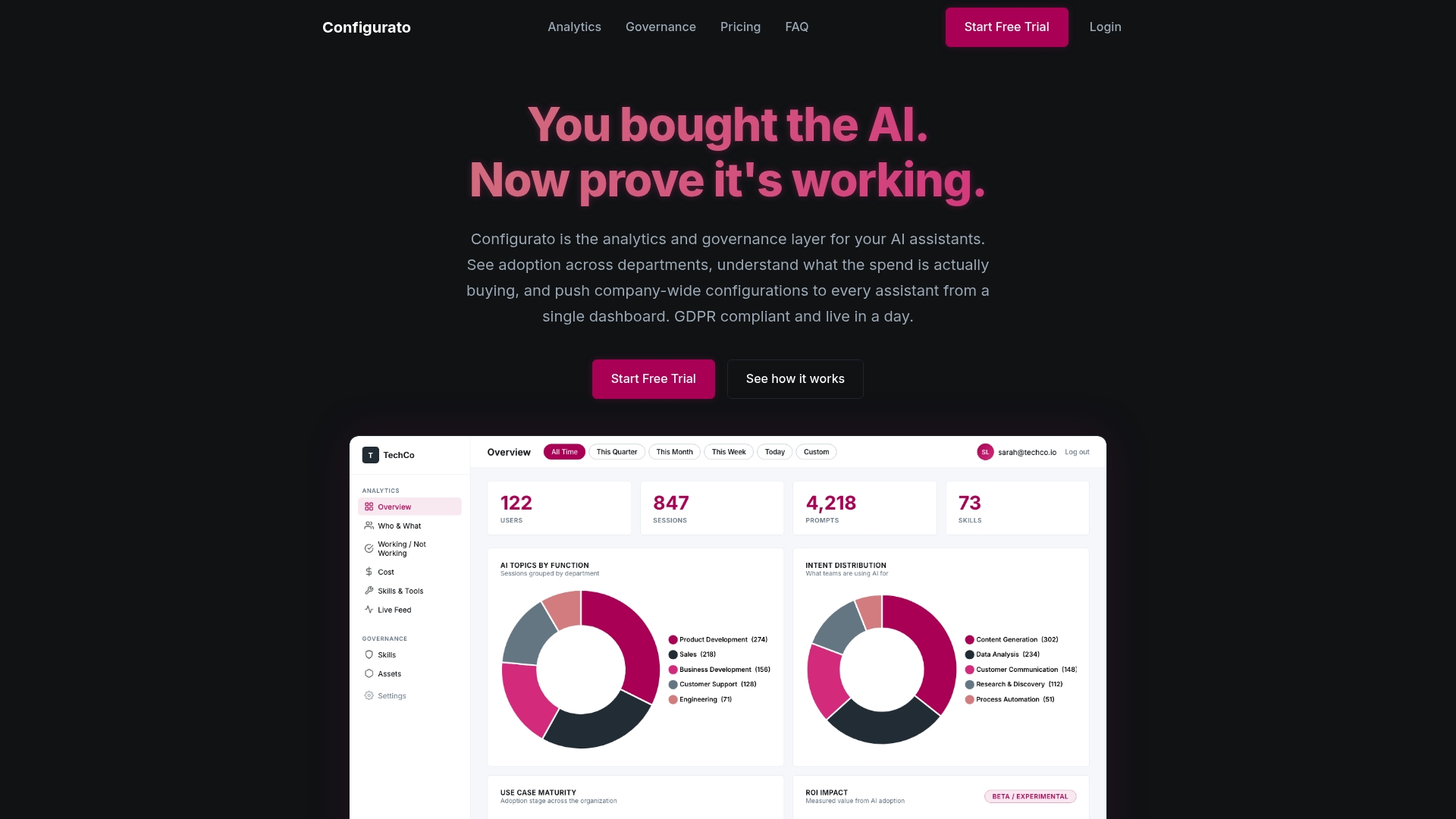
Tekkr’s analytics and governance platform is built specifically for enterprises that want to close the deployment vs. value gap. Tekkr Configurations embeds your company’s processes, quality standards, and domain knowledge directly into whatever AI assistants your people use, agent to agent, in the background. No new tools for employees to learn. No rework on every output. Your AI simply starts working like someone who already knows how your company operates. If you are ready to benchmark your adoption, trace where AI is actually accelerating work, and configure your AI layer for real productivity gains, Tekkr is the place to start.
Frequently asked questions
How is AI adoption typically measured in large enterprises?
AI adoption is measured using employment-weighted rates, survey-based usage patterns, and formal ROI tracking, focusing on both frequency of use and business outcomes. Empirical benchmarks from the Federal Reserve show employment-weighted firm AI adoption rates around 78%, with LLM adoption at approximately 54%.
Why do some companies report high AI adoption but see limited business value?
Without integrating AI into operational workflows and managing change, adoption may be high but business value stays low. This is the deployment vs. value gap, and HBR Analytic Services confirms it is widespread across industries.
What is the best first step for CTOs wanting effective AI adoption?
Start by defining clear adoption metrics tied to workflow outcomes, ensure cross-functional buy-in, and establish formal ROI measurement. Leaders increasingly define adoption as weekly usage and formal ROI measurement across functions rather than simple deployment counts.
How do benchmarks differ for LLM adoption versus general AI?
LLM adoption rates are typically lower than general AI adoption. Employment-weighted data shows firm AI adoption around 78% compared to roughly 54% for LLM-specific workloads, reflecting that many firms still run narrower AI tools rather than generative systems.
What are typical pitfalls executives face when implementing AI?
Common pitfalls include siloed pilots with no path to production, weak governance, and failing to align AI outputs with business quality standards. Treating AI adoption as operating-model change rather than a technical deployment is the corrective move most executives need to make.