
You’ve rolled out AI tools across your organization, the licenses are paid, the announcements were made, and the dashboards show healthy usage numbers. Yet somehow, the competitive edge you expected still hasn’t arrived. As of Q1 2026, 78% of Global 2000 companies have at least one AI workload in production, but only 29% achieve significant ROI. That gap isn’t a technology problem. It’s a structural one. This guide walks you through the ai adoption best practices 2026 that separate organizations getting real business value from those stuck in an endless cycle of promising pilots.
Table of Contents
- Understanding the AI adoption landscape in 2026
- Preparing your organization: governance, strategy, and cultural readiness
- Executing AI adoption: phased implementation and pilot scaling
- Verifying impact: measuring ROI, productivity, and overcoming common pitfalls
- Rethinking AI adoption: why organizational redesign beats tool rollout
- Accelerate AI adoption success with Configurato’s analytics and governance tools
- Frequently asked questions
Key Takeaways
| Point | Details |
|---|---|
| AI adoption is widespread | Most large enterprises have deployed AI at scale but few achieve strong organizational ROI. |
| Governance is essential | Establish oversight boards and risk management before scaling AI projects. |
| Prioritize high-ROI use cases | Focus on automations delivering measurable business impact and operational KPIs. |
| Address employee resistance | Build trust through transparency, monitoring, and workflow redesign for AI collaboration. |
| Measure and verify impact | Track time savings, throughput, error reduction, and financial returns continuously. |
Understanding the AI adoption landscape in 2026
Before you fix a problem, you need to understand the size of it. AI adoption trends in 2026 tell a story that should concern every executive responsible for making this work.
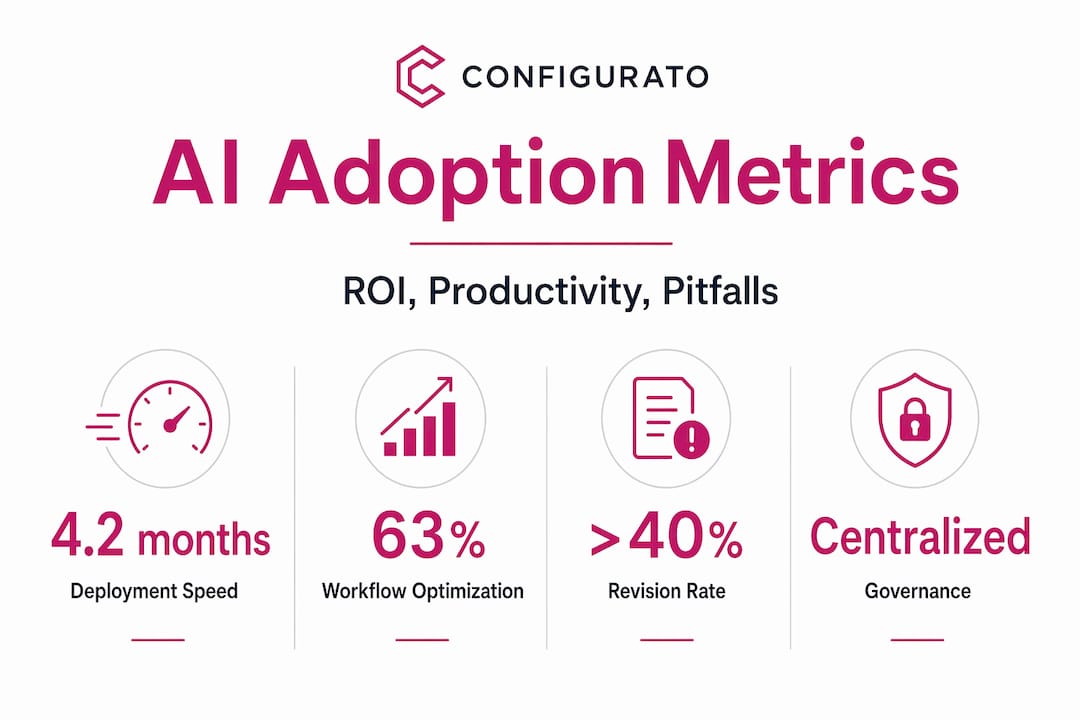
The median pilot-to-production time has dropped from 11 months in 2024 to just 4.2 months in 2026. Deployment is accelerating. Customer support automation leads ROI performance at 3.4x, followed by software engineering assistance and document analysis. The tools are maturing fast, and your competitors are moving.
On the investment side, 86% of organizations plan to increase AI budgets in 2026, with most of that capital aimed at workflow optimization. But the number one obstacle to realizing those investments is not adoption speed. It is data quality. Garbage-in, garbage-out applies to AI more painfully than it ever did to traditional software.
Here is where most enterprises are deploying AI right now:
- Customer service and support automation
- Code generation and software development assistance
- Document review, summarization, and contract analysis
- Internal knowledge retrieval and employee self-service
- Marketing content production and personalization
And here is what budget priorities actually look like across industries:
| Investment area | % of organizations prioritizing |
|---|---|
| Workflow optimization | 63% |
| Data quality and management | 58% |
| AI governance and compliance | 44% |
| Employee training and enablement | 39% |
| New AI use case development | 34% |
Notice what sits near the bottom. Employee enablement is fourth on the list, which helps explain why AI productivity gains in agencies and other early-adopter verticals rarely translate to organization-wide results. You can have world-class tools and still have a workforce that doesn’t know how to use them for your specific work. With this market picture in mind, let’s get into what you need to build before launching any AI initiative at scale.
Preparing your organization: governance, strategy, and cultural readiness
Here is an uncomfortable truth: 75% of AI strategies lack substance, and 54% of executives report internal friction as a top obstacle to scaling. That friction isn’t coming from outside. It’s coming from inside your organization, and no amount of budget will fix it if you skip the groundwork.
Preparation comes in three layers: governance, strategy, and culture. Compress any one of them, and you’re building on sand.
-
Form a multidisciplinary AI governance board before you scale anything. This board should include legal, compliance, IT, HR, and business unit leads. Its job is to define risk tolerance, establish an AI system inventory, and own the NIST AI RMF guidance your organization will follow. Governance built after the fact is theater.
-
Align your AI strategy to revenue-impacting use cases with clear, measurable KPIs. If a proposed use case can’t be tied to cost reduction, cycle time improvement, or revenue generation within 12 months, it’s a research project, not a business initiative.
-
Identify your AI champions inside business units early. These are the people who will carry adoption forward on the ground. They need visibility, resources, and a direct line to the governance board.
-
Run a workforce readiness audit. Survey employees on their comfort with AI tools, their perceived job security concerns, and where they see AI as genuinely useful versus threatening. You cannot address resistance you haven’t measured.
-
Communicate the “why” with specifics, not platitudes. Employees who understand exactly how AI changes their role are far more likely to engage than those who receive generic reassurance.
Common governance gaps that stall progress:
- No defined process for retiring or replacing underperforming AI models
- No clear accountability for AI-generated errors or compliance violations
- No audit trail connecting AI outputs to business decisions
- AI budgets owned by IT but success measured by business units
Pro Tip: Tie your first governance board meeting output to a published internal policy document. Organizations that commit governance to writing in the first 30 days are measurably faster to scale than those that keep it verbal.
You can explore AI governance best practices to understand how centralized oversight integrates with your existing compliance architecture before you write your first policy.
Executing AI adoption: phased implementation and pilot scaling
Execution is where most of the failure happens. Not because teams aren’t capable, but because they try to run before they can walk. A phased approach forces discipline, and discipline is what turns a pilot into a production system.
The recommended ai adoption step by step process follows four phases with realistic timelines:
-
Assessment (weeks 1 to 4): Map every candidate use case against three dimensions: business value, technical feasibility, and risk level. Rank them. The highest-value, lowest-risk tasks go first. This isn’t a creative exercise. It’s triage.
-
Piloting (weeks 4 to 12): Launch bounded pilots with a defined test group, clear success metrics, and a human-in-the-loop validation layer. According to ATI Lab’s practical playbook, the piloting phase should target an ROI signal within 6 to 12 months. If you can’t see directional movement by week 8, something in your setup is off.
-
Scaling (months 3 to 9): Expand pilots that hit KPI thresholds. Add governance checkpoints at each expansion stage. Applied’s AI adoption strategy recommends weekly KPI reviews during early scaling, not monthly. Things move fast enough that monthly reviews leave you chasing problems that compounded quietly.
-
Continuous monitoring: Once a system is in production, it needs anomaly detection, rollback procedures, and a defined retraining schedule. AI models degrade. Plan for it.
Here’s how piloting success metrics typically break down by use case category:
| Use case | Primary KPI | Secondary KPI |
|---|---|---|
| Customer support automation | First-contact resolution rate | Average handle time |
| Code generation | PR merge rate | Developer cycle time |
| Document analysis | Processing time per document | Error rate vs. manual review |
| Internal knowledge retrieval | Query resolution rate | Escalation frequency |
Pro Tip: Your pilot group should include skeptics, not just enthusiasts. Skeptics surface edge cases and failure modes that your most engaged users will work around without flagging. You want to find the cracks before you scale.
If you’re working through executing AI adoption at scale across multiple business units simultaneously, the governance checkpoints between phases become even more critical. Decentralized execution without centralized visibility is how adoption fragmentation starts.

You can also look at how streamlining AI production workflows plays out in content-heavy environments for a concrete example of phased rollout producing measurable time savings.
Verifying impact: measuring ROI, productivity, and overcoming common pitfalls
Here’s the paradox of AI adoption in 2026: AI super-users show 5x productivity gains, yet only 29% of organizations achieve significant ROI. The super-users are real. The gains are real. But they’re not spreading. That is a measurement and distribution problem, not a technology problem.
Effective measurement for this AI adoption full guide covers three layers:
- Quantitative operational KPIs: task completion time, throughput per employee, error rate per process, cost per transaction
- Adoption behavior metrics: active users vs. licensed users, prompt quality scores, output revision rates
- Qualitative signals: employee confidence surveys, manager assessments of output quality, customer satisfaction scores tied to AI-assisted touchpoints
Wharton’s AWARE framework gives you a structured way to address the resistance side of measurement. AWARE stands for Acknowledge employee concerns, Watch usage behaviors, redesign processes for human-AI collaboration, Ensure transparency about how AI is used, and empower employees with agency over their workflows. Organizations that skip this layer wonder why their utilization numbers plateau.
Common ai adoption pitfalls that kill ROI:
- Measuring adoption by license activation instead of actual task completion rates
- Treating AI output as final without building review checkpoints into workflows
- Ignoring data quality until models start producing visibly wrong outputs
- Deploying AI without redesigning the downstream processes that consume its output
- Letting individual super-users hold all the workflow knowledge without systematizing it
Pro Tip: Track the revision rate on AI-generated outputs. If employees are rewriting more than 40% of what AI produces, the model isn’t the problem. The problem is that AI doesn’t know how your organization works, what your standards are, or what “good” looks like for your specific context.
You can build this kind of measurement infrastructure through AI adoption measurement and analytics tools that surface where AI is actually accelerating work and where it’s quietly creating rework.
Rethinking AI adoption: why organizational redesign beats tool rollout
Here’s the take that most consultants and vendors won’t give you, because it doesn’t serve their interests: the tools are mostly fine. The problem is that organizations are treating AI adoption as a software rollout when it’s actually a workflow redesign program.
The gap between super-user gains and org-wide ROI is the clearest proof point we have. When one person on your team gets 5x more productive using AI and the team’s overall output barely moves, you don’t have a technology problem. You have a systems problem. There is no mechanism to take what that person figured out and make it the default for everyone.
Winning organizations are doing something structurally different. They’re centralizing IT governance while decentralizing execution. Business teams own the use cases, define what great output looks like, and drive day-to-day adoption. IT owns the oversight layer, the compliance guardrails, and the infrastructure that makes consistent AI behavior possible at scale. That separation of responsibility is not a bureaucratic formality. It’s what allows AI gains to compound instead of staying trapped inside individual contributors.
Trust is also non-negotiable. You cannot govern what you don’t track, and you cannot build employee trust with opacity. Every AI system in production should have a clear owner, a defined scope, and an audit trail that managers can actually read. Organizations that embed accountability into AI deployment from day one scale faster and with less resistance than those that add it retroactively.
The artificial intelligence strategies 2026 that are actually working share this common thread: they treat AI as a change to how work gets done, not as software to install. That distinction changes everything about how you prioritize, govern, and measure. Explore scaling AI adoption through organizational redesign to see how this structural shift translates into a practical execution model.
Accelerate AI adoption success with Configurato’s analytics and governance tools
Every tactic in this guide runs into the same wall if you’re trying to hold it together manually. You need visibility across every AI workflow, not just the ones your most engaged teams are running.
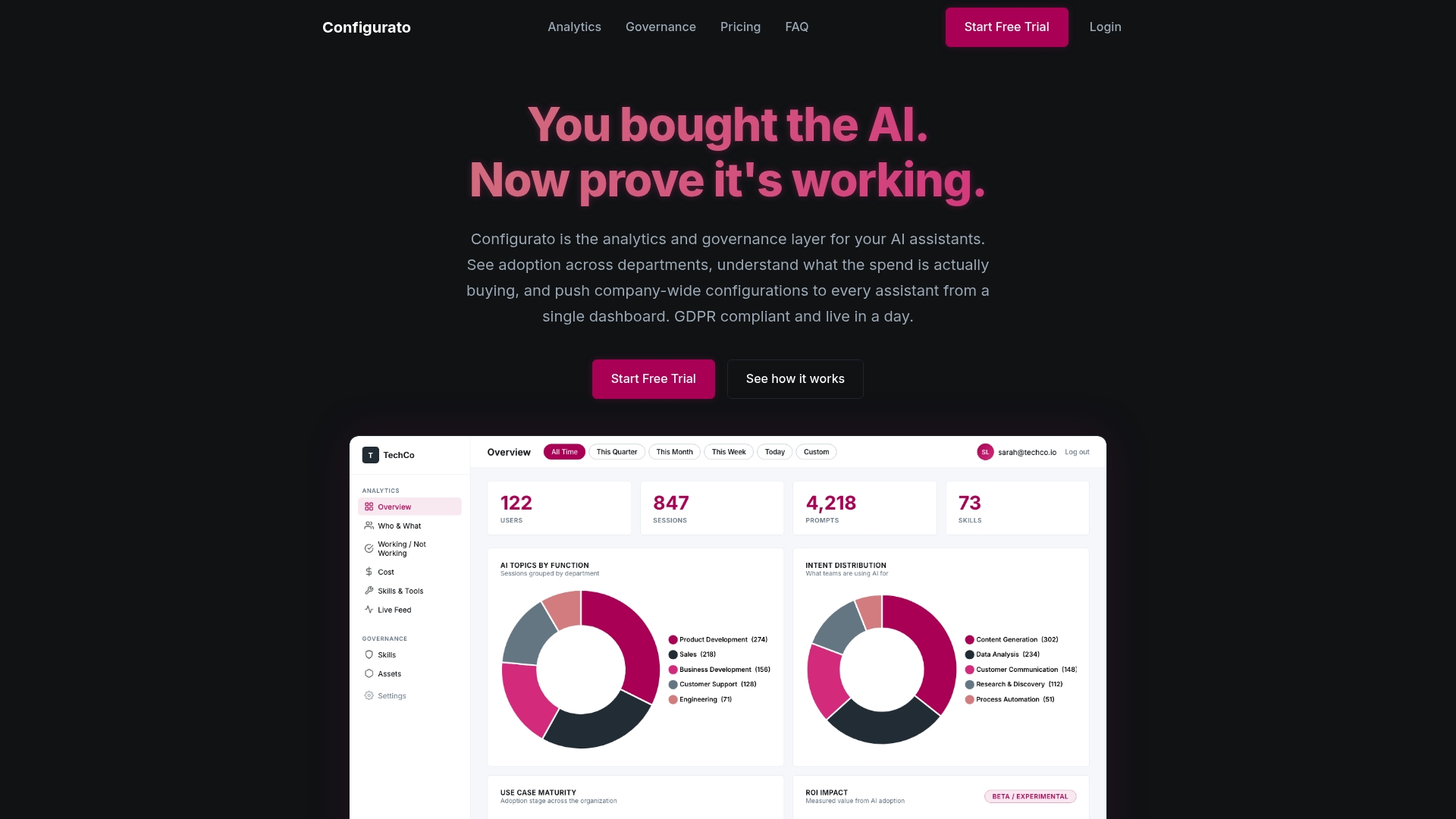
Configurato, built by Tekkr, gives executives a centralized control layer for AI adoption: real-time usage analytics that show where AI is generating value and where it’s creating rework, built-in governance tools that enforce compliance without slowing teams down, and cross-company benchmarking data that reveals what high-performing AI adoption actually looks like in practice. It works across Claude, GPT, Copilot, and Gemini, so you’re not locked into a single vendor’s definition of success. If you’re ready to move from scattered pilots to measurable, organization-wide ROI, the Configurato analytics and governance platform is where that work starts.
Frequently asked questions
What are the biggest challenges executives face with AI adoption in 2026?
Executives struggle with cultural resistance, fragmented strategies, data quality issues, and governance gaps that prevent scaling AI’s organizational ROI. 79% of enterprises report AI challenges including trust breakdowns and governance weaknesses as primary blockers.
How long does it typically take to move an AI pilot to production?
The median time from pilot to production fell from 11 months in 2024 to 4.2 months in 2026, driven by maturing tooling and more experienced implementation teams.
What strategies help overcome employee resistance to AI adoption?
Acknowledging concerns, redesigning workflows for human-AI collaboration, and maintaining transparency about how AI is used build lasting trust. Wharton’s AWARE framework outlines exactly how to sequence these interventions for maximum adoption impact.
How can organizations measure the ROI of their AI initiatives effectively?
Track operational KPIs like task time reduction, throughput, error rates, and cost per transaction alongside qualitative employee feedback. Bounded pilots with weekly KPI reviews give you the signal speed needed to course-correct before problems compound.
What role does governance play in successful AI adoption?
Governance defines risk tolerance, establishes accountability, and ensures compliance before AI reaches production scale. The NIST AI RMF guidance recommends building governance boards and risk inventories as a prerequisite to any scaling activity.