
Most executives believe they’ve already deployed AI. They’ve handed their teams Copilot licenses, stood up ChatGPT access, and watched adoption metrics climb. What they haven’t seen is the productivity leap they expected. The reason is straightforward but uncomfortable: AI tools don’t transform work on their own. The organizations seeing productivity gains of up to 50% aren’t just automating repetitive tasks like data entry, invoice processing, and HR inquiries. They are fundamentally redesigning how humans and machines collaborate across entire workflows. This guide shows you exactly how to get there.
Table of Contents
- How AI truly accelerates work: More than just automation
- Benchmarking AI’s enterprise impact: What the data reveals
- Barriers and risks: Why AI rollouts stall or underperform
- Actionable strategies: Building a high-performance human-AI workforce
- Why most AI integrations fail—and how to tip the odds in your favor
- Ready to accelerate your productivity with AI? Here’s your next step
- Frequently asked questions
Key Takeaways
| Point | Details |
|---|---|
| Go beyond task automation | Enterprise AI delivers outsized value when reshaping entire workflows instead of just isolated tasks. |
| Validate with hard data | Rely on productivity, error rate, and ROI benchmarks to measure AI success and refine deployment. |
| Prioritize human-AI teams | Hybrid approaches consistently outperform pure automation in reliability and output quality. |
| Address barriers up front | Mitigate risks by modernizing workflows and workforce together and by building robust oversight into every rollout. |
How AI truly accelerates work: More than just automation
Having set the strategic context, let’s clarify how AI’s impact extends beyond basic automation into end-to-end workflow transformation.
The conversation about AI in the enterprise has been dominated by task-level automation for too long. Can AI handle invoice processing? Yes. Can it respond to routine HR inquiries? Absolutely. But framing AI as a task executor misses where the real value lives. The most significant gains come from orchestrating how work moves between people and machines across an entire process.
AI reshapes entire workflows through task sequencing, intelligent grouping, and dynamic human-AI handoffs. Think about a contract review process. A purely task-based view says: use AI to extract clauses. A workflow-based view says: redesign the entire sequence so AI handles initial extraction, flags anomalies with confidence scores, routes edge cases to specialists, and generates a structured brief for the attorney. The attorney now spends 20 minutes on judgment, not 90 minutes on reading. That is the difference.
“The companies seeing the biggest productivity returns are not the ones with the most AI tools. They are the ones that have thought hardest about where human judgment actually adds value and designed their workflows accordingly.”
Key mechanisms that power this transformation include:
- Robotic Process Automation (RPA) for structured, rules-based tasks like data entry and system reconciliation
- Large language models (LLMs) for generating, summarizing, and classifying unstructured content
- Agentic AI for multi-step, dynamic tasks where the system makes sequencing decisions autonomously
- Human-AI handoff protocols that define precisely when and how a human enters the loop
The improving productivity with AI evidence is compelling. Studies project 30 to 50% productivity gains for knowledge workers when AI is embedded into redesigned workflows rather than bolted on top of existing ones. In customer support alone, organizations have reported 94% of routine inquiries resolved autonomously, freeing human agents for escalations that actually require empathy and judgment.

You can explore AI project ROI benchmarks to understand what realistic gains look like across different enterprise functions before you commit budget.
Benchmarking AI’s enterprise impact: What the data reveals
With the core mechanisms outlined, it is critical to ground expectations in data. Where does AI truly deliver, and where does it fall short?
The enterprise AI results landscape is genuinely mixed, and pretending otherwise will get you into trouble with your board. Let’s look at the organizations that have done this at scale and what they actually achieved.
| Organization | Metric | Outcome |
|---|---|---|
| IBM | Productivity gains | $4.5B in 2024 |
| IBM | Hours saved | 3.9M hours |
| Repsol | Time saved per employee | 121 minutes per week |
| Repsol | Output quality improvement | 16.2% |
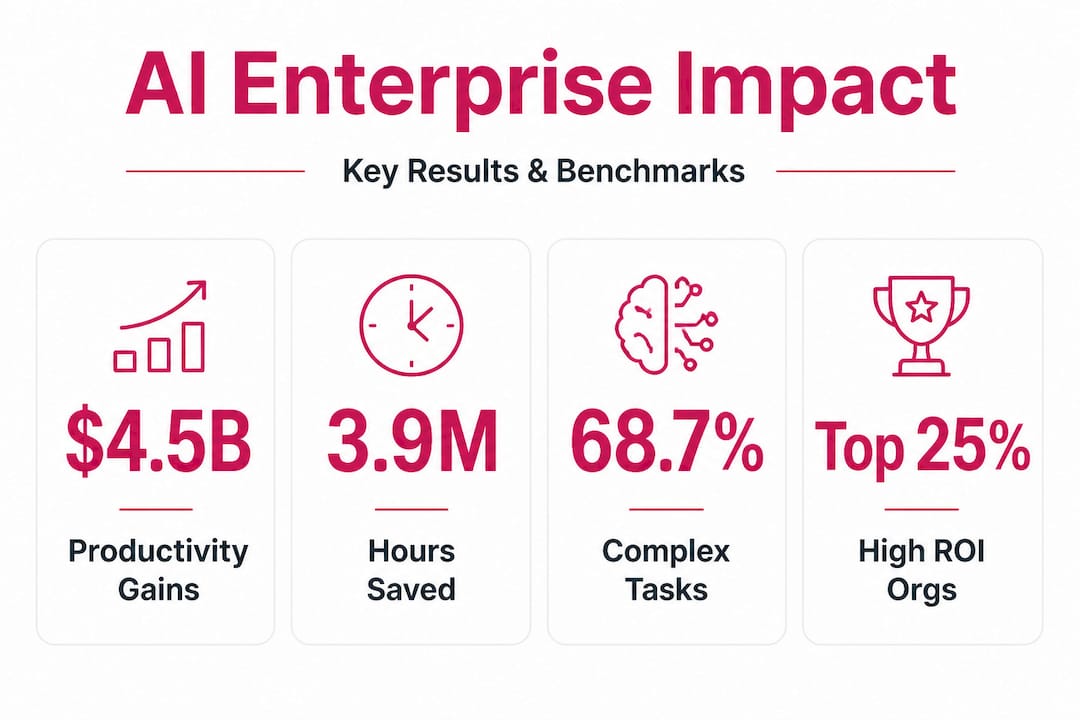
These enterprise AI results are real and worth taking seriously. But they represent the top of the distribution, not the median. IBM and Repsol are organizations that invested heavily in workflow redesign alongside the technology deployment. They did not simply hand employees access to a tool and measure what happened.
The broader picture is more sobering. UK benchmark data shows that while 82% of working hours are potentially AI-enhanceable, only 3% of processes are currently ready for fully autonomous agentic AI execution. Perhaps most critically, only 25% of AI projects actually deliver the ROI that was projected at the business case stage.
What separates the 25% from the 75%? A few patterns emerge consistently:
- Success concentrates in domains where outputs are measurable and quality can be evaluated quickly, particularly customer support, software development, and document processing
- Organizations that redesign workflows before deploying AI outperform those that retrofit AI onto existing processes
- Teams that track error rates and rework time alongside speed metrics catch quality degradation before it becomes expensive
Pro Tip: Never let adoption rates be your primary AI success metric. Track real productivity indicators: time to first draft, error rate before human review, and rework cycles. Those numbers tell you whether AI is actually helping or just creating the illusion of activity.
You can leverage analytics for AI deployment to build the measurement infrastructure that separates genuine ROI from vanity metrics.
Barriers and risks: Why AI rollouts stall or underperform
Just as important as measuring the upside is confronting the barriers. Understanding why AI initiatives sometimes fail to meet ambitious goals is where the real executive learning happens.
The failure modes are more predictable than most executives realize. They cluster into three categories: technical reliability gaps, organizational resistance, and the trap of premature automation.
On the technical side, AI hallucination is a real and underappreciated risk. AI models can generate confident-sounding output that is factually wrong, legally problematic, or simply misaligned with your company’s standards. This is especially dangerous in regulated industries where the cost of a single error can be significant. AI reliability challenges are not going away in the short term, which means human oversight is not optional.
The data on hybrid versus autonomous approaches is striking. Hybrid human-AI teams outperform fully autonomous AI agents by 68.7% on complex tasks. That number should shape how you architect your AI programs. Full autonomy is not the near-term goal. Optimal collaboration is.
Here is a breakdown of how the two approaches compare:
| Dimension | Hybrid human-AI teams | Fully autonomous AI agents |
|---|---|---|
| Complex task performance | 68.7% higher | Baseline |
| Error recovery | Human catches and corrects | Errors can cascade |
| Regulatory compliance | Auditable human checkpoint | Harder to trace decisions |
| Employee trust | Higher adoption | Resistance and skepticism |
| Speed | Slightly slower | Faster on routine tasks |
Beyond technical risks, the organizational challenges are equally significant. Optimists see rapid productivity surges. Patient observers and more alarmed practitioners point to reliability gaps, the difficulty of actual workflow redesign, uneven adoption across teams, and the potential for AI to widen skill gaps between high and low performers rather than leveling the field.
The specific risk factors to track in your organization:
- Over-reliance on AI output without critical review, leading to errors that compound downstream
- The “jagged frontier” problem, where AI performs brilliantly on some tasks and fails unpredictably on adjacent ones that seem similar
- AI fatigue, where employees who initially embraced the tools gradually revert to manual methods when outputs require constant rework
- Underestimating the human input required to maintain, evaluate, and improve AI systems over time
Pro Tip: Build human-in-the-loop checkpoints from day one. Do not treat oversight as a temporary training measure. In most enterprise contexts, structured human review is a permanent feature of responsible AI deployment, not a sign that your AI is underperforming.
Strong governance for AI projects is what separates organizations that scale responsibly from those that cycle through expensive restarts.
Actionable strategies: Building a high-performance human-AI workforce
Having outlined the pitfalls, here is how forward-thinking leaders are translating lessons learned into scalable, high-impact strategies.
The organizations that consistently land in the top quartile of AI ROI do not have better tools than everyone else. They have better execution discipline. That starts with process selection and extends through governance, workforce development, and continuous measurement.
Here is the sequenced approach that actually works:
-
Start with high-volume, low-risk workflows. Your first AI deployments should be in areas where the task volume is high, the output is easy to evaluate, and the cost of an error is manageable. Document summarization, routine customer inquiry triage, and code review assistance are classic starting points. Resist the temptation to begin with your most complex or high-stakes processes.
-
Build agent contracts before you build agents. An agent contract is a structured specification that defines what an AI agent is responsible for, what decisions it can make autonomously, what triggers a human escalation, and how success is measured. Clear agent contracts and control towers are foundational to modular, maintainable AI orchestration. Without them, your AI programs become ungovernable as they scale.
-
Design for modularity. Each AI component should do one thing well and connect to adjacent components through defined interfaces. This lets you swap models, update processes, and scale individual components without rebuilding your entire architecture. Monolithic AI deployments are brittle and expensive to maintain.
-
Address workflow debt before deploying AI. Automating a broken process just produces broken results faster. Workforce modernization done right means cleaning up process documentation, clarifying ownership, and defining quality standards before you introduce AI into the loop. Skipping this step is the single most common reason AI pilots fail to scale.
-
Invest in concurrent reskilling. AI changes what skills matter, not just how fast work gets done. Your workforce needs to develop prompt engineering fluency, AI output evaluation skills, and the ability to identify where human judgment genuinely adds value. This is not a one-time training event. It is an ongoing capability that needs to be treated as seriously as any other core competency.
Key principles for building your human-AI workforce:
- Prioritize hybrid team structures over full automation in any domain requiring judgment, creativity, or nuanced communication
- Establish a control tower function that monitors AI performance, catches drift, and owns the continuous improvement cycle
- Measure rework rate alongside speed, because fast output that requires heavy editing is not actually saving time
- Use AI business strategy best practices to ensure your AI investments are aligned with genuine business priorities, not technology enthusiasm
“The question is not whether to integrate AI. The question is whether you have the execution discipline to make it actually stick.”
AI workforce modernization solutions can help you build the infrastructure to make these strategies operational rather than aspirational.
Why most AI integrations fail—and how to tip the odds in your favor
Let’s cut through the hype and share a hard-won lesson from enterprise-scale AI rollouts. The uncomfortable truth is that tool deployment and AI transformation are not the same thing. Most organizations have accomplished the former while believing they have achieved the latter.
The core problem is what we call the execution gap. You can have the right model, the right budget, and genuine leadership commitment. If you have not simultaneously modernized your workflows and your workforce, the gains will be marginal and temporary. The data makes this stark: only 16% of AI projects scale to enterprise-wide deployment. The other 84% stall after a promising pilot or deliver results that do not justify expansion.
The temptation to over-automate is real. Executives see early wins in a narrow process and ask: can we automate more of this? The answer is often yes, technically. The better question is: should we? Pushing automation into areas where human judgment is genuinely required does not eliminate the need for that judgment. It just hides it until something goes wrong, and by then the error has usually propagated through several downstream steps.
What actually works is precise pilot selection, paired with relentless measurement. Choose your initial deployments based on three criteria: high task volume, low error consequence, and clear measurability. Run them with rigorous human oversight, track real productivity indicators, and only scale what you can prove is working. This feels slower than the “move fast” instinct that drives most technology initiatives. But it is the approach that gets you to scaling enterprise AI sustainably, rather than cycling through expensive restarts.
The organizations winning with AI are not the ones with the most tools. They are the ones that have been honest about where the execution gaps live and disciplined enough to close them before scaling.
Ready to accelerate your productivity with AI? Here’s your next step
If you have made it this far, you already understand that the gap between AI deployment and AI transformation is an execution problem, not a technology problem. The strategies exist. The data is clear. What most enterprises lack is the infrastructure to embed their own processes, standards, and quality expectations into the AI systems their people use every day.
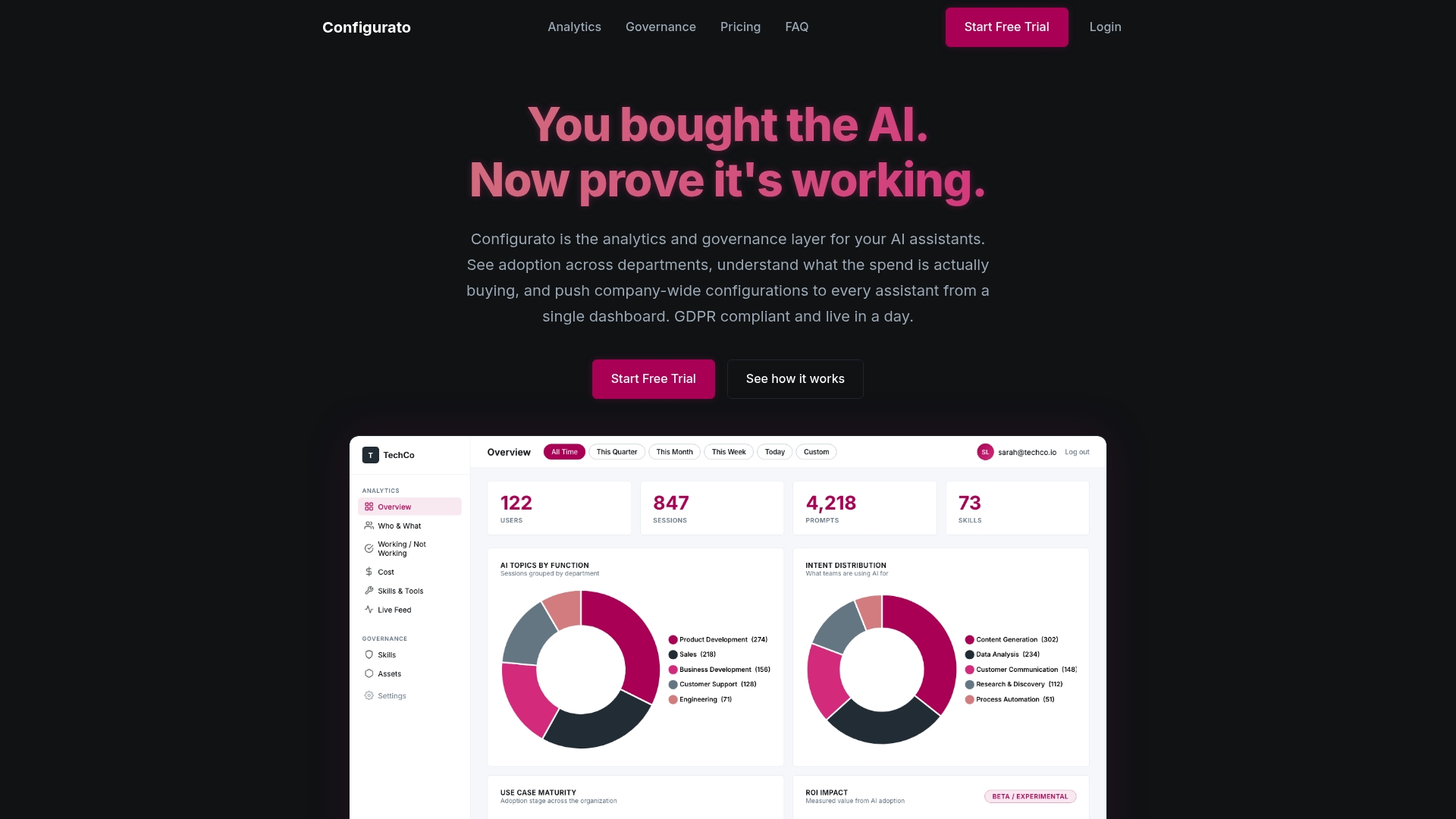
That is exactly what Tekkr’s Configurato platform is built to solve. Configurato gives you the analytics, orchestration, and governance to operationalize your AI workforce. It embeds your company’s way of working directly into the AI tools your teams already use, so output arrives aligned to your standards without extra training or rework. Whether you need to benchmark your current AI performance, close the governance gap, or trace where AI is actually moving the needle, Configurato gives you the visibility and control to act on it.
Frequently asked questions
Which types of enterprise work benefit most from AI acceleration?
Repetitive processes like data entry, HR inquiries, and routine customer support see the fastest initial gains, but full workflow redesign across knowledge-intensive functions delivers the highest sustained impact.
How can leaders ensure ROI from AI investments in their teams?
Start with high-volume, low-risk processes and build in rigorous outcome measurement from day one, tracking error rates and rework cycles alongside speed metrics.
What is the biggest risk when integrating AI into enterprise workflows?
Over-automating without human oversight creates reliability failures that compound downstream. Hybrid human-AI teams consistently outperform fully autonomous agents by 68.7% on complex tasks, making human-in-the-loop design a strategic advantage.
How much of typical corporate work is currently AI-enhanceable?
Benchmarks show 82% of working hours are potentially AI-enhanceable, but only a small fraction of processes are currently ready for agentic AI deployment without significant workflow redesign first.