
Most executives deploying AI assistants today are running a collection of isolated bots, each doing its own thing, with no awareness of what the others are doing. That’s the real productivity gap. It’s not that the tools are weak. It’s that they’re not talking to each other. Agent-to-agent AI changes that equation entirely. When autonomous agents can discover, delegate, and collaborate using standardized protocols, you stop getting siloed outputs and start getting coordinated work. This article walks through how agent-to-agent systems operate, what the benchmarks actually show, where the risks hide, and how you can build enterprise workflows that hold up under real conditions.
Table of Contents
- What is agent-to-agent AI?
- How agent-to-agent AI orchestrates enterprise workflows
- Benchmarks and practical limitations in agentic frameworks
- Expert strategies for robust enterprise agent collaboration
- A sharper perspective: What most frameworks miss about agent-to-agent AI
- Take your agent-to-agent AI workflows further
- Frequently asked questions
Key Takeaways
| Point | Details |
|---|---|
| Collaboration unlocks productivity | Agent-to-agent AI enables autonomous agents to work together, multiplying enterprise efficiency and workflow complexity. |
| Benchmarks highlight consistency | Successful frameworks deliver consistent outcomes, not just high accuracy or speed—especially at scale. |
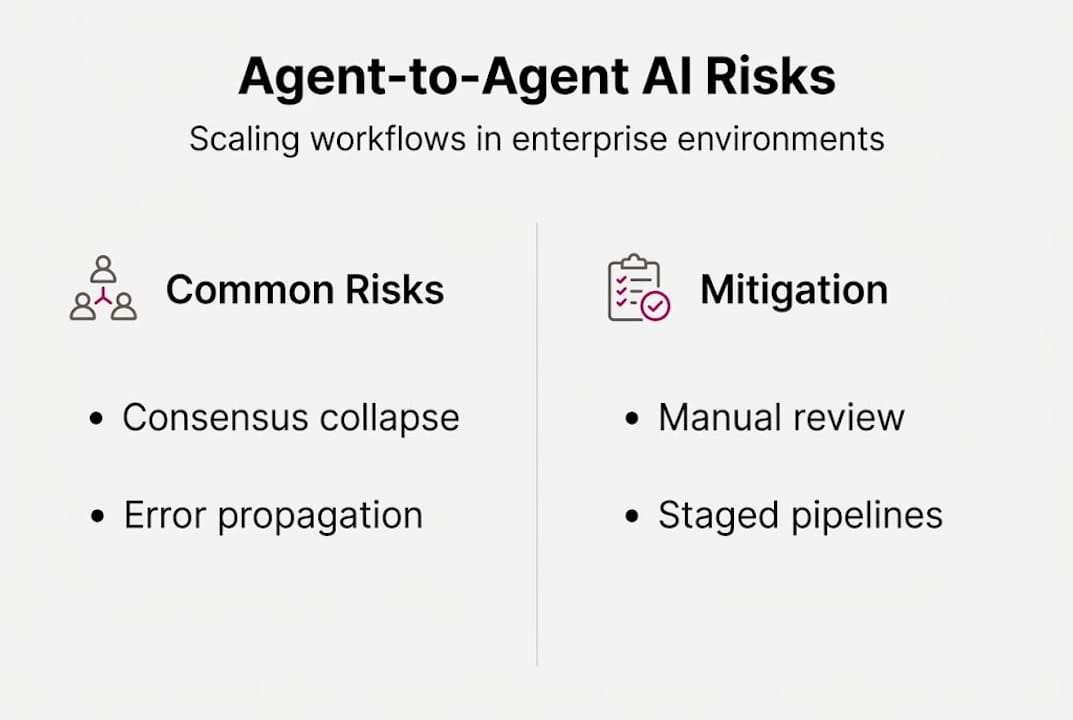
| Risk mitigation is critical | To prevent failures like infinite loops or consensus collapse, use heterogeneous agents and staged pipelines with human-in-the-loop oversight. |
| Expert orchestration required | Enterprise leaders should embed protocols, explicit task routing, and practical guardrails for robust agent collaboration. |
| Governance tools provide oversight | Analytics and governance platforms help monitor, refine, and scale agent-to-agent AI deployments safely. |
What is agent-to-agent AI?
Agent-to-agent AI refers primarily to protocols and systems enabling independent AI agents to discover, communicate, delegate tasks, and collaborate on complex workflows using standardized interfaces like Google’s A2A protocol. That’s a mouthful, so here’s what it means in practice: instead of one AI assistant trying to handle everything alone, you have a network of specialized agents that hand off work to each other based on capability.
Think of it like a well-run operations team. One agent researches. Another verifies. A third drafts. A fourth reviews for compliance. Each agent knows its role, and the system knows how to route work between them.
To understand where A2A fits, you need to know how it differs from MCP (Model Context Protocol). Here’s a quick comparison:
| Protocol | Direction | Purpose |
|---|---|---|
| MCP | Vertical (agent to tool) | Connects agents to external tools, APIs, and data sources |
| A2A | Horizontal (agent to agent) | Enables peer agents to communicate and delegate tasks |
As A2A complements MCP: MCP handles agent-to-tool interactions while A2A enables agent-to-agent peer communication, allowing modular ecosystems where agents delegate subtasks to specialists. Both protocols are necessary. MCP gives agents reach into your systems. A2A gives agents the ability to collaborate with each other.
Key characteristics of agent-to-agent AI:
- Agents can advertise their capabilities to other agents in the network
- Task delegation happens programmatically, not through human prompting
- Agents maintain context across handoffs, so nothing gets lost in translation
- Specialized agents outperform generalist agents on their specific domain
For companies serious about embedding agent-to-agent AI into their operations, the modular nature of A2A is what makes it scalable. You can add a new specialized agent without rebuilding the whole system. That’s the architectural advantage that standalone assistants simply cannot match.
With this foundation, let’s explore how agent-to-agent AI actually operates within enterprise environments.
How agent-to-agent AI orchestrates enterprise workflows
Knowing what A2A is matters less than knowing how it behaves when you put it to work. The orchestration patterns used in multi-agent systems are what determine whether your deployment is reliable or a liability.
Multi-agent systems use patterns like router-supervisor pipelines, parallel spawning with serial fallback, staged workflows such as research-verify-write-review, and explicit error handling for production reliability. Each pattern serves a different operational need.

Here’s how the most common orchestration patterns break down:
| Pattern | Best use case | Risk profile |
|---|---|---|
| Router-supervisor | Complex task routing with oversight | Medium: depends on supervisor quality |
| Parallel spawning | Speed-critical tasks with redundancy | Low to medium: requires fallback logic |
| Staged pipeline | Sequential quality gates | Low: errors caught at each stage |
| Serial fallback | High-stakes decisions | Low: conservative but slower |
For enterprise teams, staged pipelines are often the most practical starting point. A research agent gathers information, passes it to a verifier agent, which flags gaps or inaccuracies, and then a writer agent produces the output. A final review agent checks against your company’s standards before anything reaches a human.
Here’s a practical sequence for implementing staged workflows:
- Map your existing workflow and identify where errors or rework most often occur
- Assign a specialized agent role to each stage of the workflow
- Define explicit handoff criteria so agents know when to pass work forward
- Build error handling logic that routes failed tasks back rather than forward
- Add a human-in-the-loop checkpoint at your highest-risk stage
Error handling is not optional. It is the difference between a system that works in demos and one that holds up in production. Agents that fail silently create compounding problems downstream. Agents that fail loudly and route back give you a recoverable system.
Pro Tip: Before you automate any workflow with agents, run it manually three times and document every decision point. Those decision points are where your agents will need the most explicit instruction.
For teams focused on production reliability techniques, the router-supervisor pattern combined with staged pipelines gives you both speed and oversight. Now, let’s examine how agent-to-agent AI performs against benchmarks and where its strengths lie.
Benchmarks and practical limitations in agentic frameworks
Benchmarks tell you what’s possible. They don’t tell you what’s likely in your environment. That distinction matters a lot when you’re making investment decisions.
Empirical benchmarks show agentic frameworks achieve 74.6-75.9% mean accuracy on reasoning tasks including BBH, GSM8K, and ARC with 4-6 second execution time, but higher cost and latency don’t guarantee better performance, and consistency across frameworks varies significantly.
“Consistency across frameworks varies” is the phrase executives should be paying attention to. A system that hits 90% accuracy on its best day but drops to 55% under load is not a reliable system. You want the framework that performs at 75% predictably, every time.
The accuracy range of 74.6-75.9% sounds modest. But for most enterprise use cases, consistent 75% accuracy on complex reasoning tasks, delivered in under 6 seconds, represents a meaningful productivity gain over manual processes that take hours and carry their own error rates.
Where agentic systems genuinely struggle:
- Infinite loops: agents can get stuck in cycles when no clear termination condition exists
- Error propagation: a bad output at stage one contaminates every stage that follows
- Prompt injection: malicious or malformed inputs can redirect agent behavior unexpectedly
- Context overflow: long workflows can exceed an agent’s context window, causing it to lose earlier information
- Consensus collapse: in multi-agent debates, sycophancy can lead to shared hallucinations where agents agree on a wrong answer
Consensus collapse is the edge case most teams don’t anticipate. When you have multiple agents reviewing each other’s work, there’s a real risk they start agreeing to avoid conflict rather than catching errors. This is not a hypothetical. It shows up in production systems where agents are too similar in their training or configuration.
Scaling beyond small networks amplifies every one of these risks. A three-agent system is manageable. A fifteen-agent system with unclear routing and no error handling is a liability. For teams responsible for managing agent delegation, understanding these failure modes before deployment is what separates a controlled rollout from a crisis. Understanding these strengths and challenges, it’s essential to focus on expert strategies for robust AI collaboration.
Expert strategies for robust enterprise agent collaboration
You now know what can go wrong. Here’s how to prevent it.
The most effective enterprise deployments don’t just configure agents. They design systems with adversarial thinking built in. Expert nuances include preferring falsification over self-reflection, using heterogeneous model stacks to avoid bias echo chambers, relying on explicit dispatch tables over vibe-based routing, and maintaining human oversight for high-stakes decisions.
Let’s break down what each of these means in practice:
- Use falsification loops: instead of asking an agent to verify its own answer, generate counterexamples designed to break the solution. If the solution survives, it’s more trustworthy.
- Build heterogeneous agent stacks: use different underlying models for different agents. A GPT-based researcher paired with a Claude-based verifier is less likely to share the same blind spots than two identical models.
- Replace vibe-based routing with explicit dispatch tables: define exactly which agent handles which task type. Ambiguous routing is where workflows collapse under pressure.
- Keep humans in the loop for high-stakes outputs: legal review, financial decisions, customer-facing communications. Agents accelerate the work. Humans own the outcome.
For embedding company-specific workflows, the approach that A2A-like protocols enable is particularly powerful: specialized agents like a research agent delegating to a verifier, while staged pipelines and adversarial verification keep quality high.
Pro Tip: Audit your agent outputs weekly for the first month after deployment. You’re not looking for perfection. You’re looking for systematic errors that reveal gaps in your workflow design.
The practical steps to get started:
- Identify one workflow where output quality is inconsistent and rework is high
- Map the stages and assign agent roles with explicit handoff criteria
- Configure heterogeneous models for research and verification stages
- Build falsification checks into your verification agent’s instructions
- Set a human review checkpoint before any output reaches external stakeholders
For teams working on ensuring production reliability, these strategies are the operational discipline that makes the difference between a benchmark result and a business outcome. Let’s wrap up with a perspective you won’t find in most industry guides.
A sharper perspective: What most frameworks miss about agent-to-agent AI
Here’s the uncomfortable truth most vendor guides won’t tell you: the technology is not the hard part. The hard part is workflow design and operational discipline.
Most enterprise agent deployments stumble not because the models are weak or the protocols are flawed. They stumble because the workflows were never clearly defined in the first place. You cannot automate a process you haven’t documented. You cannot delegate to an agent a task you haven’t specified. Garbage in, garbage in at scale.
The teams seeing real productivity gains from real-world agent collaboration share one trait: they invested time upfront in defining what good output looks like before they wrote a single agent instruction. They built guardrails around their messiest workflows, not their cleanest ones.
Chasing benchmark scores is a distraction. A 75% consistent system built on your actual processes will outperform a 90% peak system built on generic prompts every time. Robustness comes from orchestration and oversight, not from the model itself. That’s where your focus should be.
Take your agent-to-agent AI workflows further
If this article has made one thing clear, it’s that agent-to-agent AI is not a plug-and-play upgrade. It requires deliberate design, operational discipline, and the right governance layer to deliver consistent results at scale.
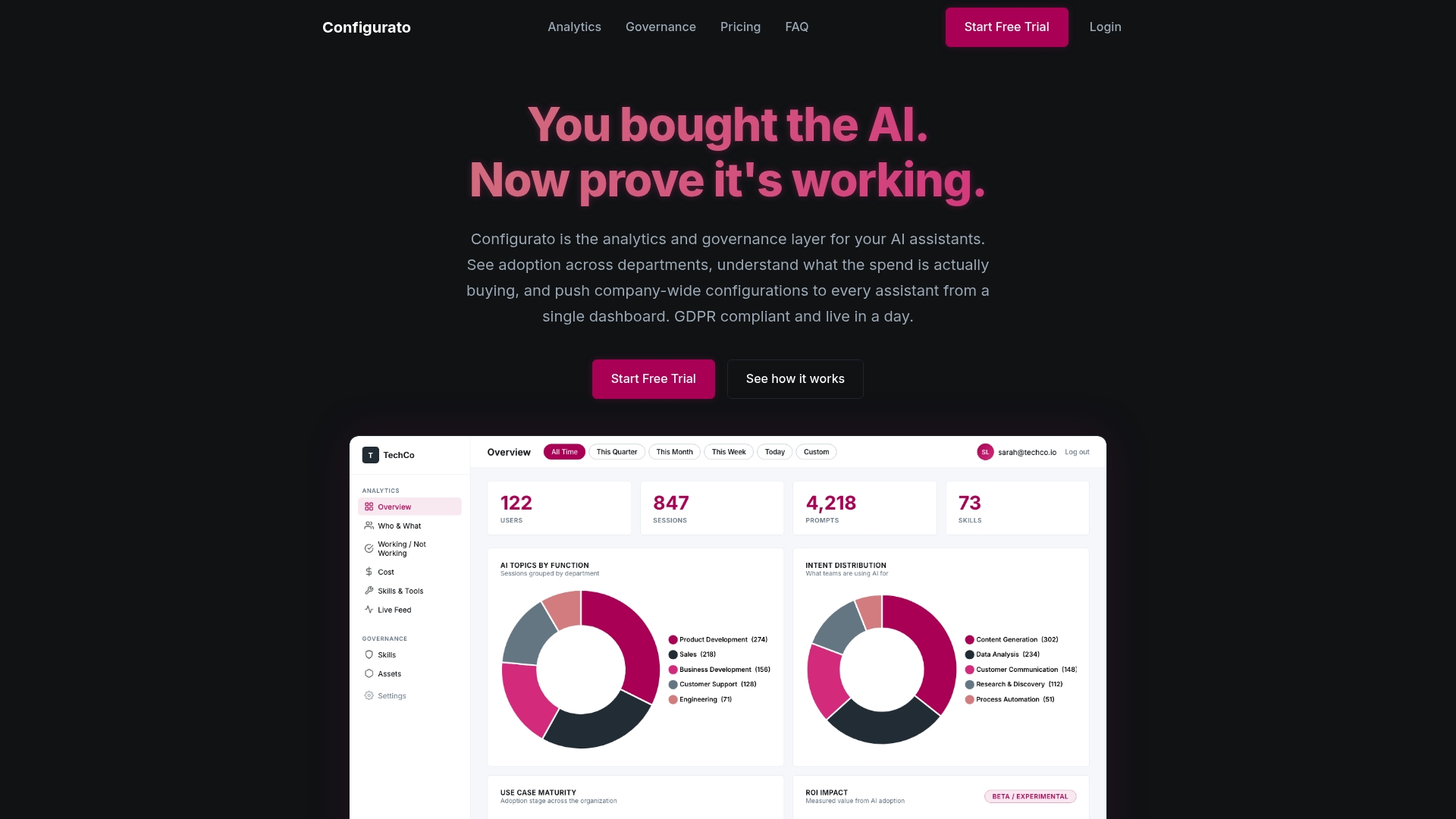
Tekkr’s Analytics & Governance for AI Assistants gives implementation leaders exactly that: visibility into where agents are performing, where they’re drifting, and where human oversight is needed. You get cross-company benchmarking data that shows what high-performing AI adoption actually looks like, not just in theory but in organizations similar to yours. If you’re ready to move from AI adoption on paper to AI advantage in practice, Tekkr is where that work starts.
Frequently asked questions
How does agent-to-agent AI differ from typical AI assistants?
Agent-to-agent AI enables multiple autonomous agents to cooperate, delegate tasks, and collaborate on workflows, unlike isolated assistants that operate independently without awareness of each other.
What are common risks when scaling agent-to-agent AI systems?
Risks include infinite loops, error propagation, prompt injection, consensus collapse, and unreliability beyond small agent networks, all of which require explicit error handling and human oversight to manage.
What benchmarks exist for agent-to-agent AI performance?
Agentic frameworks achieve about 74.6-75.9% mean accuracy on reasoning tasks with 4-6 second execution times, though consistency across deployments matters more than peak scores when evaluating enterprise fit.
How can enterprises implement robust agent-to-agent collaboration?
Embed protocols like A2A, design staged pipelines with explicit handoff criteria, use heterogeneous agent stacks to avoid bias echo chambers, and maintain human oversight for any high-stakes decisions.